GLAMhack23
- GLAM
- Hackathon
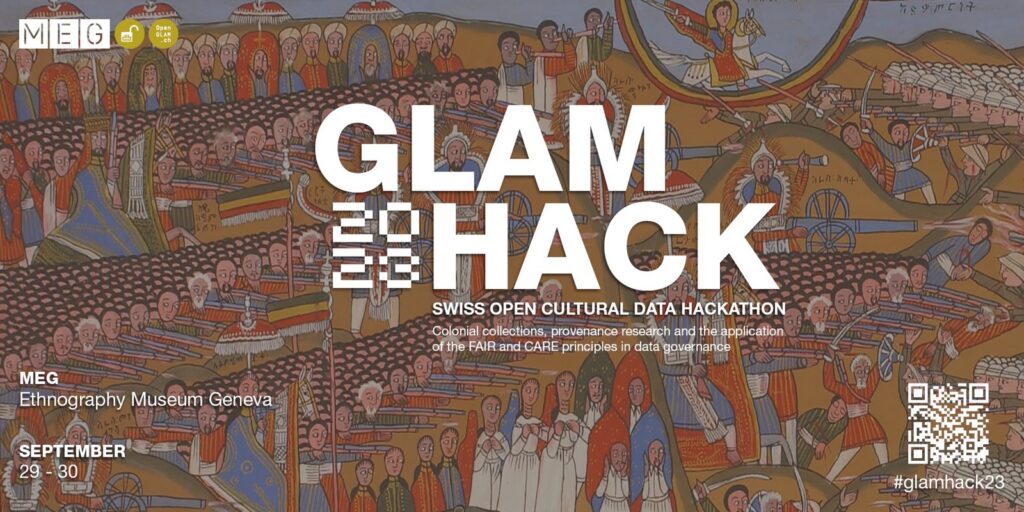
29–30 September 2023, 09:00 @ Musée d’ethnographie de Genève, Boulevard Carl-Vogt 65, 1205 Genève, kostenlos
The GLAMhack 2023 took place on 29–30 September 2023 at the Musée d’ethnographie de Genève (MEG), preceded by four pre-events. It focused on colonial collections, provenance research and the application of the FAIR and CARE principles; for the occasion, MEG published part of its collection metadata under a Creative Commons licence. The hackathon platform documents 14 challenges and projects, and infoclio.ch provides the recordings of the final presentations.
Documentation and recordings
- Aufzeichnungen der Schlusspräsentationen (infoclio.ch)
- Challenges und Projekte auf der Hackathon-Plattform
- Challenges
- Aufzeichnungen der Schlusspräsentationen (infoclio.ch)
- Aufruf an Datenlieferanten
- Invitation aux fournisseurs de données
- Ankündigung auf opendata.ch
Challenges
- Accessibility of Cultural Events
Making accessibility-related information about the venues and the events themselves available in a standard format.
- Telling a different story: a new reading of subalternity in notebooks
Die Feldnotizbücher des Ethnologen Felix Speiser aus Vanuatu (1910–1912) neu gelesen.
Challenge description
Während seiner Feldforschung in Vanuatu (1910–1912) benutzte der Ethnologe Felix Speiser (1880–1949) Notizbücher unterschiedlicher Formate, um Daten zu sammeln. Nach der Rückkehr nach Basel verbrachte er Jahre damit, dieses Material zu ordnen und museumseigenen Kategorien zuzuweisen. Seine Objekt- und Fotosammlung ist gut bekannt, ebenso seine Veröffentlichungen. Wer dagegen die Notizbücher durchblättert, findet ein wildes Nebeneinander der Gattungen — von Personen- und Ortsnamen über anthropometrische Berechnungen bis zu Karikaturen.
- Tracking down colonial and racist traces in Geneva
create an interactive map of Geneva to track down the racist and colonial traces in the city of Geneva
- OCR and linking of MEG inventories
Create a program to read and transcribe the handwritten MEG inventories and link the corresponding pages to the database
- Decolonise the MEG inventories
Create a programm for transversal research and tagging of racist, violent and discriminative information
- Interactive Provenance Research of Chinese Paintings
Making provenance research into chinese collectors stamps interactive
- Ra – the world's oldest vertical sundial
Bringing the 3200 year old timepiece from Egypt's Valley of the Kings to life again.
- Link MEG Letters and Objects
Link MEG Objects and the corresponding letters to improve provenance information
- Identifying colonial traces in early modern travelogues
 Annabelle WiegartGünter HiplerMaurice BonvinIbrahim Halil KurayBasil
- Visualize Portrait Gallery
Libr Erli
- Visualizing Collections & Enabling Collaborations
Data visualisation to develop collaborative provenance research projects with concerned communities
- A thread to position myself
Help create a digital interactive exhibition installation on slavery for the online platform of the exhibition ‘Memories'
- Add Traditional Knowledge labels to Wikimedia Commons
Can Traditional Knowledge labels be added to Wikimedia Commons? What are the challenges? Let's work with Local Contexts!
Susanna Ånäs Corrie RoeSadik Shahadu
- Audio2Commons
Decolonizing objects using audio on wiki comons






Programme
Monday, 26 June
- 18:00
Thursday, 31 August
- 11:15–12:45
MEG AuditoriumPre-Event 2: Le GLAMhack23 au Musée d’Ethnographie de Genève (in French)
Cet événement a lieu dans le cadre de la conférence LibreABC.
Le 9ème GLAMhack (Hackathon culturel suisse) aura lieu du 28 au 30 septembre 2023 au Musée d’Ethnographie de Genève : /events/glamhack2023/. Ses thématiques principales seront les collections coloniales et l’accessibilité des données numériques. Lors des GLAMhacks, entre 60 et 100 participant.e.s d’horizons différents travaillent ensemble sur des données ouvertes (images, sons, métadonnées, …) d’institutions culturelles suisses pour développer des concepts originaux, des prototypes d’applications ou réutiliser ces données dans de nouveaux contextes pour les rendre plus visibles (par exemple pour un événement, une exposition, du crowdsourcings ou sur Wikipedia/Wikidata) tout en encourageant les échanges entre tous les participant.e.s. Venez découvrir comment se déroule un hackathon, ce que sont des données libres ainsi que les challenges qui seront proposés lors du GLAMhack 2023. Puis, par petits groupes, esquissez quelques pistes qui pourront être poursuivies lors du GLAMhack. Si vous avez une idée à mettre en œuvre avec des données culturelles libres, venez la présenter à cette occasion et échanger à ce sujet.
Intervenant.e.s
Marina Berazategui (Musée d’Ethnographie de Genève)
Après une formation en muséologie à l’Université de Neuchâtel, Marina Berazategui a participé à plusieurs projets de recherche en provenance dans divers musées suisses. Actuellement collaboratrice scientifique au MEG, elle collabore au projet d’exposition “Mémoires. Genève dans le monde colonial” (03.05.2024-05.01.2025). Dans ce cadre, elle contribue aussi à l’organisation du GLAMhack23.
Gaston Wey (Opendata.ch)
Après des études d’informatique de gestion à la haute école spécialisée bernoise, Gaston Wey a rejoint l’association opendata.ch en tant que chef de projet en 2022. Il est en charge de domaine GLAM (Galleries, Libraries, Archives, Museums) et organise entre autres dans ce cadre chaque année le GLAMhack ainsi que la coordination du groupe de travail OpenGLAM CH.
Lionel Walter (arbim IT)
Après des études de mathématiques à l’EPFL, Lionel Walter s’est spécialisé dans l’informatique des bibliothèques, archives et musées. Il a travaillé successivement à la bibliothèque de l’EPFL, de l’Université de Genève et de l’Université de Bâle, où il a notamment contribué aux projets swissbib, swisscollections et memobase. En 2022, il fonde arbim IT, une société qui offre des services de conseil et développements informatiques aux institutions culturelles en privilégiant les données et logiciels libres. Il est aussi membre du groupe de travail OpenGLAM CH.
Pre-Event 3: Wednesday 13th of September, 6 pm., online
Local Contexts: Supporting Indigenous Data Sovereignty and Cultural Authority in Collections and Data
https://cvs5133.ergonet.host/b/iol-gdq-fbx-tst
Every Indigenous community has cultural and biological knowledge within educational systems, archives, libraries, and museums that they do not own, do not control, and cannot govern circulation over. Issues of responsibility, ownership, as well as incomplete or significant mistakes in the metadata extend to every other knowledge asset or digital record building upon this information.
Local Contexts offers a digital labeling system, the Traditional Knowledge (TK) and Biocultural (BC) Labels and Notices, that work to enhance and legitimize locally based decision-making and Indigenous governance frameworks for determining ownership, access, and culturally appropriate conditions for sharing historical, contemporary, and future collections of cultural heritage and Indigenous data. This presentation will give an introduction to the Local Contexts initiative, how its TK and BC Labels and Notices operationalize the CARE Principles for Indigenous Data Governance and are being used in various settings around the world.
Wednesday, 13 September
- 18:00
OnlinePre-Event 3: Local Contexts: Supporting Indigenous Data Sovereignty and Cultural Authority in Collections and Data
Every Indigenous community has cultural and biological knowledge within educational systems, archives, libraries, and museums that they do not own, do not control, and cannot govern circulation over. Issues of responsibility, ownership, as well as incomplete or significant mistakes in the metadata extend to every other knowledge asset or digital record building upon this information.
Local Contexts offers a digital labeling system, the Traditional Knowledge (TK) and Biocultural (BC) Labels and Notices, that work to enhance and legitimize locally based decision-making and Indigenous governance frameworks for determining ownership, access, and culturally appropriate conditions for sharing historical, contemporary, and future collections of cultural heritage and Indigenous data. This presentation will give an introduction to the Local Contexts initiative, how its TK and BC Labels and Notices operationalize the CARE Principles for Indigenous Data Governance and are being used in various settings around the world.

Thursday, 28 September
-
Bibliothek des MEGWorkshop on colonial collections and archives in the library of MEG + brainstorming session on challenges
- 16:30–18:00
Bibliothek des MEGPre-Event 4: Workshop: From manuscript register to database: what is a museum inventory?
As a pre-event to GLAMhack23, come and find out more about MEG’s historical and digital inventories. MEG’s library. Thursday 28 september. 4.30 – 6 pm.
As part of GLAMhack23, MEG has published some of its digital metadata under a Creative Commons licence: https://www.meg.ch/fr/recherche-collections/catalogue-collections/opendata
In this workshop, we will talk about what exactly our metadata consist of. We will also discuss some of the issues related to the publication of heritage data: how can the MEG’s data be made accessible to as many people as possible, while respecting the intellectual property rights of indigenous communities over the collections?
We will then introduce you to the history of Geneva’s ethnographic collections and the various inventories which have kept track of these over the last 200 years. For the occasion, the original handwritten registers, the ancestors of our contemporary database, will be available to you for the duration of the workshop.
- 18:15
Friday, 29 September
- 08:30–09:00
FoyerCheck-in, Breakfast
- 09:00–09:20
AuditoriumOpening Session, the official start of the Hackathon
- 09:20–09:40
AuditoriumPresentation of the datasets
- 09:45–11:00
- 11:00–12:00
AuditoriumGroup Creation – First Group Meeting
- 12:00–13:00
Café du MEGNoon Break, Café du MEG and outdoor
- 13:00–18:30
Work in groups
- 16:00–16:20
Treffpunkt -2MEG’s exhibition guided tour
- 17:00–17:20
Treffpunkt -2MEG’s exhibition guided tour
- 18:30–20:00
Café du MEGDinner, Café du MEG and outdoor
- 20:00–23:30
Work in groups (“night shift”)
Saturday, 30 September
- 08:30–09:00
FoyerBreakfast
- 09:15–09:30
AuditoriumCheck-in “Welcome to Day 2”
- 09:30–13:00
Work in groups
- 11:00–11:20
Treffpunkt -2MEG’s exhibition guided tour
- 13:00–14:00
Café du MEGLunch, Café du MEG and outdoor
-
Work in groups
- 15:30–17:00
- 17:00–18:00
Café du MEGApéro/End
- 18:00–19:30
Read the original announcement
Cover image: The battle of Adwa (1896). Victory of the Ethiopian troops putting an end to the first Italian-Ethiopian colonial war. Painting on canvas, unknown artist. MEG ETHAF 034815. Photo J. Watts. Graphic Design: Saskia Knobel
Once a year, the Swiss OpenGLAM working group brings together cultural institutions, software developers, digital humanists, artists, Wikipedians and other interested parties to promote openness among galleries, libraries, archives and museums (GLAM). At the GLAMhack, we collaboratively experiment and innovate with cultural content and digital tools for research, web and mobile applications, Wikipedia and other uses. This edition focuses on colonial collections, provenance research, as well as the application of the FAIR and CARE principles in data governance.
Join us for GLAMhack23 (29-30.9) at the Musée d’ethnographie in Geneva, where creativity meets innovation. Develop prototypes with open cultural data to strengthen the digital transformation of the GLAM sector.
We will spend 2 to 2.5 days at the Musée d’ethnographie de Genève (MEG) in Geneva from 29 to 30 September.
The GLAMhack 2023 official program starts on Friday, but we are working on a possibility to participate in a side programme already on Thursday.
Results
You can find all the videos of the final presentations here. Thanks again to infoclio.ch.
Datasets and challenges
Metadata of Musée d’Ethnographie de Genève (MEG) collections
Rietberg Museum :
- Pictures and Objects from the Hans Himmelheber Archive (focus : African Art). They can be browsed on https://africa-art-archive.ch .
- Chinese paintings (1400-1899) collected by Charles A. Drenowatz
PARC – Portal for African Research Collections : Metadata of PARC and Digitized Images from Old Books about Africa
Bibliothèque de Genève : Images from the “Exposition Nationale” in Geneva in 1896
Archives de la Ville de Genève : Index of Letters to and from the Musée d’Ethnographie (1900-1952) as well as Official Documents from the City of Geneva, which very often mention MEG Objects (for example page 96 of this document).
Zentralbibliothek Zürich :
- Early modern travel literature (fulltext and metadata)
- Maps from the collection “Magnificent Atlases” with title cartouches
If you have interesting open data that you want to provide, reach out to us :
If you’re taking part in a hackathon for the first time, you can learn more about how such an event works in our Hackathon handbook.
Organizers
This event was organized by the OpenGLAM CH Working Group of the Opendata.ch association, in collaboration with Open Science for arts, design and music.

Torbjorn Toby Jorgensen, CC BY-SA 2.0, via Wikimedia Commons
Organising team
 Gaston WeyOpendata.ch: Projektkoordinator 2023
 Lionel WalterOpendata.ch: Coaching, Leitung Datensatz-Team, Supervisor
 Jonas LendenmannOpendata.ch: Datensatz-Team
 Dominik SieviOpendata.ch: Datensatz-Team
 Floriane MorinMEG: Koordinatorin, Gastgeberin
 Marina BerazateguiMEG: Koordinatorin, Gastgeberin
- Grégoire de CeuninckMEG: Koordinator, Gastgeber, Datenmanager
 Enrico Nataleinfoclio.ch
Host


Partner


- Noircir Wikipédia


