
GLAMhack 2026
- GLAM
- Hackathon
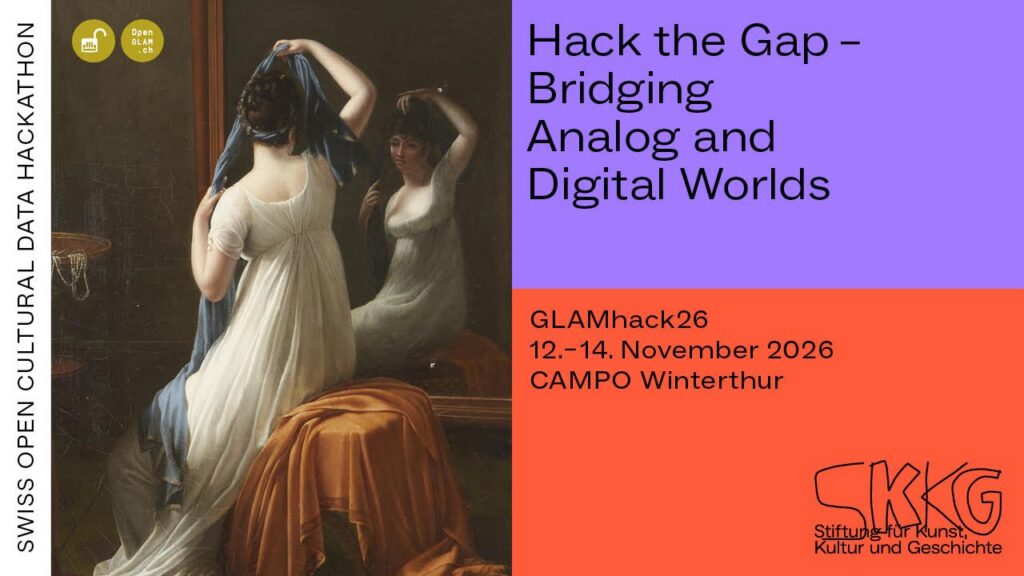
12–14 November 2026 @ SKKG campo, Zum Park 5, 8404 Winterthur, Free
Challenges
- Your Selection of Pralines – Stiftung für Kunst, Kultur und Geschichte (SKKG)
Put Your Collection of Objects in a Box
Challenge description
Create an application that allows users to select their favorite objects from a GLAM collection. AI creates interesting stories around these objects and invites users to guess which object among the existing ones is invented. A statistic shows how accurate the users’ estimations are.
The goal is to develop an application that allows:
- Users to select a few objects from the SKKG collection (see “Sammlung digital”: https://digital.skkg.ch/) and put them virtually in a box of pralines.
- The user defines a title for the created box of pralines/objects and defines some more parameters according to a few questions to set the direction for the content description.
- AI transforms the objects from the images into 3D models when they are placed in the praline box.
- One praline is created by AI and therefore represents an invented object.
- For the box and each praline AI generates a description based on the object metadata from “Sammlung digital”, the information added by the user, and further information found in internet sources or in other collection data. So, the generated texts are a mix of facts and storytelling which makes it entertaining to read them.
- The application gives users public access to all created chocolate boxes.
- A rating functionality allows users to guess which are the pralines that base on an invented object. After submitting the guess for one box, the statistics of what all participants guessed for this box and the correct answer are displayed.
- As a plus: Find a way to have the box of praline in physical space and connect it with the application.
If the above-mentioned steps and functionalities are too many to be realized during the hackathon, it is possible to make a selection depending on the ideas and skills of the team.
The challenge owners have a background in Art Education and Art History and know SKKG’s collection data very well.
Data
The Public API gives access to “Sammlung digital”’s Linked Data Knowledge Graph.
- Documentation: https://github.com/swiss-art-research-net/skkg-pipeline/wiki/6.-How-to-use-the-SKKG-Linked-Data
- SPARQL endpoint: https://sparql.digital.skkg.ch/
- or execute queries against the endpoint via QLever UI: https://qlever.digital.skkg.ch/
- metadata and images of objects (CC0), images of artworks in the public domain (CC BY -> provide the artist name and work information), see SKKG’s Open Data Policy and Nutzungsbedingungen (Terms of Use).
Five objects from the collection are on site during the GLAMhack.
- Metadata (CSV, CC0, incl. links to the IIIF manifests for the images and links to the object on https://digital.skkg.ch/) and object images (CC0): https://kdrive.infomaniak.com/app/share/136533/7b8ab950-c7c6-4647-9599-96540e2c087a/files/106335
Keywords
Fun Facts, Storytelling, AI, 3D Object Generation, Fake Objects, Fake News, Rating, Participation, Gamification
Challenge owners
Christine Müller (c.mueller at skkg.ch), SKKG und Sonja Gasser (s.gasser at skkg.ch), SKKG
Please join us!
—————————————–
Result
This challenge became part of "Marionette Theatre, back in 3D": /project/2095
Access the final presentation by visiting https://glamhack26-theatre.github.io/puppetshow/ and pressing
CTRL+SHIFT+P.- The final slide shows the modelled and animated 3D objects from SKKG collection presented in a box of pralines.
- The animation uses the sound of this object: Spiel-Karussell mit Musik, um 1910, Inv. 42500, Stiftung für Kunst, Kultur und Geschichte, Winterthur, 1992
https://digital.skkg.ch/object/80d4ea6a-937e-4fd9-9ed6-d91a408ffe4c
- Do you find the two objects which are not part of the SKKG collection?
Download the 3D Model of the box of pralines via View raw from GitHub.
Pralinen.png
- Digital Impact Monitor – Stiftung für Kunst, Kultur und Geschichte (SKKG)
Objects from the Artothek with their hosts
Challenge description
Museums and collections preserve cultural heritage. What if, in twenty years’ time, they were to share this responsibility with the hosts of the collection objects – and we could, at the same time, highlight their social impact? Since January 2026, the Foundation for Art, Culture and History (SKKG), in collaboration with the City of Winterthur’s Department of Culture and the Winterthur libraries, has been running an Artothek.
At this Artothek, members of the public with a library card can borrow paintings, photographs and prints. The artworks come from the city’s art inventory, the Winterthur Collection and the SKKG’s collection. Through the Artothek, the three institutions are creating low-threshold access to original works of art.
The SKKG is seeking ideas for a digital object impact monitor for the Artothek, which would make visible not only an object’s physical condition but also its social use and impact. The aim is to develop, based on data from a few dozen works of art and objects from the SKKG collection and the Winterthur Collection, a prototype application that enables the following:
- Select a collection object from the SKKG’s digital collection or the Artothek Winterthur
- https://digital.skkg.ch/de/intro?q=artothek
- https://my.winbib.ch/suche?p_r_p_arena_urn%3Aarena_search_query=artothek
- Record standard conservation data via an input form such as: Temperature, Humidity, Exposure to light, Condition of the object
- Record new data on social impact via an input form for example: How many people live in the household with the object? How long was the object viewed for? Did the object spark conversations? Among other things
- Record the circulation of the objects via an input form for example: How often was the object passed on to new hosts?
- Develop a dashboard that brings together physical and social data
The dashboard is intended to highlight the fact that, in future, cultural artefacts will not only be preserved but also actively utilised for social purposes.
Skills we're looking for in our team
Developers
UX/UI designers
Data scientists
AI specialists
Open data enthusiasts
Museum and GLAM experts
Creative technologists
People who enjoy exploring speculative future scenariosData
Ten artworks are part of the Artothek.
- Artwork metadata (CSV, CC0, incl. links to the IIIF manifests for the images and links to the object on https://digital.skkg.ch/) and images (CC BY -> provide the artist name and work information): https://kdrive.infomaniak.com/app/share/136533/7b8ab950-c7c6-4647-9599-96540e2c087a/files/106308
Five objects from the collection are on site during the GLAMhack.
- Metadata (CSV, CC0, incl. links to the IIIF manifests for the images and links to the object on https://digital.skkg.ch/) and object images (CC0): https://kdrive.infomaniak.com/app/share/136533/7b8ab950-c7c6-4647-9599-96540e2c087a/files/106335
The Public API gives access to “Sammlung digital”’s Linked Data Knowledge Graph.
- Documentation: https://github.com/swiss-art-research-net/skkg-pipeline/wiki/6.-How-to-use-the-SKKG-Linked-Data
- SPARQL endpoint: https://sparql.digital.skkg.ch/
- or execute queries against the endpoint via QLever UI: https://qlever.digital.skkg.ch/
- metadata and images of objects (CC0), images of artworks in the public domain (CC BY -> provide the artist name and work information), see SKKG’s Open Data Policy and Nutzungsbedingungen (Terms of Use).
___
Project description
The SKKG Artothek lends artworks to private homes for three to six months. That's where most of the social impact happens, and it's also where SKKG has no visibility. Between pick-up and return, the conservation team gets no data on temperature, humidity or light, and the Artothek learns nothing about the conversations or emotions the artwork sparks.
Our concept is an artwork rental kit that sits next to the artwork. It holds sensors and an NFC tag. Scanning the tag opens a mobile page with artwork info, care instructions and live conservation data. The same page lets hosts share the conversations, emotions and inspiration the work brings. Everything feeds a dashboard that combines physical and social data, so the Artothek can show what an artwork does when it leaves storage.
1. The challenge
How do we measure the social impact an artwork has, and how do we make the conservation-relevant data from the rental period available to the Artothek team?
2. Two layers of the challenge
##### Conservation data the Artothek needs from the rental period
- Temperature of the room the artwork is in
- Humidity in the room
- Exposure to light
- General condition of the object (photos and descriptions)
##### Social impact – how do we measure it, and with what criteria?
Impact could be measured through:- Emotions the artwork evokes (references: Museo Thyssen – Emotions in art, Geneva Emotion Wheel)
- Conversations the artwork started or provoked
- Access – renting artworks breaks barriers tied to social status and the privilege of owning art
- Details different people notice
- Inspiration and creativity it sparks
Open questions we discussed:
- Is an object more valuable kept in storage, or should it be opened up for more cultural impact, despite the risk of damage?
- How does impact differ between a purely visual artwork and an object people can interact with? (different interactions → different emotional connection)
- Does spending more time with an artwork change your relationship to it? In a museum you see it for a few minutes. At home you see it every day, come back to it, and start noticing (or no longer noticing) certain details.
##### What could we learn from the data?
Illustrative examples of possible insights, not real data:- Emotional impact: "This artwork frequently evokes joy, curiosity or irritation." / "The funniest artwork."
- Social reach: "This artwork has been displayed in X households and seen by an estimated Y people."
- Conversation potential: "X% of hosts report that the artwork sparked conversations."
- Change in perception: "X% of hosts say the experience changed how they perceive cultural heritage."
- Collection usage: which artworks are borrowed often (e.g. recurring theme: flower paintings) and which get little attention (e.g. war paintings)
- Conservation: "This artwork is repeatedly kept in unsafe conditions" → rethink whether it should stay in the Artothek?
3. The current rental journey
##### Steps
- Learning that the Artothek exists and that you can rent artworks – pain point: low awareness
- Starting a membership
- Choosing an artwork – online (reservation only) or in person (browsing artworks like books in a library)
- Picking up the artwork in person – library staff show it and give care instructions
- Signing a contract (you're responsible for it and will return it)
- The artwork lives in your home for 3–6 months
- Returning the artwork
- The SKKG conservation team checks its condition (protocol + photo documentation)
Existing tools:
- Care instructions ("care recipe") given at rental, also available online
- Option to share photos or comments about your rented artwork on the Artothek website
- Online overview of all artworks available to rent
4. Users
##### Main users
- The host – the private person renting the artwork
- Artothek library staff
- SKKG conservation team
##### Other users
- Friends and family of the host (anyone who comes in contact with the artwork)
- Institutions like schools and public places that could rent artworks and reach a wider audience
Back to the initial challenge goals
- Record standard conservation data via an input form: temperature, humidity, light exposure, condition of the object
- Record new social impact data via an input form, e.g. how many people live in the household, how long the object was looked at, whether it sparked conversations
- Record the circulation of objects, e.g. how often an object is passed on to new hosts
- Build a dashboard that brings physical and social data together
- Show that cultural artefacts can be not only preserved, but actively used for social purposes
5. Core problems we focused on
- Most of the social impact happens in people's homes, which is also where the least control and measurement is possible
- The conservation team needs specific data that isn't measured during the rental
- Artwork information, care instructions and the place to share impressions are spread across different touchpoints
- Between steps 4 and 7, SKKG has no information about conversations around the piece, the conditions it was kept in, or anything else relevant to social and conservation impact
6. Our concept
##### Tools
- Artwork rental kit – a small physical object the person gets when they come to pick up the artwork and place next to it – the kit contains an NFC tag plus humidity, light and temperature sensors
- Mobile web page opened by scanning the NFC tag, where hosts find all the information and add their own contributions to measuring social impact
##### Features
Everything is accessible by phone.###### How it works:
the host (renter) scans the NFC tag and lands directly on a mobile web page. It opens with a very basic overview of the rented artwork and gives access to three pages:1. Basic info page
- Year, artist, technique
- Return date
- Where the artwork was before / previous hosts
- In-depth descriptions
2. Conservation page
- Overview of what the sensors are measuring
- Care instructions
- Contact button – Q&A about artwork conservation
3. Social impact page
- Conversation starters – how many conversations the artwork sparked, conversation cards (conversation prompts and questions), questions to answer
- Emotions – which emotions the artwork evoked in each person, compared with other hosts and viewers
- Impressions – comments from previous hosts, plus your own
- Inspiration – photos or stories inspired by the artwork
- Artothek on Instagram – the artworks in other homes
##### Dashboard
The dashboard combines sensor and host data per artwork, so the conservation team can track conditions and Artothek staff can see how each work circulates and what it sparks.7. Resources
- GLAMhack 2026 challenge by SKKG (Christine Müller Stalder, Sonja Gasser): hack.glam.opendata.ch/project/303
- Artothek Winterthur, a collaboration between SKKG, Winterthurer Bibliotheken, Sammlung Winterthur and Amt für Kultur Winterthur
- SKKG datasets: Artothek artworks (CC BY) and on-site objects (CC0), via the SKKG digital collection: digital.skkg.ch
- Photos in prototype: Winterthurer Bibliotheken, Instagram @winterthurer_bibliotheken
- Museo Thyssen-Bornemisza – Emotions in art
- Geneva Emotion Wheel, University of Geneva
- Prototype: julieagu.github.io/GLAM_Hack_repo
- Code: github.com/julieagu/GLAM_Hack_repo
Challenge owners: Christine Müller Stalder (c.muellerstalder at skkg.ch), SKKG und Sonja Gasser (s.gasser at skkg.ch), SKKGDX496EXU.pdf
- Provenance Pursuit – Stiftung für Kunst, Kultur und Geschichte (SKKG)
Can You Read the Back of a Painting?
Challenge description
Every provenance researcher knows the feeling: you turn an artwork around and discover a mysterious label, stamp, handwritten note or inventory number. You know you've seen something similar before… but where?
Provenance marks are among the most valuable clues for reconstructing an artwork's history. Unfortunately, they are scattered across museum databases, publications, personal photo collections, and researchers' hard drives. Finding a match often means searching for hours—or simply hoping someone else has seen it before.
The goal is to develop a database that allows:
Users to upload and document provenance marks (labels, stamps, inscriptions, seals, inventory numbers, framing labels, transport labels, and more).
Each mark to be described using an existing controlled vocabulary developed by our provenance researchers.
Images and descriptions to be stored in a growing, searchable database.
Users to link entries to museum collection records or other online resources whenever possible.
Powerful filtering by mark type, location on the object, language, material, institution, or period.
As a dream feature: a reverse image search that helps answer the eternal question: "Have I seen this label somewhere before?"
As a bonus: a mobile app that allows researchers to photograph provenance marks directly in front of an artwork, search the database on the spot, and upload new discoveries in just a few clicks.
If all of this is a bit too ambitious for one hackathon, a prototype with image upload, structured descriptions, and a basic search based on descriptions would already make provenance researchers very happy (and probably save them quite a few hours).
For the development of the prototype, we will provide access to high-resolution images of the front and reverse of artworks via the IIIF interface of our digital collection platform, Sammlung Digital. In addition, participants will receive an existing Excel dataset containing numerous examples of object photographs, together with a curated selection of JPEG images to facilitate testing and development without the need to work with the entire collection.
The challenge owners have a background in provenance research and art history and already developed a structured nomenclature for describing provenance marks. We know the research problem—we just need your magic.
Missing skills in the team: Developers, AI & Computer Vision Enthusiasts, Database Wizards, UX Designers, GLAM Nerds, and anyone who enjoys solving little historical mysteries.
Please join us!
Keywords: Provenance Research, AI, Computer Vision, Image Matching, Reverse Image Search, Museum Collections, GLAM, Digital Humanities, Collaboration, Metadata, Mystery Solving.
Contact : Nora Rub, SKKG Winterthur
Data
Find a list of labels with provenance information (XLSX, CC0), a list with the metadata of 237 artworks with provenance information (CSV, CC0, incl. links to the IIIF manifests for the images and links to the object on https://digital.skkg.ch/), the provenance documentations for these works (PDF, [CC BY](https://creativecommons.org/licenses/by/4.0/ -> mention the provenance team and the year), as well as images of the front (CC BY -> provide the artist name and work information) and back (CC0) of the paintings: https://kdrive.infomaniak.com/app/share/136533/7b8ab950-c7c6-4647-9599-96540e2c087a/files/106358
The Public API gives access to “Sammlung digital”’s Linked Data Knowledge Graph.
- Documentation: https://github.com/swiss-art-research-net/skkg-pipeline/wiki/6.-How-to-use-the-SKKG-Linked-Data
- SPARQL endpoint: https://sparql.digital.skkg.ch/
- or execute queries against the endpoint via QLever UI: https://qlever.digital.skkg.ch/
- metadata and images of objects (CC0), images of artworks in the public domain (CC BY -> provide the artist name and work information), see SKKG’s Open Data Policy and Nutzungsbedingungen (Terms of Use).E914K6OQ.pdfE914K6OQ.pdf
- Mapping Historical Sporting Events – Swiss Sports History
Show historical Swiss Sporting Events on a map
Challenge description
English:
For decades, numerous sporting events and competitions shaped social life in Switzerland. Today, however, many have largely faded from public memory or are no longer held. For GLAMhack, we at Swiss Sports History would like to invite participants to bring these vanished sporting events to life on an interactive map:
Where did they take place?
When were they held?
Which sports were involved?
What significance did they have for their region?Depending on the available data, individual locations could be enriched with historical photographs, event programmes, newspaper articles or other sources. A time filter could also reveal how Switzerland’s sporting landscape has changed over the decades. The aim of the challenge is to make forgotten sporting history and vanished sporting events accessible again, allowing users to explore geographical and historical developments interactively.
Potential databases include the ETH Image Archive (https://ba.e-pics.ethz.ch/), https://data.openglam.ch/
examples/inspiration: https://rechtegewalt-hamburg.de/karte/ https://www.suedkurve.ch/fczmuseum/fans/welt/
Deutsch:
Viele Sportanlässe, Wettkämpfe oder Veranstaltungen prägten über Jahrzehnte das gesellschaftliche Leben in der Schweiz – heute sind sie jedoch weitgehend in Vergessenheit geraten oder existieren nicht mehr. Für den GLAMhack möchten wir (Swiss Sports History) Teilnehmende dazu einladen, diese verschwundenen Sportanlässe auf einer interaktiven Karte sichtbar zu machen:
- Wo fanden sie statt?
- Wann existierten sie?
- Welche Sportarten wurden ausgeübt?
- Welche Bedeutung hatten sie für ihre Region?
Je nach verfügbarer Datengrundlage könnten die einzelnen Orte mit historischen Fotografien, Programmheften, Zeitungsartikeln oder weiteren Quellen ergänzt werden. Denkbar wäre zudem eine zeitliche Filterfunktion, mit der sichtbar wird, wie sich die Sportlandschaft der Schweiz im Laufe der Jahrzehnte verändert hat.Ziel der Challenge ist es, vergessene Sportgeschichte und verschwundene Sportanlässe neu zugänglich zu machen und räumliche sowie zeitliche Entwicklungen auf interaktive Weise erfahrbar zu machen.
Dies wären mögliche Datenbanken, die verwendet werden können: ETH-Bildarchiv (https://ba.e-pics.ethz.ch/), https://data.openglam.ch/
Contact : Lucie Reisinger (Swiss Sports History)
- Locate the Past – Burgerbibliothek Bern
Geospatial metadata in Archives
Challenge description
During the GLAMHack we merged groups with the Group "Historical Photos on the Map".
This project is part of the GLAMHack26, the Swiss Open Cultural Data Hackathon.
Baseline
TL;DR Project scope is to enrich a dataset – containing 23 501 places – with geospatial metadata to gain new insights and visualization possibilities.
The Burgerbibliothek Bern uses descriptors (index terms) for the description of their descriptive units. The advantage of assigning descriptors is that archive units relating to, for example, the same place can be found across different archive holdings. One of the commonly applied descriptor types is “places” of which there are currently 23 501 recorded.
The dataset provided contains these place descriptors and their related person descriptors, and descriptive units. For a more detailed explanation of the dataset, see the folder `data`. As of right now the place descriptors lack geospatial metadata.
The application of geospatial metadata in archives facilitates the possibility of new visualizations and the gain of new or the confirmation of insights. The description of places in archives is more complex than simple point geocoding, because the relevant geography is often temporal, and contextual (e.g. addresses and structures cease to exist, and/or are renamed, borders change; a rare but interesting case: In Aarau (AG) an entire building was moved 54 meters).
The primary goal is to acquire geospatial data for the place descriptors, which the Burgerbibliothek Bern can incorporate in their archival information system. The assignment of geospatial metadata ensures that our data is unambiguous and enables it to be linked to external resources automatically or semi-automatically. Furthermore, the data forms the basis for further presentation options, such as display on maps. All of this helps to provide better search options for our users.
Pains
- The place descriptors lack geospatial data.
- The place descriptors are not differentiated, sometimes a place descriptor describes a point (e. g. Bernastrasse 15) sometimes a zone (e. g. Bern).
- A challenge remains how to describe places in a historical manner. In other words, how does one depict the various stages in the expansion of a changing territory?
- Most place descriptors have no persistent ID, which makes it not ideal for interoperability (Which criteria has to be fulfilled in order that the promise behind a persistent id can be held?).
Goals
- Add geospatial data to the existing descriptors (e.g. by from wikidata.org or openstreetmap.org).
- Assure the quality of acquired data.
- Documentation of process and challenges.
Further possible goals and/or outcomes
- Create a data model in which geospatial data can be recorded in a historized manner.
- Use enhanced data for visualizations (e.g. on a map).
- Use the place descriptors in combination with the person descriptors to visualize or gain insights (e.g. who died the farthest from their birthplace?).
- Your idea!
We need your help!
- The challenge owners have a background in History and Web Development and know the dataset very well.
- Sought after skills: GIS-Specialists, Metadata-Geeks, Wiki(data)pedians, OpenStreetMappers, UX Experts, Knowledge Managers, …
Organization of repository
This repository is organized as a monorepo:
- The
datafolder contains the dataset and some scripts for data wrangling. - The
docsfolder contains the documentation of the project (methodology, insights, etc.) - The
webfolder contains the map and arc visualisation, which is published with GitHub Pages and readsdata/src/data/map_data.json.
The person enrichment (data from the ARK pages, reconciliation against GND/Wikidata, Metagrid links) and the generation of the visualisation data are documented in `data/README.md`.
Challenge owners
Nadja Ackermann (nadja.ackermann@burgerbib.ch), Burgerbibliothek Bern
Nadja Glarner (nadja. glarner@burgerbib.ch), Burgerbibliothek Bern
Gionathan Diani (gionathan.diani@burgerbib.ch), Burgerbibliothek Bern
- Picture Guessr
Leo StalderNoah Fahrni
Challenge description
Unser Projekt ist ein Ratespiel ähnlich wie GeoGuessr oder Swissguesser. Als Grundlage verwenden wir die digitale Datensammlung der SKKG mit Bildern und den dazugehörigen Informationen. Wir verwenden nur Bilder von Objekten oder Orten, bei denen Herkunft und Datum beziehungsweise Zeitraum bekannt sind. Die Spieler müssen anhand des Bildes den Ort und das Alter möglichst genau erraten und erhalten dafür Punkte. Zusätzlich wollen wir ein ELO-System einbauen, mit dem die Spielstärke der Spieler bewertet wird. So können Spieler gegeneinander antreten und sich in einer Rangliste vergleichen. Ziel ist es, Geografie, Geschichte und Bildanalyse in einem unterhaltsamen Spiel zu verbinden.
— stalderle@ethz.ch / nofahrni@ethz.ch
- Turner
A Weather-Responsive Art Gallery
Challenge description
Turner is a weather-responsive art gallery featuring the work of the British Romantic painter Joseph Mallord William Turner (23 April 1775 – 19 December 1851). Five of his iconic paintings are selected according to the current weather, thus creating an ever-changing exhibition shaped by the weather conditions outside.
Turner determines your current location and retrieves local weather data from the Open-Meteo network. The selection of paintings displayed by the app is based on local real-time weather data. Click one of the paintings to view it in fullscreen mode, click or escape to close it, and drag the gallery to rotate and explore.
turner.png
Licenses: The images used in this webapp are in the public domain in their country of origin and other countries and areas where the copyright term is the painter's life plus 75 or 100 years.
Version history:
v1.0, 14.11.2026: Basic web app
v1.1, 16.11.2026: Rotating icon, improved image quality
Contact: Prof. em. Thomas Weibel, Realpstrasse 55, 4054 Basel
- Exhibitions – Past and Present – Museum Rietberg Zürich
Challenge description
Much data from museum is focussed on objects – lets widen the lense and have a look at exhibition data! How do we get exhibition data, what metadata does it contain, where can we publish it and what interesting questions can be answered? Can we build an discoverable time-space-topic exhibition archive? We start at the Museum Rietbergs list of exhibition, expand further in Zürich and the world!
- Etherpad for notes https://etherpad.wikimedia.org/p/Exhibitions_-_Past_and_Present
- Wikibase for exhibitions https://exhibitions.wikibase.cloud
- Repo for Wikibase with custom interface https://github.com/birk/wikibase-exhibitions
- Queer Sparkles✨
SPARQL (and other) que(e)ries on libraries catalogs metadata and indexing vocabularies (Thank you @Joris Burla for the name suggestion :))
 Marina Berazategui
 Fassaleh TaalAna Zapata Guzmán
 Andrea AllemannBradley HigginsonFelipe CovaledaNaomi BrotRenaud ChantraineSankavi ThayananthanThierry Raeber
Challenge description
https://sparkles.iniphi.co.uk/
Our challenge:
Library catalogues use subject headings to index collections and enable users to discover resources. However, indexing practices are not neutral nor fully understandable for the user. Moreover, the controlled vocabularies or indexing languages used are hard to conceptualize.In this challenge, we want to use data visualisation to explore how selected subject headings are used across libraries catalogues and over time, focusing on terms related to LGBTQIA+ identities.
We want to work on the swisscovery SLSP catalogue and the catalogue of the bibliothèque nationale de France.For the french indexation of their resources in french, they both use the RAMEAU subject headings, whereas the German version of swisscovery uses the GND language.
A first possible goal of this challenge would be to visualise the structure and relations around selected terms of the RAMEAU language (network, tree,…) following the GND visualisation, see for example the visualisation of the relations around the term "Homosexualität" and eventually compare the relations/networks in both languages.
A second step would be to analyse the use and frequency of selected terms in the various catalogues. Regarding the swisscovery SLSP catalogue, we propose working on the catalogue of the Schweizerische Sozialarchiv for a german example and the catalogue of the Centre Maurice Chalumeau en sciences des sexualités for a french one.
Possible research questions:
- When was a subject heading integrated in the thesaurus? When and how was a subject heading modified?
- How does a specific subject heading relate to other terms in RAMEAU/GND? How is the language structured?
- Since when is a specific subject heading used to index resources in the library catalogs? How often is a specific subject heading used?
- How many resources are indexed with a specific subject heading?
- Which other subject heading most frequently co-occur with the selected term?
- …
Possible visualisations:
- Histogram (subject heading/frequency of occurrence)
- Mind map (links between headings)
- Graphs (frequency of occurrence/date)
- Reconstruct the tree structure of a selected heading in RAMEAU
- …
Data sources:
- API BNF: https://api.bnf.fr/fr/sparql-endpoint-de-databnffr
- Swisscovery SLSP metadata services: https://slsp.ch/en/metadata/
- Catalogue Centre Maurice Chalumeau en sciences des sexualités: https://slsp-unige.primo.exlibrisgroup.com/discovery/search?vid=41SLSP_UGE:CMCSS
- Catalogue Schweizerisches Sozialarchiv: https://slsp-rzh.primo.exlibrisgroup.com/discovery/search?vid=41SLSP_RZH:Sozialarchive_TP2
- RAMEAU: https://data.bnf.fr/en/vocabulary/rameau and https://data.bnf.fr/en/vocabulary
- GND: https://explore.gnd.network/ and https://explore.gnd.network/gnd/4025798-8/relations
Who we need:
Programmers, Developers, Catalogers, Catalogs and library users, Anyone interested in queer history and/or critical cataloguing, Linguists, Glitter lovers etc.We bring glitters!
- Mapping the Central Swiss Geographical and Commercial Society – Bibliothek und Archiv Aargau (AG)
Challenge description
Baseline
The project scope is to enrich a dataset on Wikimedia Commons – containing 2'755 photographs – with structured data of place names and geospatial metadata to gain new insights and visualization possibilities.
Bibliothek und Archiv Aargau uploaded most of the photographs from the Collection of the "Mittelschweizerische Geographisch-Commercielle Gesellschaft" (Central Swiss Geographical and Commercial Society), which was active in Aarau between 1884 and 1905, in Wikimedia Commons: https://commons.wikimedia.org/wiki/Category:BAAG-StAAG_F.MG_Mittelschweizerische_Geographisch-Commercielle_Gesellschaft.
The metadata uploaded come from the archive information system of the State Archive. Folder and file names, as well as descriptions include information about the location depicted.The primary goal is to acquire structured data with place names and geospatial data for the depicted places to create a vizualisation of the activity and interests of the Central Swiss Geographical and Commercial Society, such as display on a map. All of this should help to provide better search options for users.
Pains
- The metadata lack systematic structured place names and geospatial metadata.
- There may be incorrect information in the metadata, e.g. https://commons.wikimedia.org/wiki/File:BAAG-StAAG_Florenz-1895_F.MG-0513.tif
- Some geographical names are historic and not used anymore.
Goals
- Add structured data with place names and geospatial data to the existing metadata on Wikimedia Commons (e.g. by from wikidata.org or openstreetmap.org).
- Assure the quality of acquired data.
- Documentation of process and challenges.
- Use enhanced data to create a world map of the photographs of the collection.
Dataset
All files in the 96 subcategories of the following Wikimedia Commons category: https://commons.wikimedia.org/wiki/Category:BAAG-StAAG_F.MG_Mittelschweizerische_Geographisch-Commercielle_Gesellschaft
UHM598DA.png
- When is someone from Aargau actually from Aargau? – Bibliothek und Archiv Aargau (AG)
Challenge description
Baseline
The project scope is to enrich a dataset on Wikidata containing 2'229 items – persons and music groups – with structured data of place names to gain new insights and visualization possibilities.
On Wikidata, Bibliothek und Archiv Aargau created a project list of all persons and music groups the works of are being systematically collected and made accessible at the Cantonal Library of Aargau (Aargauer Kantonsbibliothek): https://www.wikidata.org/wiki/Wikidata:WikiProject_Aargauer_Bibliografie
Their common denominator is the statement "on focus list of Wikimedia project" (https://www.wikidata.org/wiki/Property:P5008) with the entity "WikiProject Aargauer Bibliografie" (https://www.wikidata.org/wiki/Q131160831).
But in fact, every person and every music group has a relation to the Canton of Aargau : a place of birth, a residence, a work location and/or a place of death.
The primary goal is to acquire structured data with place names to create a vizualisation of the Canton of Aargau’s cultural life, such as display on a map. All of this should help to provide better search options for users.
Pains
- The metadata often lack unique identifiers such as GND or IdRef or ISNI. But every person or music group has at least one work available in the Cantonal Library on https://abn.swisscovery.ch
- Of course, for the moment, we are only interested in places in the Canton of Aargau 🙂
Goals
- Add structured data with place names to the existing metadata on Wikidata (e.g. from GND).
- Assure the quality of acquired data.
- Documentation of process and challenges.
- Use enhanced data to create a map of all authors, artists and music groups oft he Canton of Aargau.
Dataset
All 2'229 Wikidata files with the following statement : "on focus list of Wikimedia project" (https://www.wikidata.org/wiki/Property:P5008) with the entity "WikiProject Aargauer Bibliografie" (https://www.wikidata.org/wiki/Q131160831).NQZIRKVB.png
- To Be Renamed!
Identifying and Improving Generic or Incorrect Object Names in Museum Databases
Christa Ackermann Daniela ZurbrüggKapitolina KostinaNole Wade
 Pierre-Louis Blanchard
 Rae Knowler
 Rebekka SutterTim Rüdiger
Challenge description
Museum records often contain errors or blurry information. Many objects in databases are named under generic terms that provide little insight into the specific nature or function of an object. Moreover, some of these designations reflect colonial or outdated ways of thinking in which the objects were collected and documented.
This challenge addresses this problem and explores several methods for identifying generic, or incorrect object names in museum databases, as well as suggesting more accurate and context-specific terms to rename these objects.
The goal is not to automate cataloguing, but to support museum professionals in reviewing and improving metadata through evidence-based recommendations.
Research questions:
- Which object names occur particularly often as (too) generic, ambiguous, outdated, or uncertain designations?
- Can image similarity searches help identify comparable objects in other collections? Are there other AI tools that can efficiently support renaming efforts?
- Which museum or community databases are most useful for suggesting more specific or alternative object names?
- …
Data sources:
We will work with a sample dataset from the Ethnographic Museum at the University of Zurich.
Possible comparative databases:- Rietberg Museum Zürich: https://rietberg.ch/sammlungen
- Pitt Rivers Museum: https://www.prm.ox.ac.uk/collections-online#/search
- Museum der Kulturen Basel: https://onlinecollection.mkb.ch/#/query/e65ddcbe-62de-4949-878e-c2f759c5ad46
- Mapping Philippine Material Culture: https://philippinestudies.uk/mapping/
- Yukon First Nations: https://searching-for-our-heritage.service.yukon.ca/
- Amutat database (Alutiiq): https://alutiiqmuseum.org/collection/index.php/browse/amutatObjects
- …
Examples:
- Bambusgitarre → Röhrenzither (generic/eurocentric designation)
- Figur → Figur: Gottheitsstatue (generic designation)
- Körbli → Korb, klein (improved discoverability through standardization)
Who we need:
Programmers, developers, data scientists, museum professionals, cataloguers, metadata specialists, community heritage experts, researchers, and anyone interested in AI, cultural heritage, decolonising collections, and improving access to museum data.
What we bring:
7,000 question marks, a century of cataloguing history, plenty of metadata puzzles, and hopefully fewer "Figures" by Saturday afternoon !
- Random Scientific Fact
Create a web application which searches Sammlung digital for keywords provided by the user. The app’s output are the search results enriched by a random scientific fact based on results from a second GLAM-collection (or resources related to the primary result).
Roger ZollingerChallenge description
ZHAW Hochschulbibliothek
Create a web application which searches Sammlung digital for keywords provided by the user. The app’s output are the search results enriched by a random scientific fact based on results from a second GLAM-collection (or resources related to the primary result).
The goal is an application which:
- searches Sammlung digital (or an alternative collection) using the provided search term(s)
- then searches a second GLAM-collection (e. g. ZHAW digitalcollection, Switch OER or Swisscovery) with the same search term(s)
- presents the results from the primary platform enriched with one random scientific fact
- shows the user which collections were used
If the above-mentioned steps and functionalities are too many to be realized during the hackathon, please select the features you prefer or bend the goals according to your own ideas.
The challenge owners have a background in Information Science, Metadata Management and Application Development.
Missing skills in the team: Programmers, Application Developers, API and Linked Data Specialists, Game Designers, GLAM Enthusiasts
Please join us!
Keywords: serendipity, random fact, science, also interesting for you
- Also-Bot
Create a web application which broadens the results provided by a GLAM collection. The search results are collected using a primary search with the keywords entered by the user. In order to find a wider range of results, a second GLAM collection is searched using the same keywords, retrieving related keywords which are then used for a second query in the main collection. A broadened range of results is the desired result of this approach.
Roger ZollingerChallenge description
ZHAW Hochschulbibliothek
The goal is an application which:
- searches a chosen GLAM-collection using the provided search term(s) to retrieve primary results
- then searches a second GLAM-collection of a different type(e. g. ZHAW digitalcollection, Switch OER or Swisscovery)
- generates new search terms from the second search results (e. g. from the metadata)
- uses the new terms for a secondary query in the first GLAM-collection
- presents the results of the primary and secondary query
- shows the user which collections were used
If the above-mentioned steps and functionalities are too many to be realized during the hackathon, please select the features you prefer or bend the goals according to your own ideas.
The challenge owners have a background in Information Science, Metadata Management and Application Development.
Missing skills in the team: Programmers, Application Developers, API and Linked Data Specialists, Game Designers, GLAM Enthusiasts
Please join us!
- Häkelthon: Crochet Sammlung digital
Create a web application which lets users search the Sammlung digital and choose an object from the resuts. The app then generates "how to crochet this object"-instructions.
Julia PrioreRoger ZollingerThomas GuignardChallenge description
ZHAW Hochschulbibliothek
The goal is an application which:
- searches Sammlung digital for objects using the provided search terms
- optionally filters the results for objects which can be realized with the crochet technique
- lets the user choose one object from the results
- generates instructions how to crochet the object
- an approach might be to first generate a 3d-model of the object with the help of a generative AI using the photos provided by the dataset
- shows the user which collections and tools were used
If the above-mentioned steps and functionalities are too many to be realized during the hackathon, please select the features you prefer or bend the goals according to your own ideas.
The challenge owners have a background in Information Science, Metadata Management and Application Development and – of course – crochet.
Missing skills in the team: Programmers, Application Developers, API Specialists, AI Experts, Game Designers, GLAM Enthusiasts, Crochet lovers
Thank you for your support!
Here is the code (not quite finished, yet): https://github.com/rhodijn/crochet
Keywords: crochet, analog objects, textile, genai
- wiki-qlever
Challenge description
The challenge: Let's add more structured data to the Wikimedia Commons files of Swiss GLAM institutions!
QLever now offers a SPARQL endpoint for Commons, so the structured data of millions of files can be queried quickly. With one query we can see what a collection is still missing: what its images show, and where they were taken. Then we suggest the missing statements, let a human confirm them, and build something fun on top of the data. And if it works for one collection, it should work for the next one too.
What becomes possible
Try it first: the camera position viewer. It is a static web page. It asks Wikimedia Commons, through QLever, which photos have a depicted place but no camera position, and lets you line a photo up with Swiss 3D buildings. No server, no login.
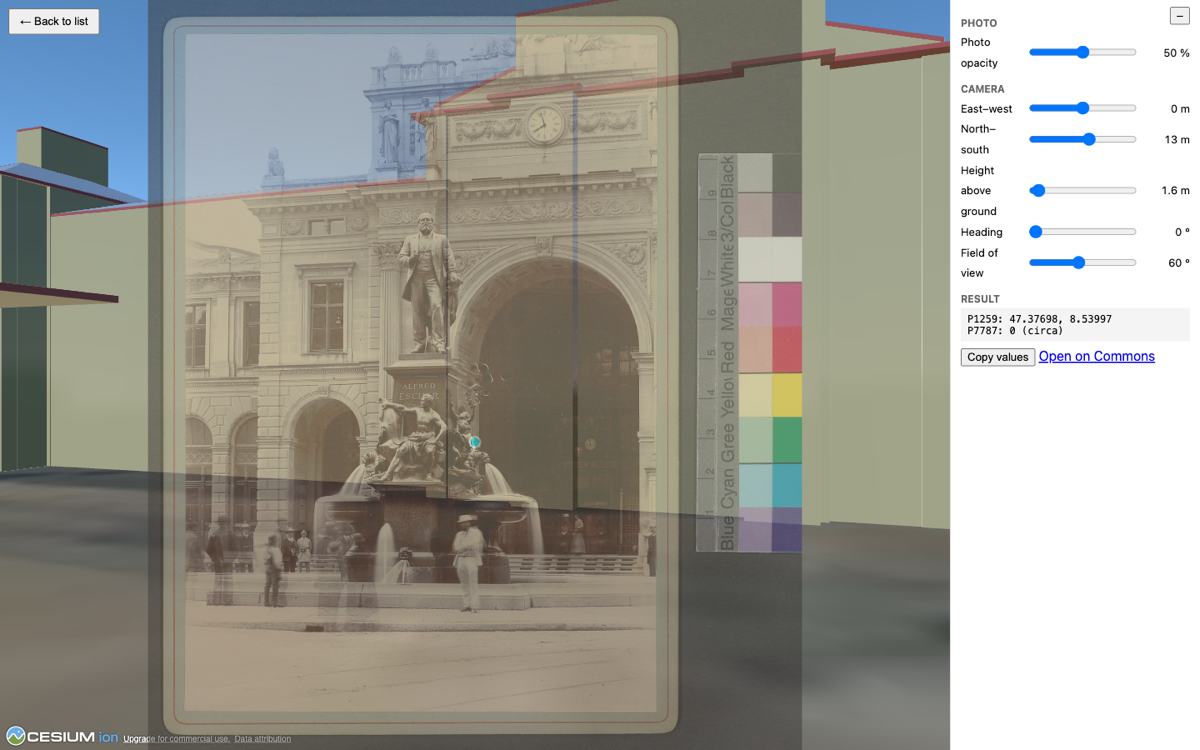
An 1889 photograph of the Alfred Escher monument at Zürich Hauptbahnhof (Robert Breitinger, public domain, Zentralbibliothek Zürich on Commons), faded over swisstopo 3D buildings in CesiumJS. The camera sits at about the position stored in this file's structured data.
That page only works because Commons stores structured data about its files, and anyone can query it with SPARQL. A file is not only a picture with a caption: it can say what it shows, where it was taken, from which direction, and which institution holds it. Once such statements exist, a few lines of static code are enough to put photos on a 3D map. The infrastructure is open, shared and free for everyone.
Every statement we add unlocks something. Some ideas, from ready to ambitious:
- Photos in 3D. Historic photos placed at their camera position in a 3D view of today's landscape (the viewer above does this for one photo at a time).
- Viewing directions on a map. Where was the camera, and what was it pointing at? Draw it for a whole collection of historic aerial photographs.
- One mountain, many archives. All photos of the same peak, bridge or building from different institutions, side by side.
- A whole institution in one query. With the collection statement (
P195), one query returns every file of an institution, with its metadata. No scraping, no category walking. - Training data.
depicts(P180) can carry a position inside the image (P2677). Together with geodata, that is a starting point for labelled data for computer vision. About 8,000 Commons files have such boxes today, almost none from Swiss institutions (details). We have not tried this yet. - A map of what is still missing. Which collection is nearly complete, which one is almost empty? Show it to the institutions.
Why it does not work for most collections yet
Most bulk-uploaded collections carry little of this data. In a random sample of 600 files from the ETH Library collection (60,449 files), about nine in ten have no
depictsstatement and only 3 have a camera position (P1259). TheP195statement exists on about 8.2 million Commons files (as of 23 October 2026), mostly from US institutions. Zentralbibliothek Zürich uses it, and one query returns its 7,224 files. For the other Swiss collections we checked, it is missing or nearly so.These are collections we picked, not a survey of all Swiss institutions. The measurements and a chart are in `docs/collections.md`.
How we get there
collection → QLever gap detection → suggested statements → human validation → Structured Data on Commons
- Select a collection. Preferably with
P195, otherwise by Commons category or file-name prefix. - Detect gaps with QLever. List the files without
depicts, without coordinates, or without heading. - Suggest statements from the file name, the caption, and the image itself:
depicts(P180): landmarks, places, people and objects, matched to Wikidata.- Camera position
P1259and depicted placeP9149, both as approximate coordinates, with the headingP7787as a qualifier. Phrases such as vom Vulcan-Hôtel or gegen Süd give hints. Careful: "seen from the north" means the camera points south.
- Validate by a human. A reviewer accepts, rejects or picks another candidate. Every suggestion records its source, for example "inferred from file name". Suggestions from file names alone are not safe, so a human decides.
- Export the accepted statements for Commons (for example as QuickStatements) instead of writing directly.
The pipeline is generic: a collection is an input, not a hard-coded part.
Where we start
We start with the ETH Library files (
Category:Media contributed by the ETH-Bibliothek) and Zentralbibliothek Zürich: large, bulk-uploaded and mostly unannotated. The Aargau society collection (challenge #319) is a possible second test case. Our pipeline complements that challenge, which is about place names and coordinates for the same collection.Already done:
- Gap measurements with QLever for five collections.
- A hand-checked test of matching file names and image content to Wikidata items, with its failure cases.
- A manual write test on one Commons file: approximate camera position, heading and depicted place saved as structured data. A heading cannot carry an uncertainty on Commons, so the pipeline has to keep it.
- The 3D viewer for correcting camera positions.
Who we are looking for
- People who like maps, 3D and visualisation: what would you build on top of this data?
- People who know Wikimedia Commons, Wikidata or SPARQL/QLever.
- People who work with cultural heritage collections and can tell a right suggestion from a wrong one.
- People who build user interfaces for reviewing suggestions, or who work with computer vision.
The question behind the project: how can we turn millions of openly available cultural heritage images into a connected, searchable and reusable knowledge graph, on infrastructure that everyone can use?
Repository
This repository contains the documents and code for the project "wiki-qlever" at the GLAMhack 2026.
- `docs/`: start here. Pick a topic (regions inside images, suggesting depicts values, camera position, collections, querying) and follow the link. The measurements and test results mentioned above live there.
- `presentations/assets/`: screenshot and charts used in this description and in the docs.
- `viewer/`: the 3D viewer for correcting camera positions of Commons photos (see its README).
- Historical Photos on the Map
Exploring Photographs Through Space and Time
Challenge description
Merged with:
/project/2073
https://odoma-ch.github.io/GLAMHACK26-HistoricalPhotos/
<!– https://github.com/CoreDB/GLAMHack26_HistoricalPhotos –>
How can we make historical photographs discoverable through interactive maps?
Historical photographs document changes in landscapes, settlements, and infrastructure over time. While many collections are accessible online, their geographical context often remains difficult to explore.
In this challenge, we aim to develop a prototype that allows users to discover historical photographs on an interactive map. As a starting point, we will use the Technical Photographs (TnA) collection from swisstopo, available through Memobase.
Possible features include map-based exploration, filtering photographs by date, image previews with metadata, and direct links to the original records on Memobase.
For Switzerland, swisstopo already provides a "Journey Through Time" (Zeitreise) service, offering historical maps from different periods. This creates an opportunity to locate and explore photographs directly on historical maps and discover how places have changed over time.
The goal is to experiment with new ways of exploring historical photographs across space and time. Ideally, the result will be an open, modular application that can later be integrated into existing websites and adapted to other photographic collections, mapping services, and platforms.
Gallery
Bild1.jpgMX3IK9UZ.jpgMF92PK2X.pngTnA.pngTool1.pngTool2.pngMap.png
- Detecting Image Manipulation
Find out whether a Photochrom really shows what it claims to show…
Challenge description
Photochrom Research Environment
Goal: a research environment for art history
- From close reading of single images to distant reading of the whole collection: craft research questions and find answers by tagging and comparing subsets
- Inspect images down to the smallest detail and reveal the secrets of their fabrication
- Analyse colours and compare two images
The photochrom collection of the Zentralbibliothek Zürich holds more than 9,600 colour prints from 1889–1914, among them over 200 reproductions of paintings. Montage and retouching were part of everyday work on photochroms. Our web app lets you browse the collection, pick candidates and put a photochrom next to the painting it copies.
- Try it: https://eliaskreyenbuehl.github.io/photochrom/
- Code (MIT): https://github.com/eliaskreyenbuehl/photochrom
1. Media Library: distant reading
All 9,604 works as a mosaic, filtered by genre, country, image content and date. Selected works travel on to the next tab.
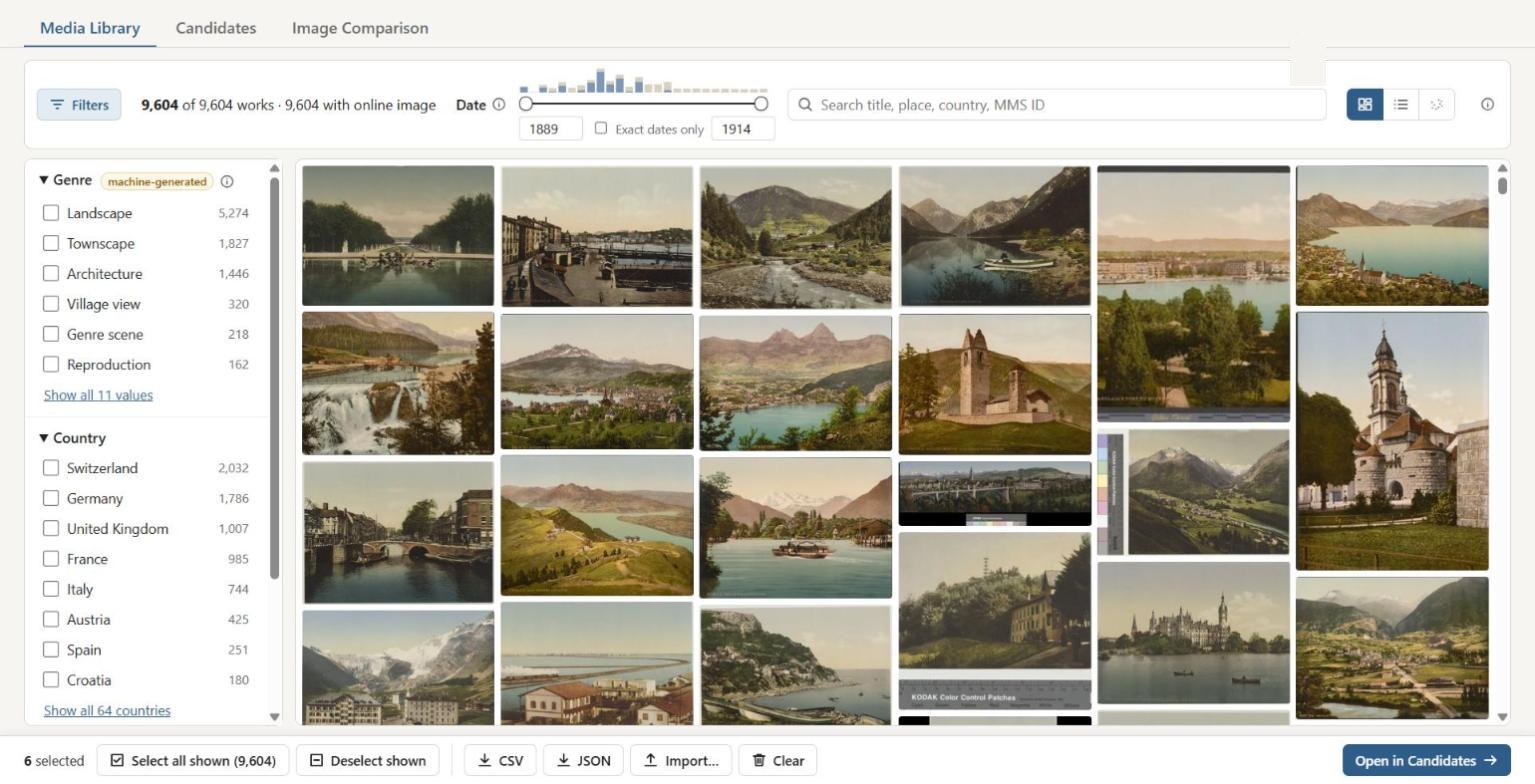
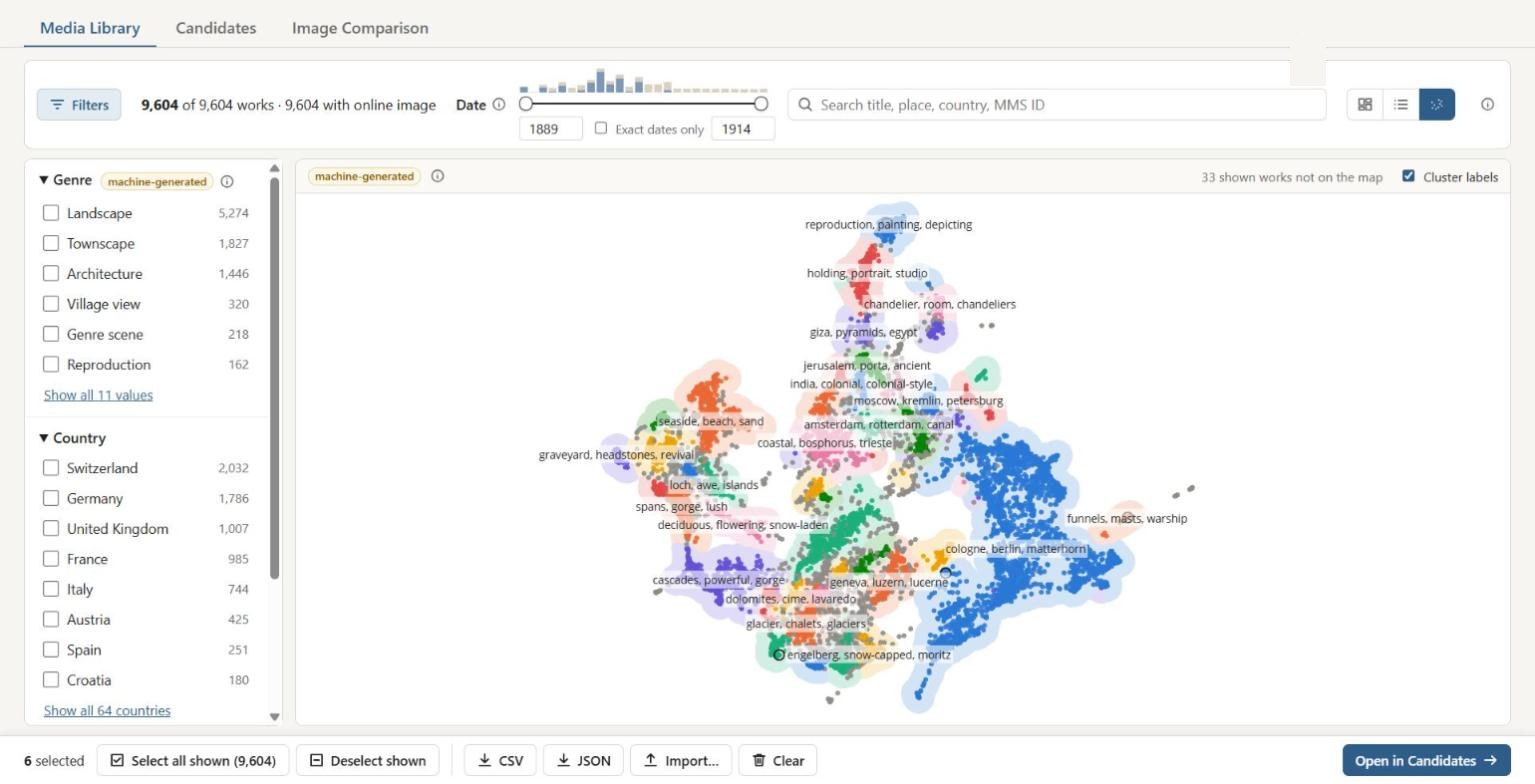
The map view arranges the collection by visual similarity (image embeddings), with automatic cluster labels such as "glacier, chalets" or "reproduction, painting". Genres, image content and clusters are machine-generated and not yet reviewed.
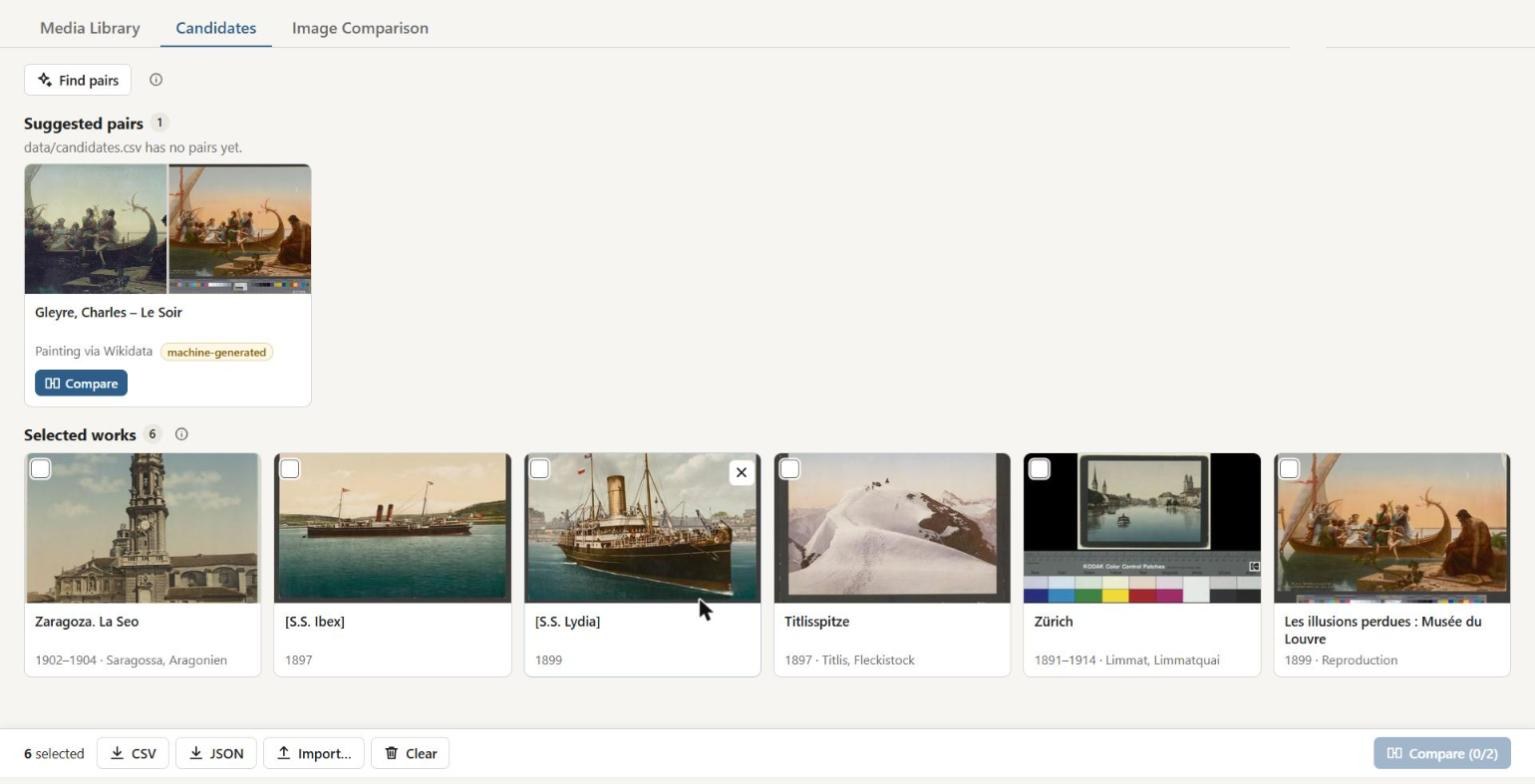
2. Candidates: building pairs
"Find pairs" suggests comparison partners for the selected works, for example the original painting via Wikidata.
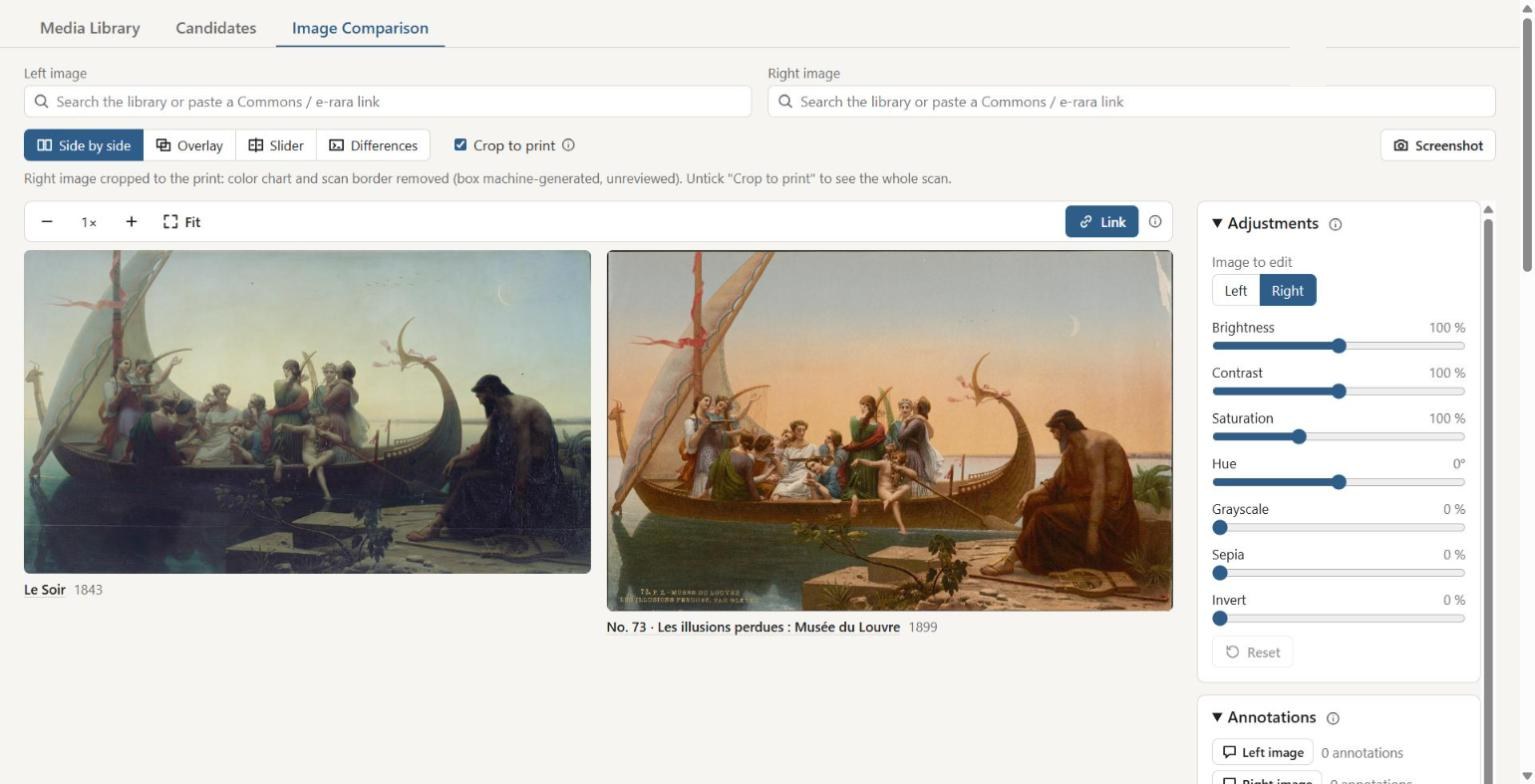
3. Image Comparison: close reading
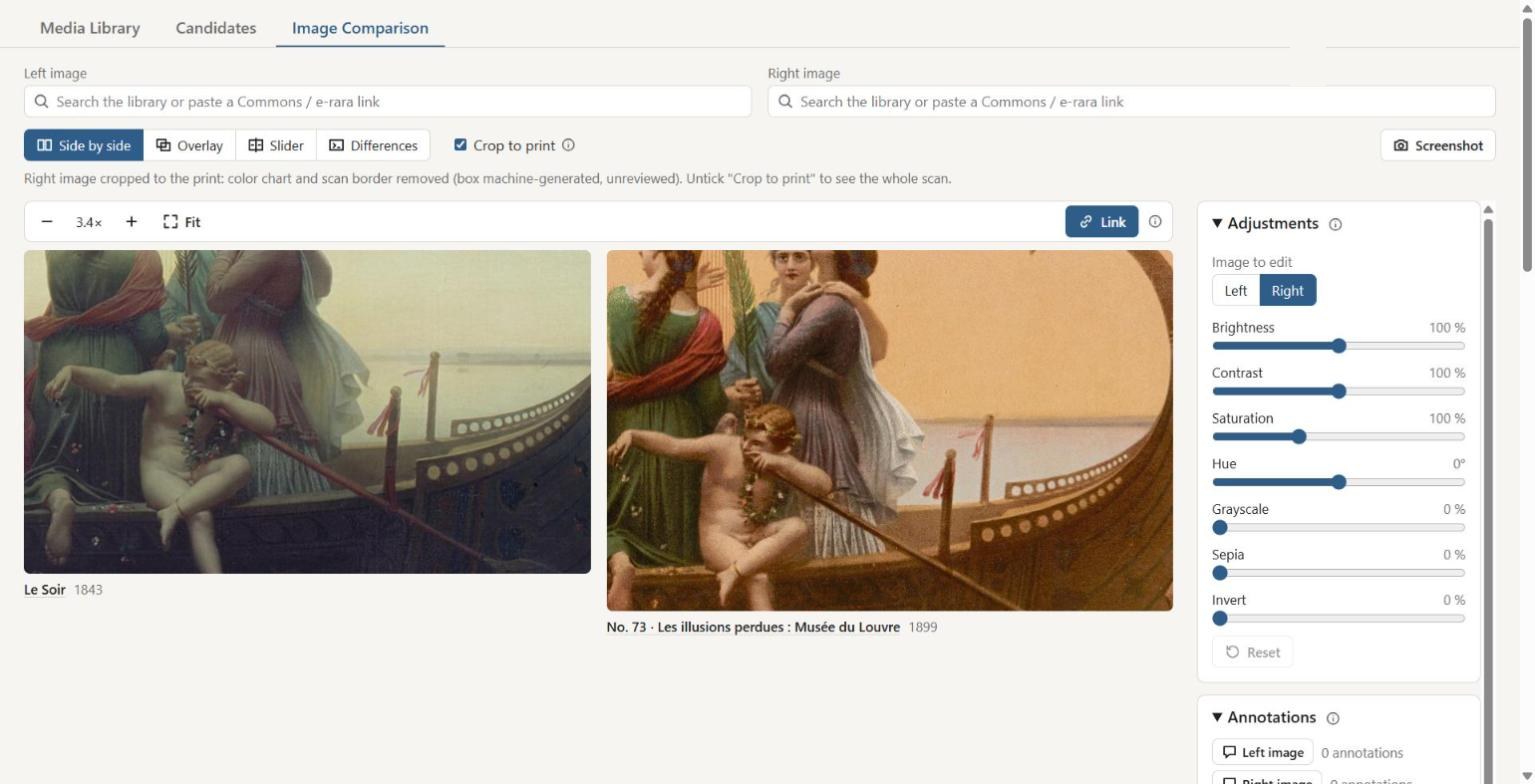
Charles Gleyre, Le Soir (1843, Louvre) next to photochrom No. 73 Les illusions perdues (1899). The colour chart and scan border are cropped away automatically. Brightness, contrast, saturation and hue can be adjusted per image.
Linked zoom down to the smallest detail: the cupid's face and the boat's ornaments in both images at once.
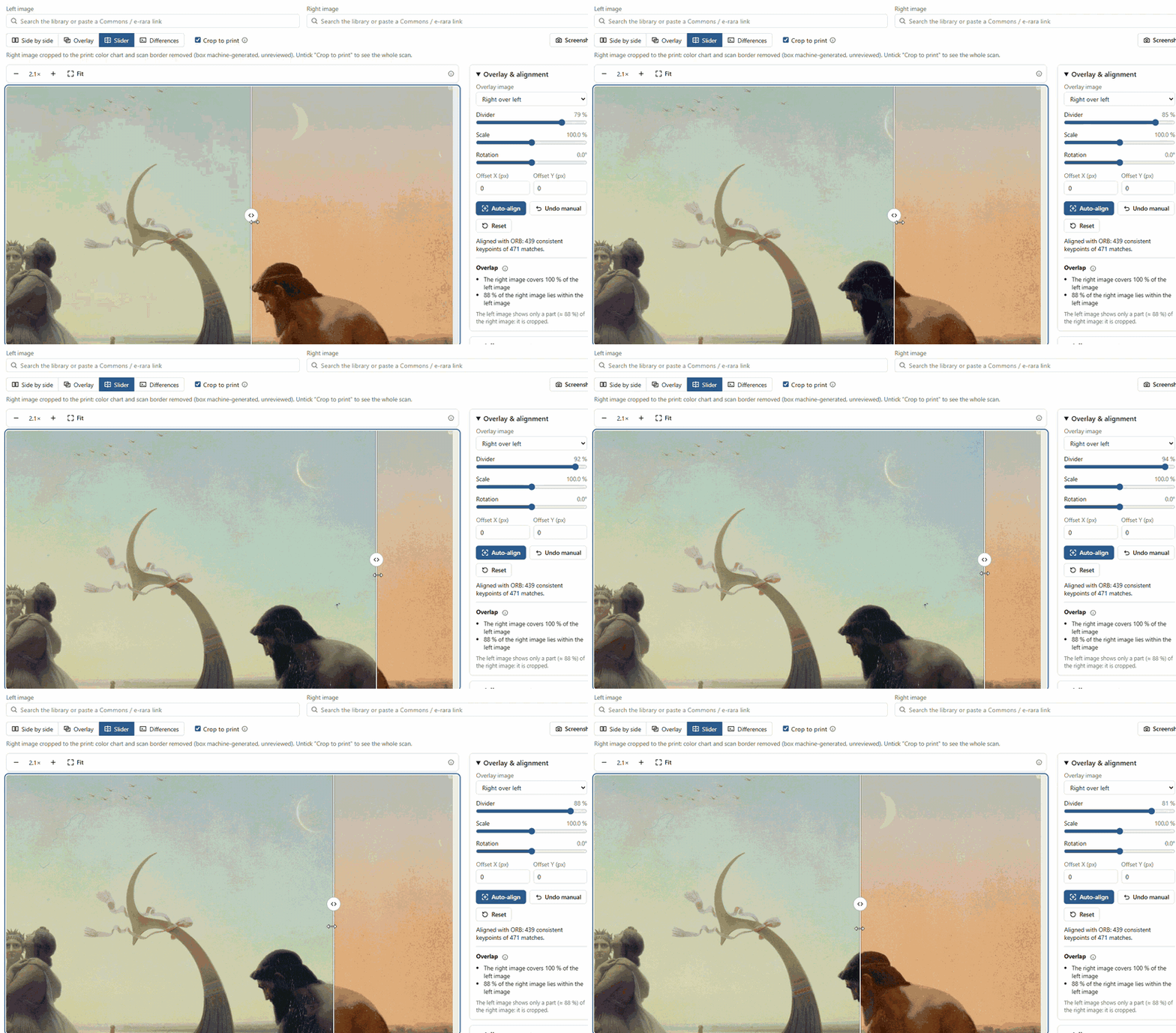
The slider, zoomed in on the moon: drag the divider across painting and photochrom and watch the evening sky change.
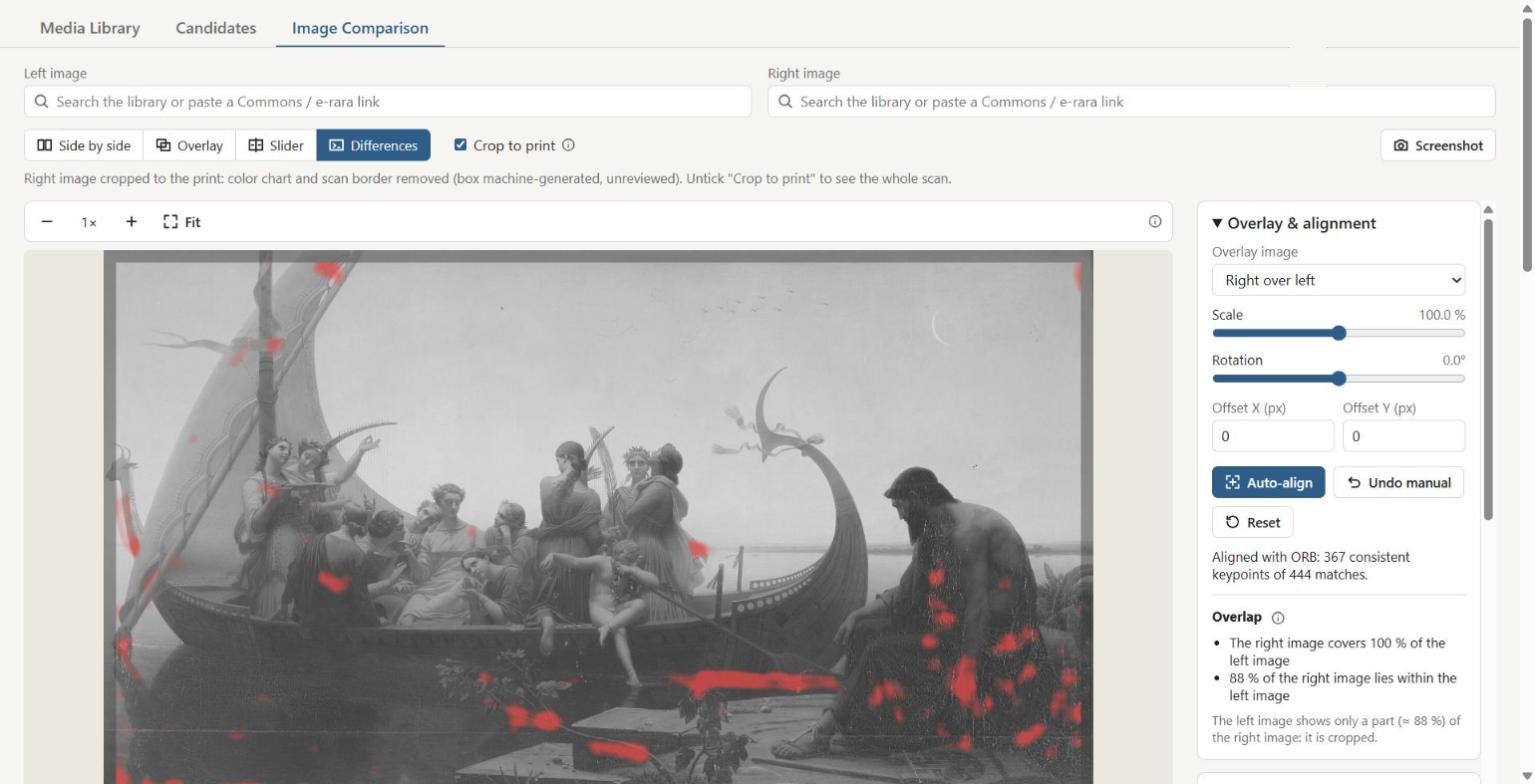
Auto-align (OpenCV, keypoint matching) lays the photochrom exactly over the painting. The difference map then marks where the two images really differ, beyond colour.
4. Colour analysis
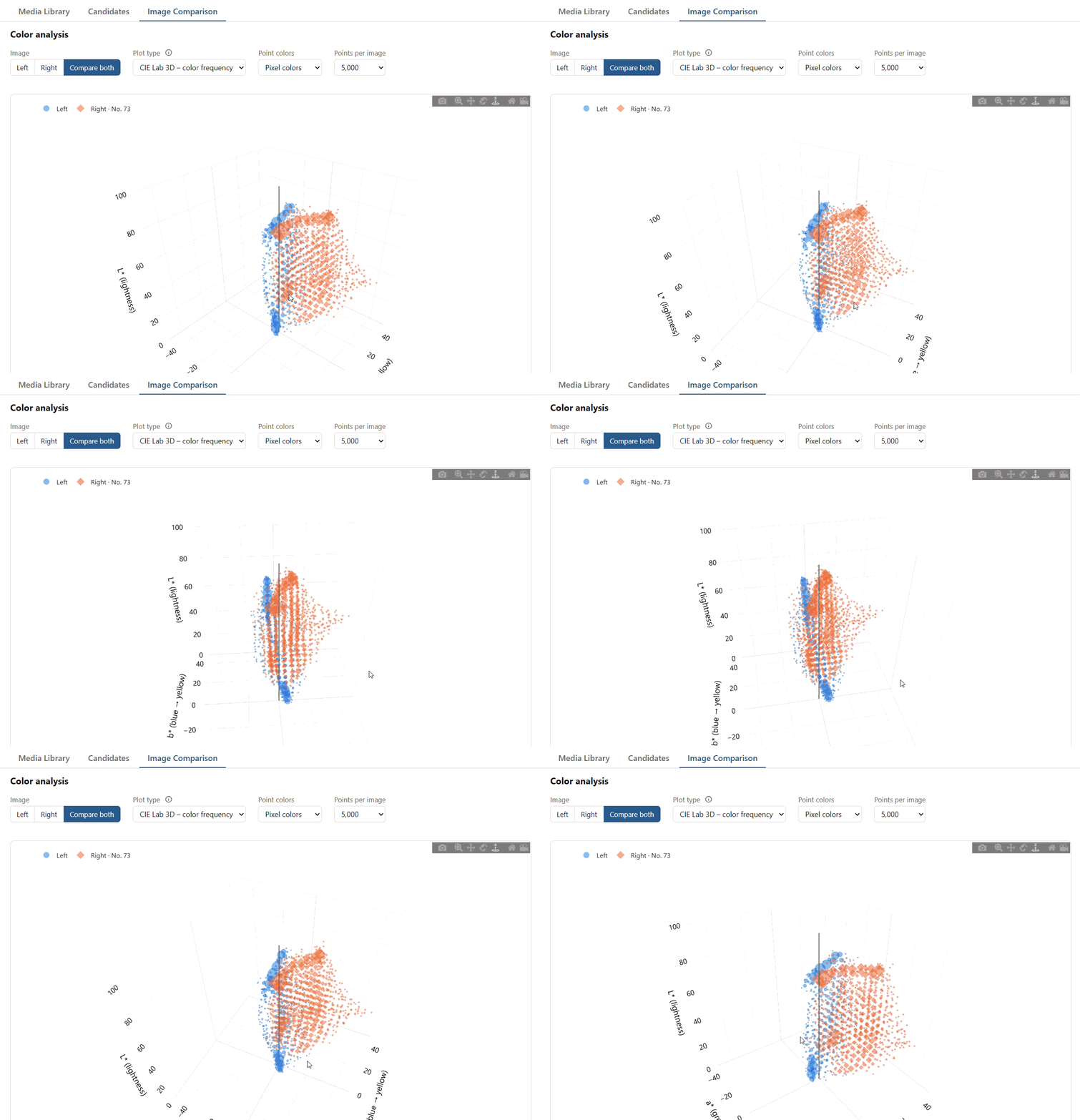
The colours of both images in the 3D CIELAB colour space (lightness L, green–red a, blue–yellow b*), compared in one rotating plot: the painting (blue) stays close to the cool, grey axis, the photochrom (orange) spreads out towards red and yellow.
Data
- Photochrom Collection of the Zentralbibliothek Zürich: 9,610 records with images and metadata: https://doi.org/10.5281/zenodo.24141227
- Photochrom images are in the public domain (Public Domain Mark), metadata is CC0. Rights to museum images vary, so please check them before reuse.
- Reading the Caption
Machine Captioning, Human Description and GLAM Practice
Ana Zapata GuzmánChallenge description
Vision-language models are increasingly used to caption images in museums, archives and libraries, from alt-text to collection metadata.
But what is a caption, and what is it for? In this challenge, we will generate and evaluate captions from different AI models for images from the collections provided by GLAMhack26, starting with the SKKG Digital Collection. Participants will also describe a selection of these images themselves in short Show and Tell sessions, reflecting aloud on how they read an image, so that human descriptions become part of the dataset. Comparing the two, we ask what models see and miss, and how captions are produced and introduced into GLAM institutions.
Using the human descriptions as a reference, teams will explore how to evaluate captioning models: which criteria matter for GLAM collections, and how human and machine descriptions can be compared. Bridging the gap between looking at an object and describing it digitally, the aim is a critical framework for human–AI interaction in GLAM captioning, one that asks when, how and whether machine captions should enter our collections.
- AI Tools Registry
Challenge description
Libraries, archives and museums maintain their own overviews of AI tools, and many become outdated faster than they can be updated. At the hack, we will develop an open core schema that lets GLAM institutions bring together information on AI tools in a machine-readable way. Each institution can then extend the core schema with its own profile. At the hack, we will test the schema using an overview of AI research tools and MCP connectors as an example. If time allows, we will extend the registry with a monitor that finds new tools and suggests them for re-view. Humans decide what goes into the registry.
https://drive.google.com/drive/folders/1gHf0E_2t7jIDsTvah_CipzxEsmzG7JYf?usp=drive_linkValérie Andres, valerie.andres@fhnw.ch
- Marionette Theatre, back in 3D
How can we bring the Marionette Paper Theatre back into the 3-dimensional space? What can be experienced in this theatre?
Challenge description
1. Starting point
The SKKG collection holds beautifully illustrated paper sheets that fold into a 3D puppet theatre stage, plus marionettes and small figures and stage objects. In the digital collection all of this exists only as photographs, so the theatre is flat again.
The pitch asked: How can we bring the Marionette Paper Theatre back into three-dimensional space, and what can people experience in it?
The pitch suggested several directions, such as a VR walk-through, an AR stage on a table, a build-it-yourself kit or a printable PDF. The final format was left open for the team to decide.
What the team decided: An interactive 3D theatre in the browser. The visitor picks a play and sets up the stage with painted backdrops and stage objects digitised from the SKKG collection. Objects from other collections can be added through IIIF Manifests. The visitor then plays a rigged SKKG marionette with their hand in front of the web 9-string control cross.
2. Data:
The objects existed only as one or two photos from the SKKG digital collection (CC0). Each was rebuilt as a textured 3D model with Blender scripts and image processing (Python, OpenCV). The exact method depends on the object's shape.
Limits of the 3D models:
- Sides not visible in any photo are plausibly completed, not documented: they are filled from the opposite side, a symmetric counterpart or a mirrored copy.
- Remnants of the photo background are retouched out.
- Fine relief such as needles, fingers or carving marks is mostly texture, not geometry.
- Large parts of the code, the Blender scripts and the 3D models were made with an AI coding assistant (Claude Code), guided and checked by the team. Each model was reimported, rendered and compared with the photo after every change.
Objects from SKKG:
- Stage: Theaterbühne 30717.1
- Sign: Schild 45567.3
- Marionette: Marionettenpuppe 46154
- Chest: Truhe 46955
- Chair: Stuhl 25210.6
- Ball: Kanonekugel 38896.3
- Bed: Bett 44012
- Cup: Becher 48468.21
- Tree: Nadelbaum 29319.27
- Cat: Katze «Villa Poupée» 29404.202
- Frog: 1 Paar Tierfiguren; Frosch 49790
- Dog: Krippenfigur Hund 38872.24
Furthermore, a 3D model of a microscope from the collection of ETH Library can be included via a IIIF manifest into the scene.
- Microscope: Mikroskop ETHZ GEOB 0055
- IIIF Manifest:IIIF Manifest
1000040098.png1000040099.png
3. Results:
| Area | Result |
| ————— | ——– |
| Web application | Browser app (TypeScript, Vite, Meta IWSDK, three.js, Rapier physics, MediaPipe). It opens with a stage curtain and play signs. The the marionette is played with one or two hands in front of the webcam. Impro mode lets the visitor set the stage and save scenes as a play. |
| Plays | Plays are lists of scenes (backdrop and stage objects). |
| Stage | 3D stage with side walls, main curtain, painted backdrops, play signs, a velvet wall and a parquet floor. Lighting rig designed with a theatre lighting expert, with a light desk and four lighting moods, plus follow spots that track each puppet. |
| Marionette | A procedural, rigged, cloth-ready model of SKKG Marionettenpuppe 46154 at real size (35 cm). It has the real 9-string control cross and engine metadata (masses, colliders, joint limits, strings). |
| Stage objects | 3D models of SKKG objects, one invented stage object, modelled from collection photos. |
| IIIF | Any IIIF 3D manifest can be dropped into the app and becomes a stage object. Example: a microscope from the ETH Library. |
| Source | Every card has an "i" that leads to the object in the SKKG collection. AI-invented objects reveal a "Fake-Objekt gefunden!" message instead. |
| Sound | Background music and sound-art excerpts streamed from archive.org, CC0 sound effects and physics sounds when objects or the puppet hit something. Music and effects each have their own button, both off until switched on. |4. Web Application:
The following technology decisions were taken for the web application. More detailed information about the architecture can be found on the here in our GitHub repository.
| Topic | Decision |
| ————— | ——– |
| Engine | Meta IWSDK in browser mode (xr: false); WebXR possible later |
| Physics | Rapier; IWSDK physics switched off |
| Input | MediaPipe hand tracking with one or two hands (main input), mouse; phone sensors planned. All sources write one ControlInput model |
| Lighting | A fixed rig of five light groups on dimmers (front light, profile/follow spots, top, side and strip lights), switched by lighting scenes |
| Plays | Oe JSON file per play in assets/plays/, written from the app (director bar) |
| Targets | Phone and desktop with webcam first; WebRTC remote and VR later |
| Assets | Sources committed in assets/<source>/; large files (over about 20 MB) on external storage in assets/external/ |
| Catalogue | assets/catalogue.json: label, scale and collection link for every stage object and backdrop |5. Running the application:
You need Node.js 22 or newer.
Get the repository from GitHub: puppetshow
Once, after cloning:
“`
npm install./scripts/fetch-mediapipe-models.sh
“`Then start it:
“`
npm run dev
“`Open http://localhost:5173 in your browser.
For a phone or another computer or have issues with camera due to untrusted connection, start it with HTTPS instead:
“`
npm run dev:https
“`6. How to play:
- Curtain and play signs: A red curtain fills the screen. Three signs drop in front of it: Hänsel und Gretel, Froschkönig and Impro.
- Choosing a play: Clicking a sign raises the curtain. The same click starts the web cam and hand tracking. Without a camera the mouse keeps control.
- Playing the marionette: The marionette hangs on its strings and follows the visitor's hand. A follow spot tracks it.
- Impro mode: Round icon buttons sit at the screen edges. On the left are Requisiten (stage objects) and Sound; on the right are Hintergrund (backdrop) and Licht (light). Each opens a panel styled like a paper theatre, with a starry night sky and a scalloped gold edge. The painted backdrops are paper cards on a curved slider. A click lowers the chosen backdrop like a sheet from the fly loft, with a torn-paper edge revealing it; a second
click removes it. Requisiten: The stage objects are on a mirrored slider. A click lowers an object onto a free spot on the stage, as if on a string. Objects can be dragged across the floor, they collide physically, and small ones can be grabbed by the puppet. A second click lifts the object off again.
IIIF card: The last card of the stage-object slider accepts a IIIF 3D manifest.- Sound: A speaker button at the bottom right switches the music on. It is off at every page load, so the visitor chooses whether there is sound.
7. Marionette control:
Strings and cross: Each of the 9 strings is a rope joint from the control cross to the puppet. The main bar follows the input; the leg bar and hand bar rock, which makes the puppet walk and raise its hands.
Hand control (MediaPipe):
- The wrist moves the control cross, and a pinch of thumb and index finger grips.
- A fist held for 3 seconds lets go of the puppet. After a 5-second countdown, raising the hand reconnects it. This way the player can lower their hand without dragging the puppet to the floor.
Grab, throw, drop: A sensor collider on each hand. A fixed joint holds an object while gripping; on release the object keeps the hand's velocity, which gives a throw.
Follow spots: Each puppet gets its own spotlight. It hangs on a lighting bar in front of the stage, as in a real theatre, and tracks the puppet's chest with a slight lag. The brightness and beam can be tuned with constants.
8. Contributions:
- Katja Rempel: Stage, curtain, signs, backdrop and stage-object sliders, catalogue, IIIF workflow in the app, UI for sound and light
- Kai Jauslin: Rigged SKKG marionette model with control cross, follow spots, camera start on the sign click, fist gesture to let go
- Cahit Atilgan: Architecture, project setup, Phase 0 spike, Rapier, MediaPipe, presentation mode, background music, debug mode
- Rita Gautschy: 3D models of SKKG collection objects, fountain and praline box, IIIF 3D manifests, documentation
- Sonja Gasser: selection of SKKG objects and of audio files
- Christiane Sibille: expertise in hand puppet movements, testing movements of marionette
- Sandra Becker: animated gifs of objects in scene
Access the final presentation by visiting https://glamhack26-theatre.github.io/puppetshow/ and pressing
CTRL+SHIFT+P. - Crawler Monitor for Institutional Repositories
When does online traffic become an attack?
Challenge description
AI bots and crawlers are flooding institutional repositories at an unprecedented scale. A 2025 survey of 66 research institutions found that over 90% face aggressive bot traffic at least weekly, causing service disruptions and tying up resources (Shearer & Walk, 2025). This isn’t hypothetical — in May 2026, the University of Zurich’s repository ZORA had to restrict access to its internal network just to stay online (Gerber, 2026). Beyond the technical strain, there’s an ethical tension: researchers happy to share data for science rarely agreed to it training AI models.
Current countermeasures — robots.txt, IP-blocking, rate-limiting — are reactive, temporary, and quickly bypassed: a constant cat-and-mouse game (Shearer & Walk, 2025; Weinberg, 2025). Worse, without monitoring, institutions often don’t even know how distorted their own usage numbers are — one institution’s reported traffic dropped from 1 million to 125,000 visits once bot activity was filtered out (Weinberg, 2025).
That’s the gap this challenge addresses: a prototype Crawler Monitor that makes bot activity visible and understandable — a foundation for data-informed decisions instead of reactive firefighting.
Full description (PDF)
Attachments:
- 9X21GR1O.pdf
- O69T2VVI.pdf
- Benchmark for Cultural Preservation in the Age of AI
An open benchmark that measures how well AI models preserve cultural heritage: reading old documents, describing objects, linking them to the right records, and not making things up.
Challenge description
Museums, archives and libraries are starting to use AI to transcribe, describe and catalogue their collections. But nobody can say which models actually do this well, and where they quietly damage the record: a wrong date, an invented provenance, a lost dialect word, a mislabelled object.
This project builds a small, open benchmark from Swiss open cultural data (for example Wikimedia Commons, Wikidata and GLAM collections) and uses it to test AI models, including Apertus, on the tasks that matter for preservation:
- Reading: transcribing handwritten and printed historical documents (OCR/HTR), including old scripts and Swiss German.
- Describing: writing catalogue descriptions and metadata for objects and images, judged against the institution's own records.
- Linking: matching people, places and objects to the correct Wikidata entries.
- Translating: carrying historical texts between German, French, Italian and English without losing meaning.
- Faithfulness: catching hallucinations, invented facts and false provenance, and checking that models keep licences and private persons' data intact.
Each task has a datasheet (sources, licences, known gaps), a scoring script and a simple leaderboard, so any institution can rerun it on a new model.
Goal for the weekend: 3 to 5 tasks with test data, a first comparison of several models, and a leaderboard others can extend.
Skills welcome: archivists and curators (to say what "correct" means), data wranglers (OpenRefine, Wikidata), Python, machine learning, and anyone curious how good AI really is at preservation.
Team: Codezilla
- Good Question!
An archive of what visitors ask about art, and when. Exhibitions raise questions that wall texts don’t answer, but art mediators might. Many of these questions are asked, and answered, but they stay invisible: other visitors never see them, and they rarely flow back into the gallery.
Visitors’ questions are a kind of knowledge museums don’t systematically collect: they show what people are curious about, what irritates them, and what is missing. And that changes over time.Alexandra ParaschivFlorian KrämerKatrina WeissenbornMarie Nanchen Melissa CaflischMona Herter
 Patricia Lenz
Challenge description
https://glamhack-app-966336370599.us-central1.run.app/
Good Question!
An archive of what visitors ask about art, and whenThe problem
Exhibitions raise questions that wall texts don’t answer. Many of these questions are asked, and answered, e.g. in a guided tour, but they stay invisible: other visitors never see them, and they rarely flow back into the gallery.
Visitors’ questions are a kind of knowledge museums don’t systematically collect: they show what people are curious about, what irritates them, and what is missing. And that changes over time.Our idea
A tool that lets visitors see which questions have come up about an artwork, and in which context: when, in which exhibition, at what moment in society.
Visitors can browse what others have asked, add their own questions, and reflect on them: Why are people asking this now?
The questions also show the museum what information is missing or hard to find, and where the visit could be improved.
Every question gets an answer, from art mediators or from the museum’s knowledge base. Every answer shows who gave it and where the knowledge comes from.
Inspired by Carmen Mörsch’s idea of deconstructive art mediation: questioning the museum together with its visitors.Why it matters for visitors
Curiosity: Browse what others have wondered about – a second, unofficial wall text.
You’re not alone: See that others asked something similar.
No question is too simple: Simple questions stand next to clever ones. No rankings, no likes – every question counts.Three works by Paul Klee
Currently on view in “Kosmos Klee. Die Sammlung”, Zentrum Paul Klee, BernUntitled (Mister Death), 1916 – one of the first hand puppets Klee made for his son Felix
Pictorial Architecture Red Yellow Blue, 1923 – a Bauhaus colour grid in which colours seem to have weight
Tendril, 1932 – sand and coloured dots, a tendril reaching from the earth towards sun, moon and starsOpen questions we want to explore
Do we need AI for this at all? Where would it help (for example, grouping similar questions), and where would a simple, non-AI solution be better?
How can visitors see trends over time, and connect them to what happens in society, without jumping to conclusions?
How do we make sure every question gets an answer?
How does a visitor know, within seconds, that a simple question is welcome?What we’ll build in two days
A simple HTML/JS prototype, starting with one work
A question page for visitors: ask a question, browse what others have asked
A timeline view: which questions were asked when, and in which context
An answer view for mediators, with sources
Since there are no real visitor questions yet, we use clearly marked example questions to show how the archive could grow
Runs locally; tested with 2–3 peopleData & openness
Catalogue metadata: Zentrum Paul Klee, published online and provided for the hackathon
Images and guide texts: local prototype only, with kind permission of the ZPK
Questions are anonymous: only the question, the artwork and the date are stored
Code (MIT) and texts (CC BY 4.0) stay open, so other museums can adapt the ideaJoin us!
We’re looking for people who enjoy JavaScript, small servers or data visualisation, and anyone interested in art mediation, critical museum practice, accessibility or visitor research. AI enthusiasts and AI sceptics are equally welcome. - AlignGeist
Building Evaluations for AI Alignment (Safety) Research with the insights of the humanities
Carmiella ZorziChallenge description
At this moment, the jobs in AI alignment (safety) research are almost entirely reserved for computer scientists and engineers. Relying on this very small group of people to both understand the complex technicalities of AI AND to contemplate the moral, creative, and social questions surrounding it is highly problematic. As the world is panicking about the future of AI, and safety researchers are quitting left and right, isn’t it time for more interdisciplinary, creative teams from the humanities to step in and help?
I am pitching AlignGeist as an independent research group/organization which develops AI alignment research and evaluation approaches with the expertise of the arts, psychology, history, philosophy, and other social sciences. This weekend we will design and run Evaluations which compare multiple LLMs. I envision exploring in particular LLMs' responses about the next developments in AI at the boundaries between digital and analog realities.
What questions could AlignGeist ask that the current field of AI alignment research struggles to approach? Let’s experiment together this weekend with forming a working concept!
- Datasheets for Datasets
Join us to create new descriptions (datasheets) for your datasets that reflect possible computational re-use
- Stitch + Audio
Stitching for resistance, coming from Arpolleras = Stitching in Chile against Pinochet dictatorship. Our stories on audio go into Wiki Commons. Presentation with Wikimedia Uruguay at UNESCO for democracy, GLAM, liberty.
Challenge description
roof copy.jpeg








Programme
Thursday, 12 November
- 13:30–14:00
Welcome and check-in
- 14:00–17:30
Workshop: Apertus and Public AI Switzerland
Workshops run in two sessions, 14:00–15:30 and 16:00–17:30, with a break in between.
Our workshop is an invitation to digital humanities researchers and members of the OpenGLAM community about leveraging Apertus and related open source LLM technologies for cultural data analysis, curation, and storytelling, while fostering a community around open, collaborative, and responsible AI use in cultural heritage projects.
Understand how to design LLM workflows that augment human research and curation processes (e.g., keyword extraction, metadata enrichment, summarization, sentiment analysis). We will explore a small demo that uses Apertus to assist in generating contextually relevant summaries for historical texts. This could be used to design digital exhibitions based on archival content.
Participants will be given free access to a Swiss inference provider, where they can proceed to set up their hackathon challenge. We will also explain how to run large language models locally (this is possible today even without a high-powered computer) for maximum privacy and flexibility.
In the last part of the workshop, we will discuss how to fine-tune models for specific domains (e.g., historical texts, local dialects) using open datasets. Understanding how to evaluate LLM outputs for performance, topical sensitivity, historical accuracy, and potential biases should be helpful for you regardless of which LLM you use.
- 14:00–17:30
Workshop: Datasheets for Cultural Heritage Datasets
Workshops run in two sessions, 14:00–15:30 and 16:00–17:30, with a break in between.
A central element of GLAMHacks is the use of cultural heritage collections as data. In recent years, there has been a debate in the wider cultural heritage community about how such data sets should be described to ensure responsible computational re-use. Building on broader considerations regarding Collections as Data (Padilla et al. 2023) and Datasheets for Datasets (Gebru et al. 2021), cultural heritage experts recently developed the idea of “Datasheets for Cultural Heritage Collections” (Alkemade et al. 2023) and developed “A Checklist to Publish Collections as Data in GLAM Institutions” (Candela et al. 2023).
During the workshop, we will first contextualise these approaches and work on practical examples.
- 14:00–17:30
Workshop: Coding with AI for Non-Developers
Workshops run in two sessions, 14:00–15:30 and 16:00–17:30, with a break in between.
One no longer has to be a developer to start turning ideas into working code with AI – this workshop is about understanding what that actually involves. It is aimed at people who work with or are interested in cultural heritage data and are curious about what AI-assisted coding can do for them – no coding experience required.
The session covers different approaches and tools for AI-assisted coding – what they can do, what their possible shortcomings are, and how they can still be useful. Through a live demo and a hands-on exercise with open cultural data, you'll experience how describing an idea in plain language can result in working code.
The goal is not to turn you into a developer. It's to give you enough understanding to build rough prototypes, recognize their limits, and find a common language with developers you'll meet at the hackathon. Think of it as a translation tool for interdisciplinary collaboration.
- 14:00–17:30
Workshop: Uploading Image Collections to Wikimedia Commons with OpenRefine
Workshops run in two sessions, 14:00–15:30 and 16:00–17:30, with a break in between.
Museums and Collections that want to share their images on Wikimedia Commons often face two challenges: First, how to upload a lot of images, and secondly how to upload them with the metadata, that they already have in their databases. In this workshop we will learn how to use OpenRefine to tackle the two challenges in one go. We will look at the whole process from start to finish, learn about the quirks of Wikidata and the potential considerations before uploading.
It would be good for participants to have some previous knowledge of OpenRefine, as the course will not be a beginners course on OpenRefine, but everyone is welcome. Due to the lack of time, we can't work with everyone's data. We will look at the process with some exemplary data.
- 17:30–18:00
End of workshops, drinks and nibbles
- 18:00–18:15
- 18:15–18:45
Keynote: these burning bridges aren’t as bright as I had hoped
As it is unlikely that the analogue world will be flooded with generative AI in the foreseeable future, we should use this time to explore the craftsmanship and artistic abilities of our species and beyond. Our institutions hold a wealth of situated knowledge(s) and perspectives that can help us to foster and preserve critical thinking. But how can we foster appreciation and accuracy in a rapidly changing (digital) landscape? From a feminist theoretical perspective, we will examine the responsibilities and moral challenges that lie ahead as we endeavour to build new bridges.
Fernando Obieta is a media theorist, artist and SNF Doc.CH PhD candidate, with a background in computer science, interaction design, and transdisciplinary studies in the arts. His artistic work and research focus on the critique and reflection on (digital) media, artefacts and systems, and how these are contingent and situated.
- 18:45–19:45
Flying dinner, conversations & networking
- 19:45–20:15
Panel: Curating Access to a Globalized World
Digital archives (in the best case) present alternative ways to navigate the world and to structure what it contains. They create curiosity in their users and gain relevance not just through interesting interfaces but also through their bond to the analog world. The panel gives insights into two such projects that take different approaches to the data they work with and the role they foresee for their users.
Sophia Prinz (ZHdK) presents the project “Müliweg Eins”, which was developed with the PHZH and SKKG as an educational tool for high school students. The project starts with a small selection of digitized objects from the SKKG collection and challenges students to conduct research on and curate them. Helmut Grabner (ZHAW) has been working as a computer vision researcher with the artist Kurt Caviezel on a website that provides users with access to more than 11,000 webcams primarily through text-based interfaces. And while “Watching the World” presents itself like an archive, its database consists of an ever-changing set of current images without memory.
At the same time, both projects address the complexities of a globalized society and try to empower non-experts to navigate this terrain. Crucially, both approaches ask what becomes visible — and what remains hidden — when we design the conditions of seeing. And both are only possible because of the accessibility of their data and the digital tools they use.
- 20:15–21:00
Born-Digital Cultural Heritage – How the Demoscene (re)imagines traditional art
As the first of its kind, the Demoscene has been recognised as UNESCO Intangible Cultural Heritage by 9 European nations, Switzerland being one of them. The application for World Cultural Heritage is now underway.
More than 2,000 of these small, realtime-rendered programs are being created every year by the community – we are presenting a selection of those which fittingly Bridge The Gap between realtime animation and traditional cultural heritage.
Shana Marinitsch is a digital artist, cyber feminist and community organiser living in Switzerland. She is member of the board at Echtzeit – Digitale Kultur and the Chaos Computer Club Zurich, part of the Haecksen collective and main organiser of the digital culture festivals MountainBytes and Revision Demoparty.
- 21:00–22:00
Drinks, conversations & networking
- 22:00
Closing




Friday, 13 November
- 08:30–09:00
Check-in, coffee
- 09:00–09:30
Opening session
GLAMhack26 information and ice breakers.
- 09:30–10:45
Presentation of challenges / idea pitching
2 minutes per person.
- 10:45–11:15
Group creation – first group meeting
- 11:15–12:30
Start hacking
- 12:30–14:00
Lunch break
- 14:00–18:00
Work in groups
- 18:00–18:30
Check-out
Overview of the GLAMhack projects and introduction to the Saturday programme.
- 18:30–19:00
Yoga class
- 19:00–20:00
Dinner
- 20:00
Work in groups (“night shift”)
Until midnight.
Saturday, 14 November
- 08:00–08:30
Campo opens
- 08:30–09:00
Check-in, coffee
- 09:00–12:30
Work in groups
- 12:30–13:30
Lunch
- 13:30–16:00
Work in groups
- 16:00–17:30
Final project presentations
- 17:30–17:45
Closing session
- 17:45–19:00
Apéro
- 19:00
Closing
Read the original announcement
The Swiss OpenGLAM working group unites cultural institutions, software developers, digital humanists, artists, Wikipedians, and other enthusiasts with a shared goal of advancing openness among galleries, libraries, archives, and museums (GLAM).
Within the collaborative environment of the GLAMhack, we engage in joint experimentation, innovation, and artistic creation, exploring the realms of cultural content and digital tools. Our focus spans research initiatives, web and mobile applications, Wikipedia, artistic creations, and a variety of other use cases aimed at fostering openness and creativity.
The 11th edition of our yearly Swiss Open Cultural Data Hackathon (or GLAMhack for short) will be hosted by the Stiftung für Kunst, Kultur und Geschichte (SKKG) in Winterthur.
This year’s theme is “Hack the Gap – Bridging Analog and Digital Worlds“
The connection between physical spaces and objects and digital spheres has grown increasingly relevant as digital technologies evolve and offer new opportunities to represent, contextualize, and make accessible our shared cultural assets.
Yet a persistent gap remains between analog collections and the digital tools, skills, and infrastructures needed to unlock their full potential. At the same time, digital content is often detached from its physical context, creating a reverse gap in which digital representations lose their tangible connection to place, materiality, and experience.
GLAMhack26 invites participants to explore both directions of this divide and experiment with creative ways to bridge it—through new forms of digitization and description, immersive and interactive experiences, or by translating digital knowledge back into physical and spatial forms.
Ultimately, the theme encourages rethinking how cultural heritage can move fluidly between the physical and digital realms, ensuring broader access, deeper understanding, and more inclusive participation.
If you wish to attend only the Opening Night on Thursday, 12 November, from 18:00, or the Final Presentations on Saturday, 14 November, at 16:00:
Workshops + Opening Night on Thursday, 12 November
Skill-building workshops (Thursday afternoon)
Want to add a few new tools to your toolbox in advance of the hackathon? We’ve got you covered!
Topics covered in the Thursday, 12 November afternoon pre-event workshops include:
- Datasheets for cultural heritage datasets
- Apertus and Public AI Switzerland
- Coding with AI for Non-Developers
- Uploading Image Collections to Wikimedia Commons with OpenRefine
Opening Night (Thursday evening)
This evening looks at how the analogue and digital worlds can inspire and challenge each other. Through a keynote and a panel discussion, speakers will explore creativity, digital archives, and the choices that shape what we see and discover online. The programme will end with an introduction to the Demoscene, a vibrant form of digital art that brings together coding, animation, music, and cultural heritage. Our Opening Evening will also be a convivial and inspiring opportunity to meet, connect, and gather ideas for a great hackathon ahead!
Hackathon program (Friday & Saturday, 13-14 November)
Friday, 13 November
The GLAMhack will kick off with an opening session followed by the challenge pitches on Friday morning. Afterwards, the participants will form groups and start hacking. Lunch and dinner as well as snacks in between will be provided at the hackathon location.
Saturday, 14 November
Participants will continue hacking and towards lunch start preparing their final presentations. The hackathon will end with the presentation of the final results of each group on Saturday afternoon followed by an apéro. All supporters and sponsors are warmly invited to join the final presentations as well as the apéro.
Open Cultural Data
At the heart of GLAMhack26 is the SKKG Sammlung Digital. Soon, more than 60,000 objects—complete with metadata and images—will be released under an open license, enabling broad and creative reuse. The dataset will be accessible through a SPARQL endpoint, following the Linked Art data model.
Participants are also encouraged to bring and work with their own datasets, or explore our curated list of open datasets from Swiss GLAM Institutions for additional inspiration.
Want to provide cultural data from your own institution? Check out our Call to data providers (German / French) and our detailed Instructions (German / French).
Our GLAMhack26 Challenges
Propose your challenge ideas in advance of the GLAMhack on our hackathon platform, which will be used extensively throughout the hackathon. Check our guide on how to submit a challenge or the extensive user handbook of our hackathon platform (called dribdat).
Contact
If you have any questions, feel free to contact lionel.walter@opendata.ch.
Organising team
 Sandra BeckerWikimedia CH: Programm
 Cathlene BellOpendata.ch: Kommunikation
- Pierre-Louis BlanchardSchweizerisches Nationalmuseum: Datensätze
 Sonja GasserSKKG: Programm
 Jonas LendenmannOpenGLAM-Arbeitsgruppe: Datensätze
 Oleg LavrovskyOpendata.ch: technischer Support
 Laura WaldeSKKG: Projektleitung Gastinstitution
 Lionel WalterOpendata.ch: Projektleitung GLAMhack26 + Datensätze
 Birk WeibergDIZH: Programm
 Anna SigristOpendata.ch: Projektleitung GLAMhack26 (bis 31. Mai 2026)
 Zoé LangmeierOpendata.ch: administrative Unterstützung (bis 30. September 2026)
Host

Main partner

Sponsor

 with GraphChat


