Fresh, fresher: Open Farming Hackdays 2022 – let’s have a byte!
- Farming
- Hackathon
As the saying goes: small but mighty! That was the Open Farming Hackdays 2022 – read on for our look back at 2–3 September 2022!
As I walked up the field next to the apple trees, the sun was shining golden on the little hill at the foot of the Liebegg. It was just after 7:00 and the Liebegg apprentices were on their way to their first lesson. After a short internal briefing, we set off to prepare the arena and the great goodie bags put together by Yannick Wagner of the LZL, and to welcome the first arrivals.
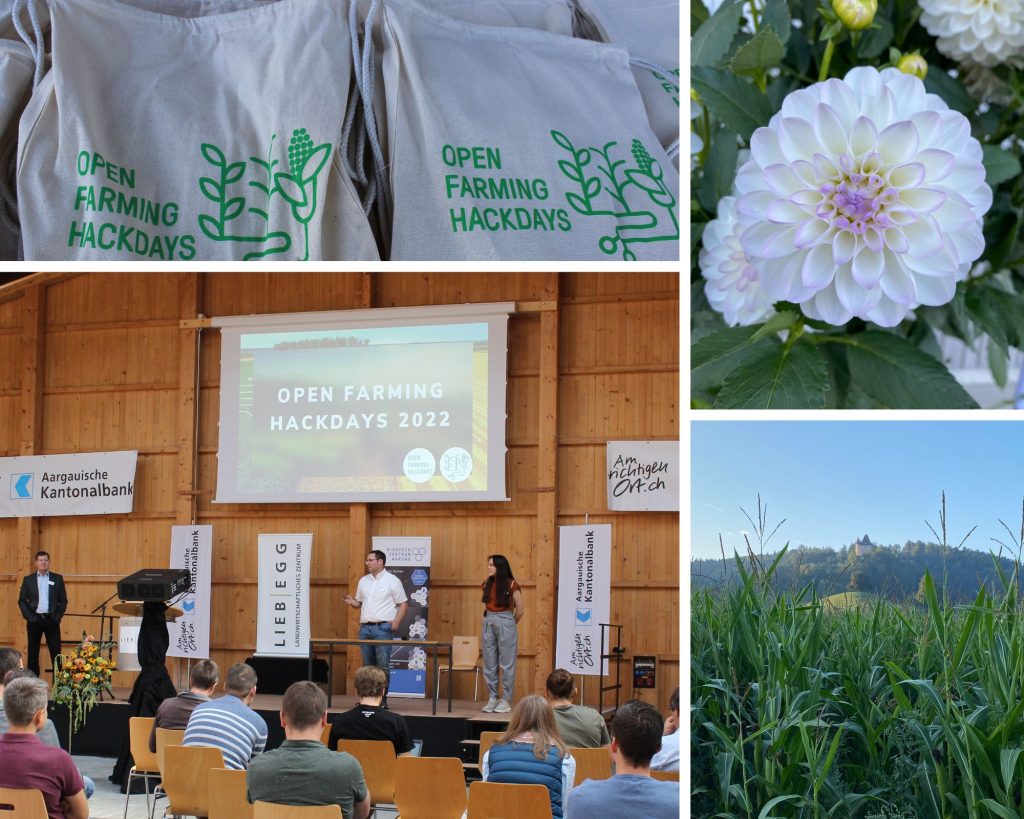
We started on Friday morning with around 60 participants and, as usual, kept our briefing short so that we could listen to the welcome address by Hans Ruedi Häflinger and the inspiring inputs from Christoph Bertschi (SmartBreed AG) and Reto Eggimann (Hightech Zentrum Aargau)! 6 challenges were pitched at first, and 2 more joined spontaneously. Of the 8 challenges, 7 became teams, and these produced 8 projects (the maths always seems a bit abstract to outsiders – but it makes sense, I promise!).
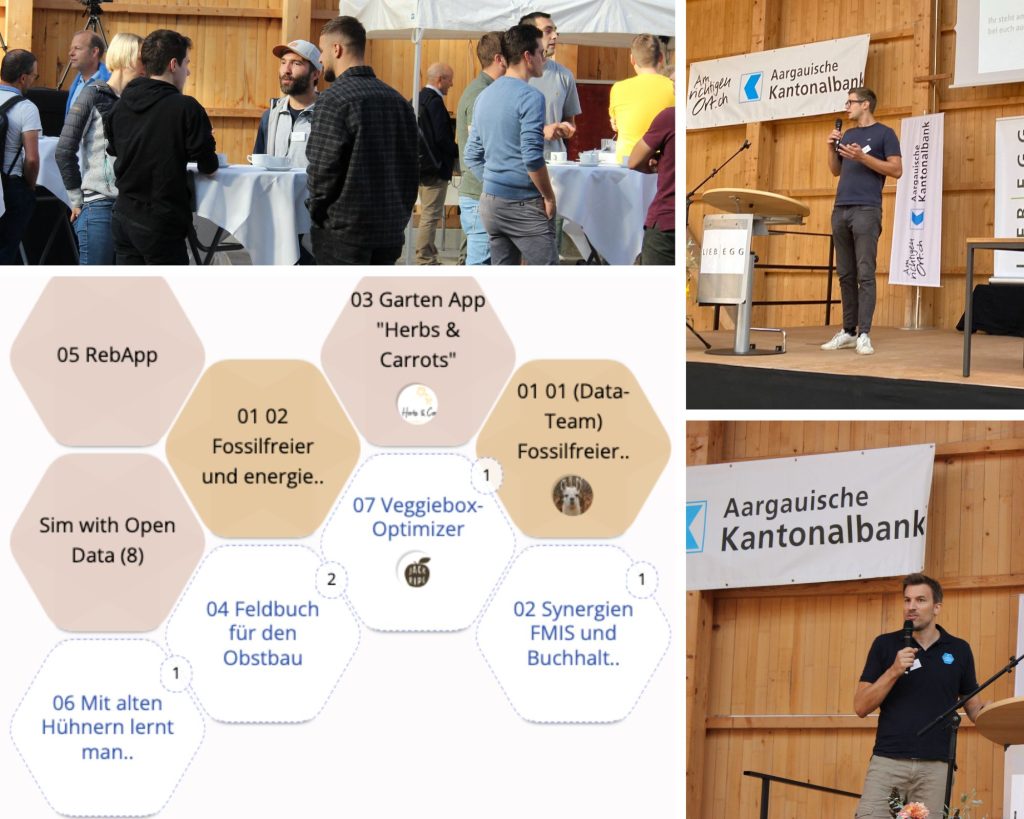
Projects & teams
#1.1 Decarb my Farm
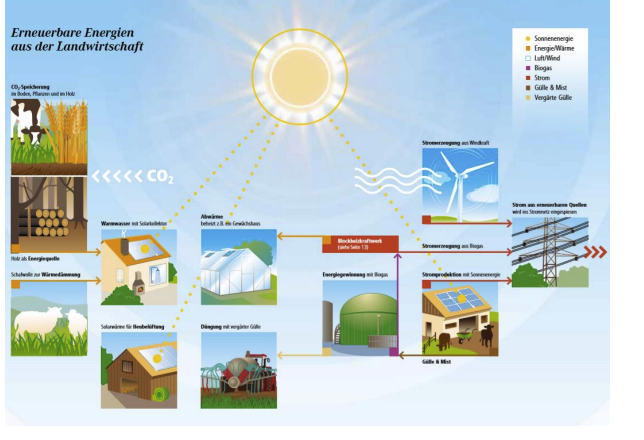
Team #1 took on a mammoth task and put together a mammoth team of 12 (!!!) members to match. The target vision is a fossil-free farm that is at least 50% energy self-sufficient. The challenge consisted of two building blocks (which were also worked on at the Open Farming Hackdays in two connected groups). With the aim of first comparing data, they took Agroscope data from 331 farms, compared their energy consumption and introduced various benchmarks and variables. These benchmarks were used as the basis for the second and very complex part of the challenge.
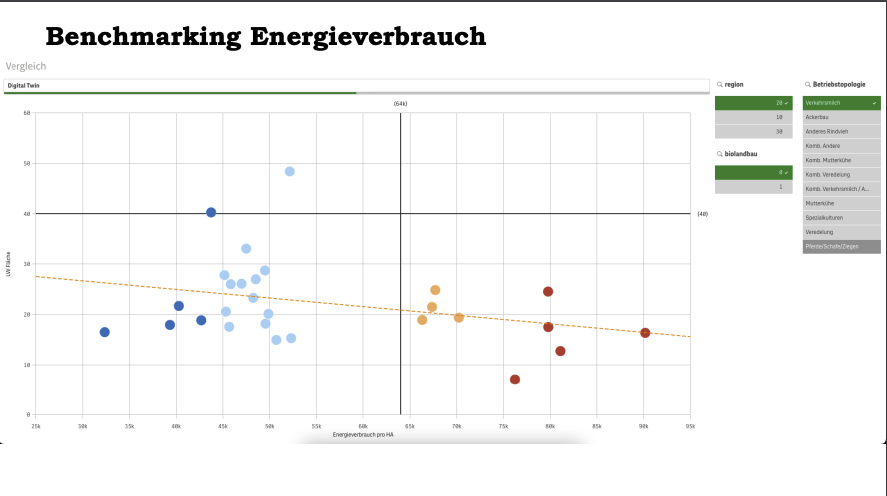
#1.2 Fossil-free and energy self-sufficient farm
The second part of the team, with 8 members, took care of putting the data to use and had to try to answer many very difficult questions: What should they focus on? How do you present an immensely complex farm simply and understandably and identify the biggest energy guzzlers? Farmers do not have much spare time to rack their brains over such concepts and questions – Team 1.2 rushed to the rescue and presented a digital twin as the solution! The team would like to pursue the project and is now looking for financial support and implementation partners!

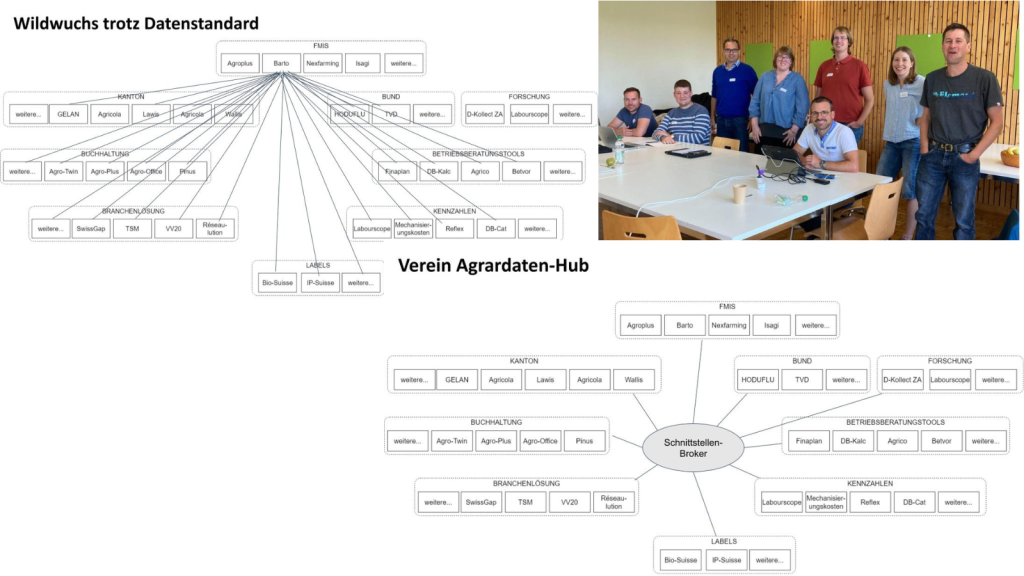
#2 Verein Agrardaten Hub (FMIS & Buchhaltung)
Farmers have to fill in huge numbers of documents and forms that rob them of valuable time in the field and for their business. Despite many attempts, the various institutions seem unable to standardise forms so that farmers, fiduciaries and the other institutions can all use them equally. With its broad team of experts, VAH (Verein Agrardaten Hub) identified the interfaces and problem areas and worked out proposed solutions in the form of an interface broker. Hard and much-needed graft, not made any easier by critical questions and the size of the team – which VAH nevertheless turned to its advantage. We hope the work continues and warmly congratulate the team!
#3 Garden app – Herbs & Carrots
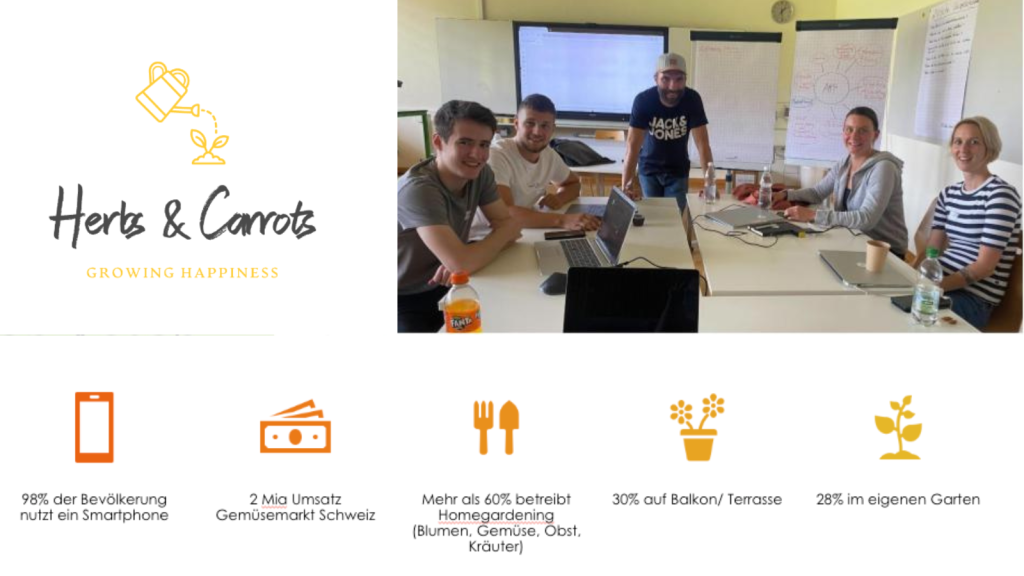
For the second time, MyFeld took part with a challenge! The success story continues with “Herbs & Carrots“, the garden app for hobby gardeners with a balcony, garden or raised bed! Which herbs should be sown and harvested where and when? Which vegetables can I grow on my south-west-facing balcony? What pest is this? Is what’s growing a weed or a good herb? Herbs & Carrots aims to let users realise their gardening dreams as efficiently and successfully as possible! With MyFeld, Herbs & Carrots already has a strong team – the next steps are a business plan, finding funding partners and developing a roadmap! Fingers crossed!
#4 Field book for fruit growing
There are already various tools of this kind (e.g. Agrotech, etc.), but they are not suitable for fruit growing. This branch of farming is becoming increasingly complicated and hard to keep track of. Obsty developed a program that connects various platforms and lists, making it easier for fruit growers in the field to make decisions. Take a look at the incredible results Dani & Urs came up with: https://obsty.nemundo.ch/https://obsty.nemundo.ch/
#5 RAPP
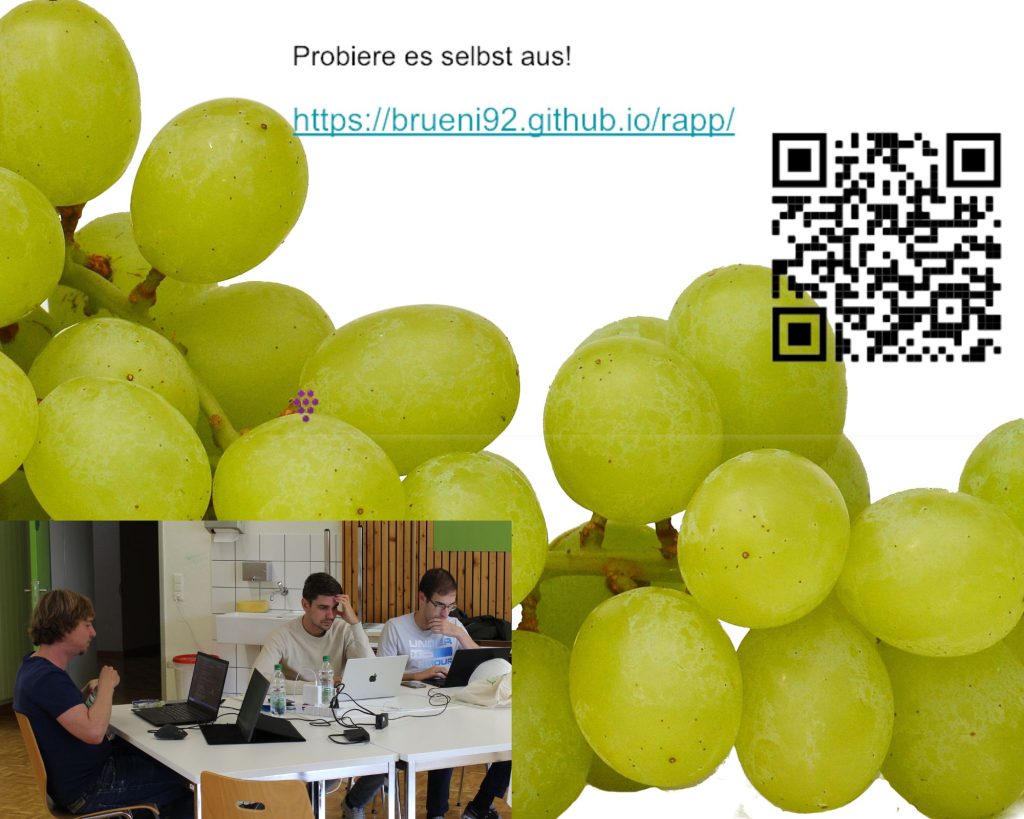
Starting point: every 30 years, a winegrower in Aargau has to ask an important question: which grape variety should be planted? In the canton of Aargau, around 90 grape varieties are approved for growing AOC wines. On top of that, more and more new fungus-resistant varieties are coming onto the market, and climate change means that more varieties familiar from southern Europe can be grown. This makes it increasingly difficult for winegrowers to choose the right variety.
To support winegrowers in choosing a variety, RAPP developed a platform containing all known varieties in Aargau. They took into account location, type of wine, production volume and much more, leaving the winegrower spoilt for choice between 1–3 varieties that could be a good fit.
This text was very easy to write, because Team #5 did exactly that: RAPP – take a look at the very, very fruity result!
#7 Veggiebox Optimizer
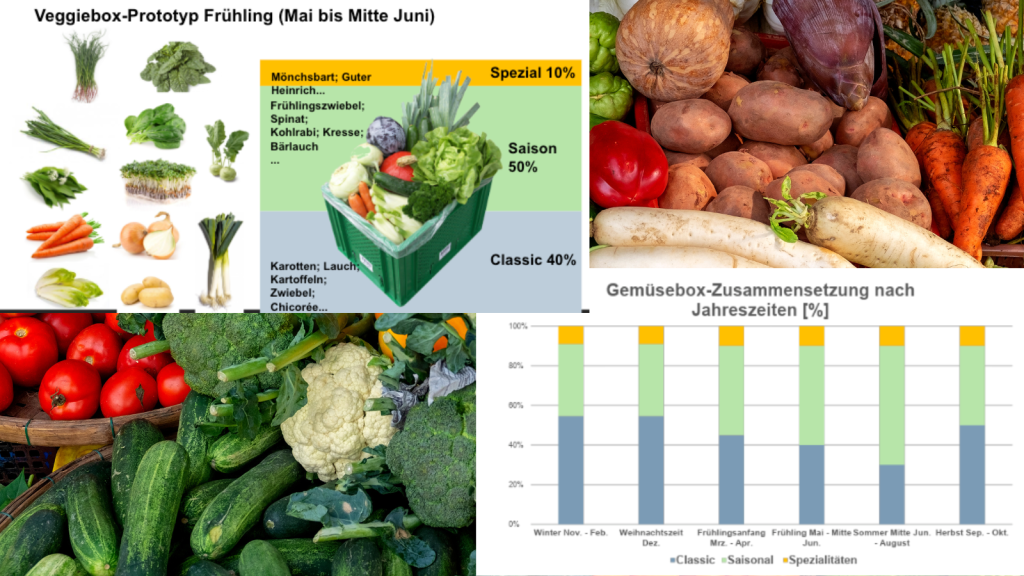
VeggieBox was a spontaneous challenge from the JackRipe team – which then did become a project after all (to our great delight¨)! In true design-thinking fashion, they found out that the original target group is not the actual target group at all! Flexibly, agilely and with incredible determination, VeggieBox Optimizer gathered data and developed a tool that makes work easier and more efficient for VeggieBox producers! JackRipe is still in the pre-seed stage and will hopefully implement the project as part of the start-up! We wish them the best of luck!
#8 Sim with Open Data
Farming Simulator (DE: Landwirtschafts-Simulator – BauernZeitung) is one of the world’s leading video game series, developed by GIANTS Software GmbH in Schlieren, Switzerland. The game is richly detailed and quite a lot of fun 🧑🏽🌾 With a wide range of challenges, it motivates thousands of people to learn the principles of farming through play – some even go as far as competing in eSports championships (Blick). It may even have inspired one or two young people to come to Liebegg to study agriculture in depth.
This challenge consists of designing and/or developing a modification based on open data. In the Farming Simulator ModHub you will find dozens of downloadable modifications as well as hundreds of new vehicles, locations and landscape extensions. A guide to this can be found here.
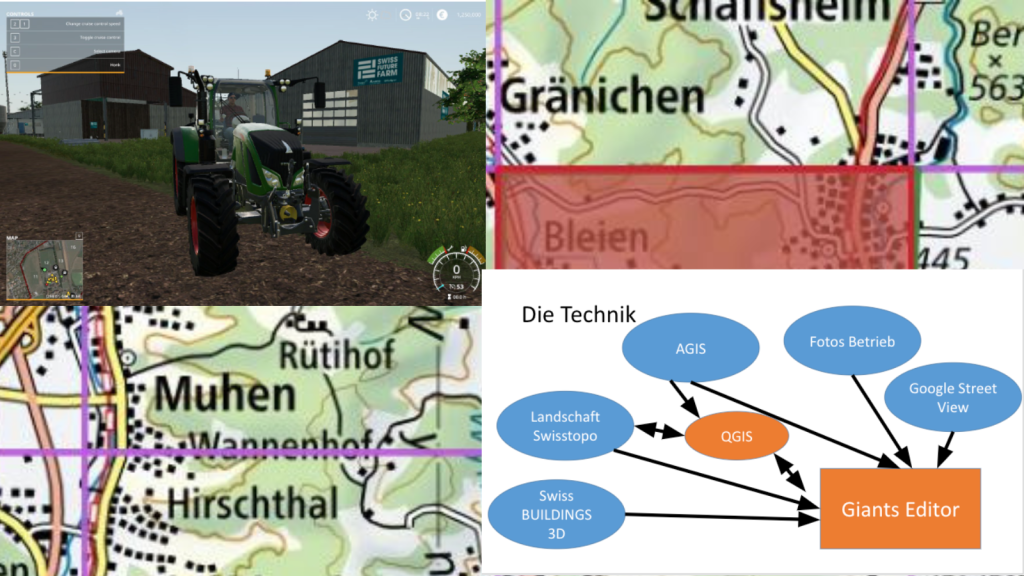
During the hackdays, Team #8 took an in-depth look at the challenge of creating a map of the Liebegg (or another farm) in the video game Farming Simulator. In addition to a conceptual and technical examination of the process of extending the game with open data and the manufacturer’s own tools, we researched existing projects and alternative platforms. They got in touch with people who have already had this experience and have a roadmap for continuing the project should there be interest in the community. You can find more details in the slides.
Thank you!
Thank you to all the participants, the Landwirtschaftliches Zentrum Liebegg, the good weather and the bad weather, the fantastic kitchen team and, of course, our main sponsor Aargauische Kantonalbank and Hightech Zentrum Aargau for the great hackdays!