Open Legal Lab 2024
- Hackathon
24.–25. März 2024, 09:30 @ Swiss Olympic House Magglingen, Hauptstrasse 232, 2532 Magglingen/Macolin, kostenlos
Veranstaltet von Opendata.ch, Verein eJustice.ch
Das Open Legal Lab 2024 brachte am 24. und 25. März rund 70 Juristinnen und Juristen, Entwicklerinnen und Entwickler und weitere Interessierte im Swiss Olympic House in Magglingen zusammen – organisiert von eJustice.CH, durchgeführt mit Opendata.ch. Nach der Eröffnung stellten die Challenge-Owner in je drei Minuten 14 Challenges vor; danach bildeten sich die Teams und arbeiteten bis in die frühen Morgenstunden.
Im Zentrum standen Large Language Models, daneben die E-ID und Entscheide des Bundesgerichts. Prägend war ein spontanes Projekt von Oleg Lavrovsky: Am Sonntagabend forderte er die Teilnehmenden zum Prompt Battle «Innocent until prompted guilty» heraus.
Am Montagnachmittag präsentierten die Teams ihre Ergebnisse am Magglinger Rechtsinformatikseminar in der Aula der Eidgenössischen Hochschule für Sport.
Fotos


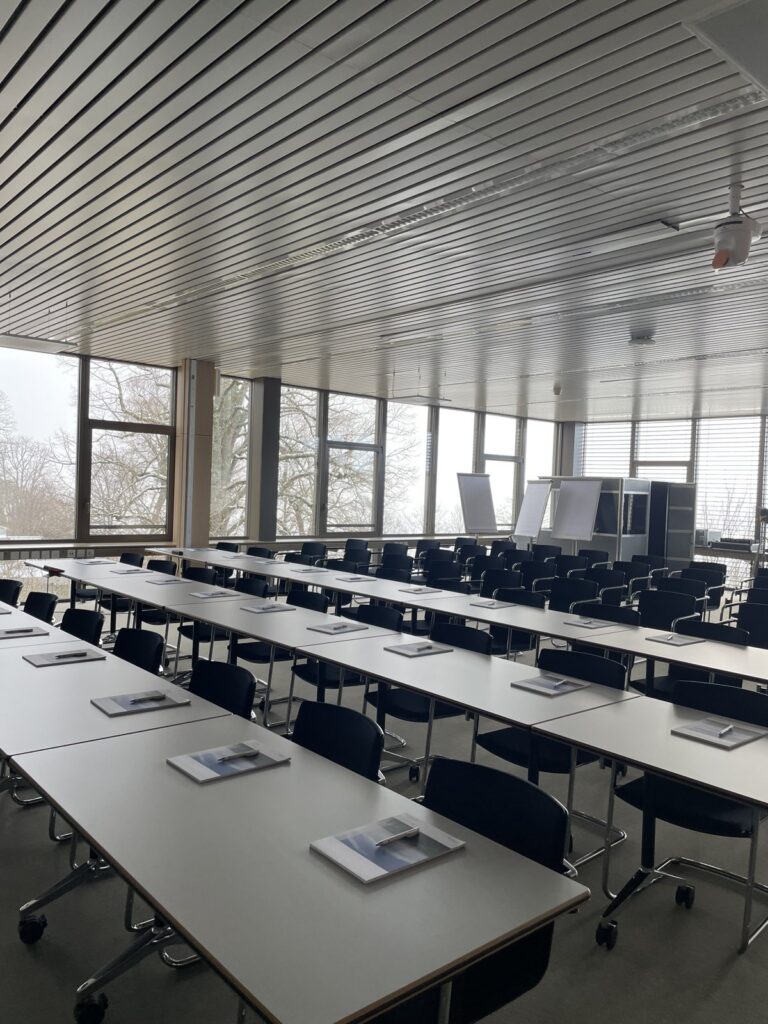
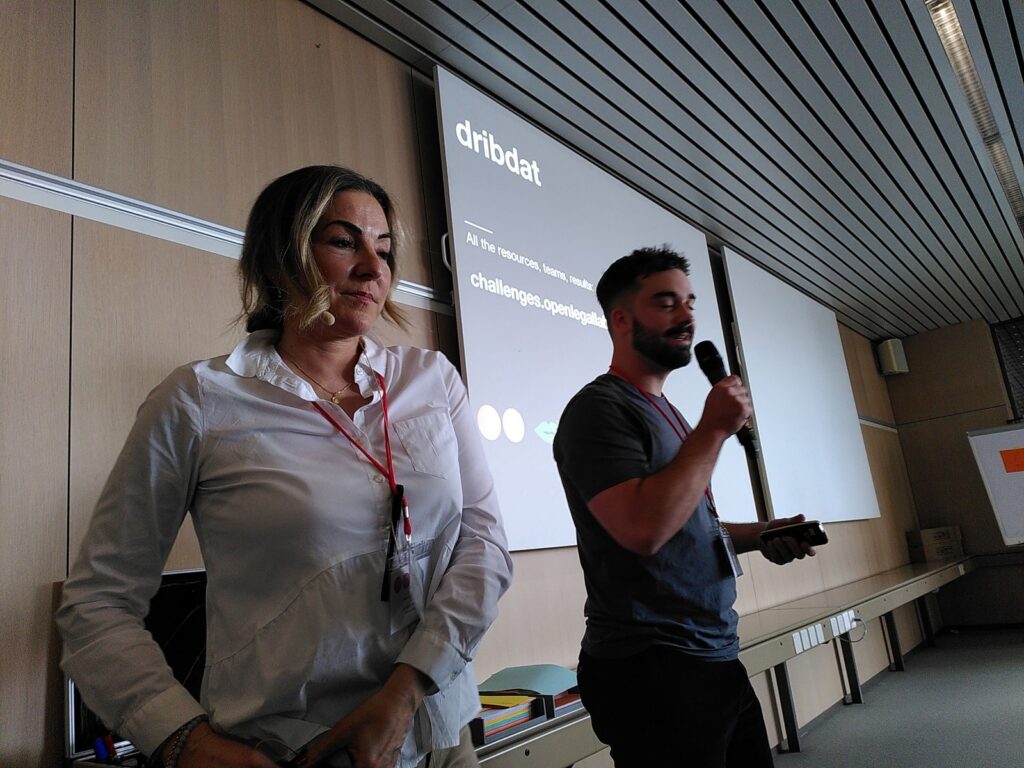
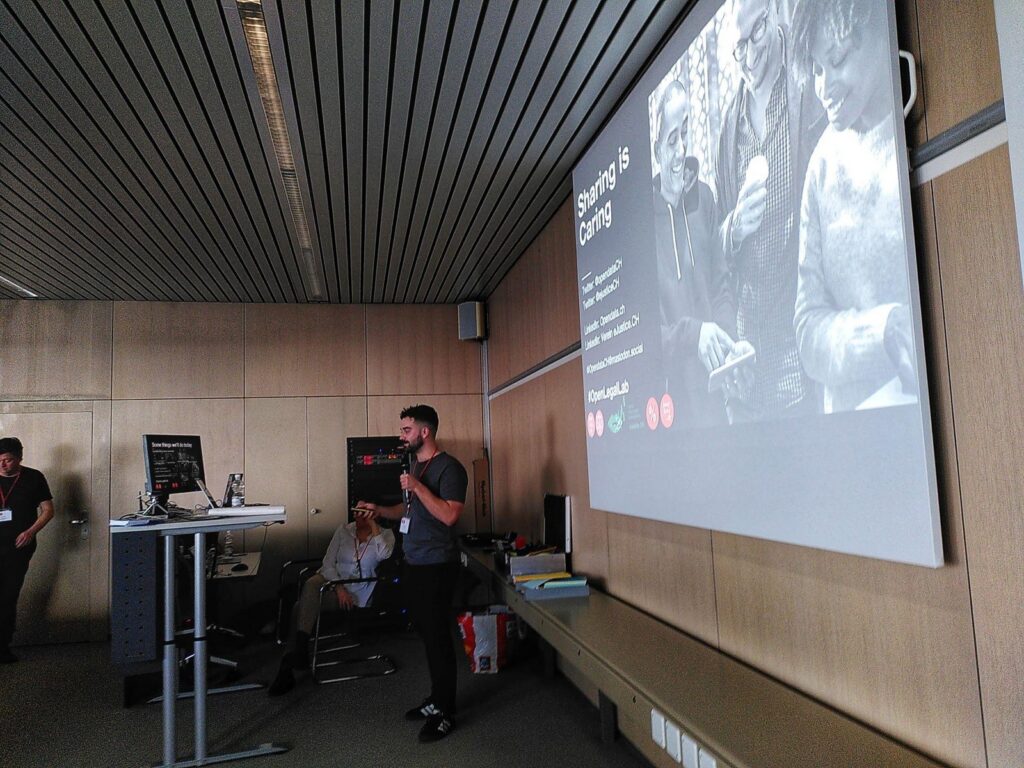
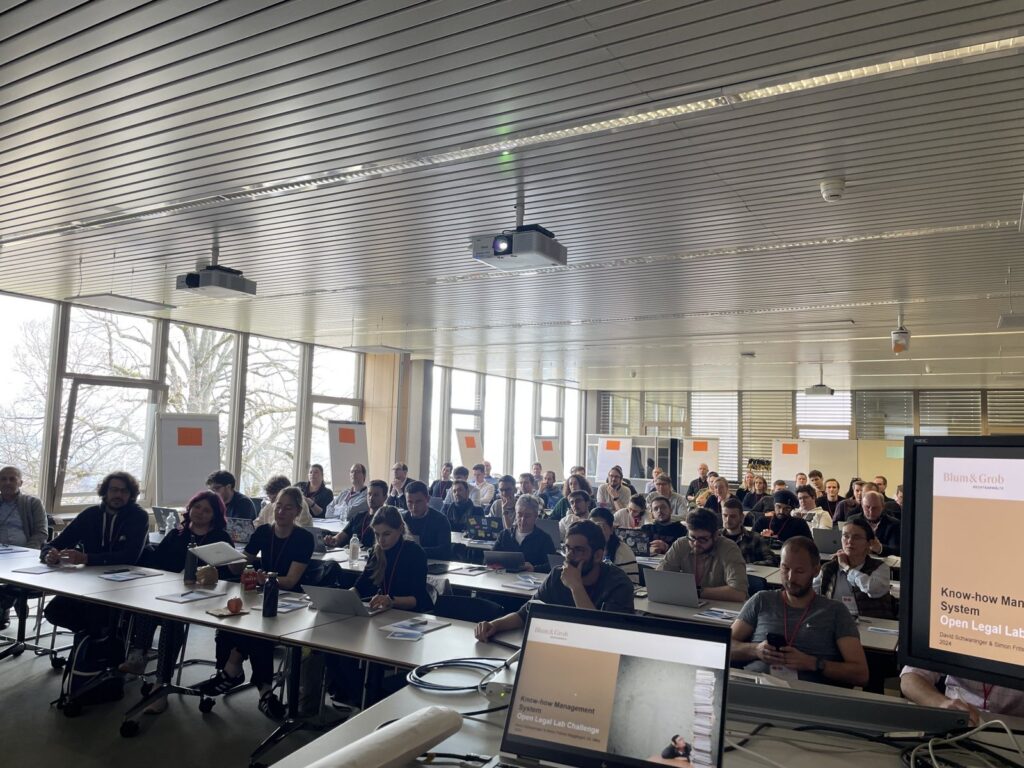
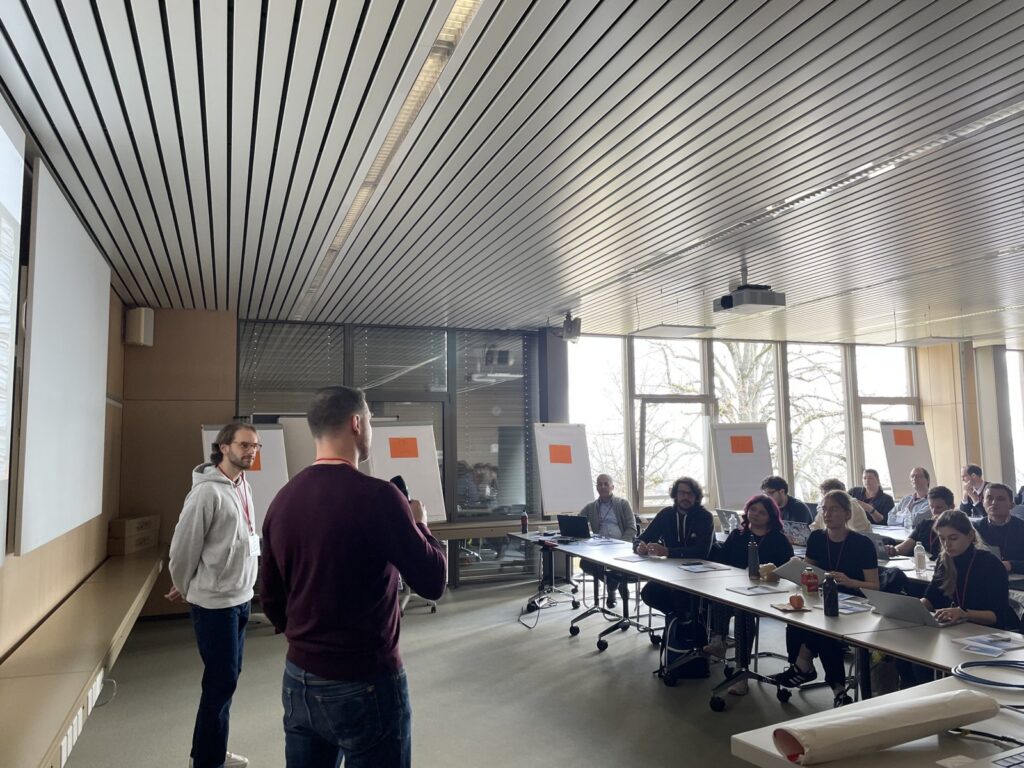

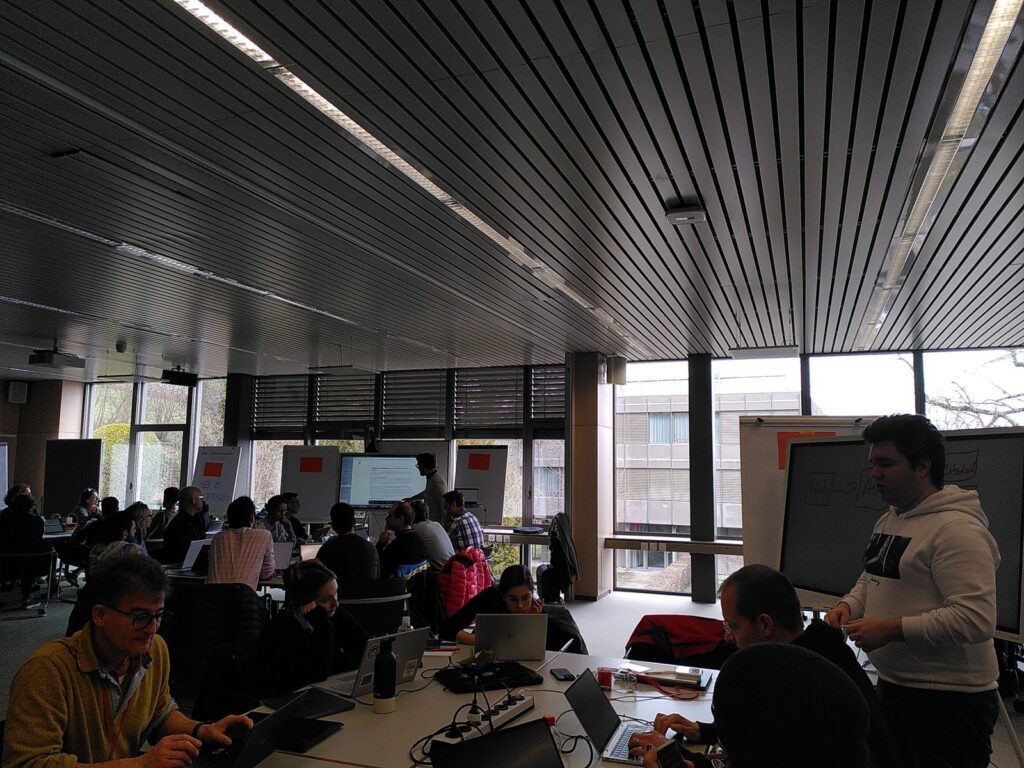
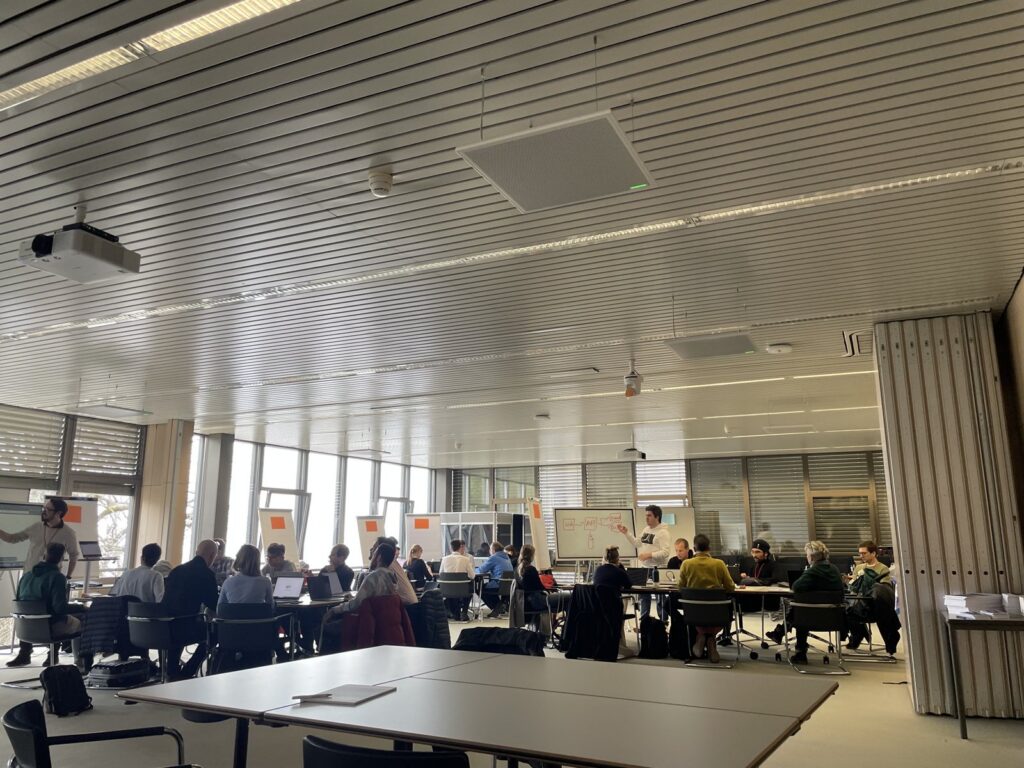
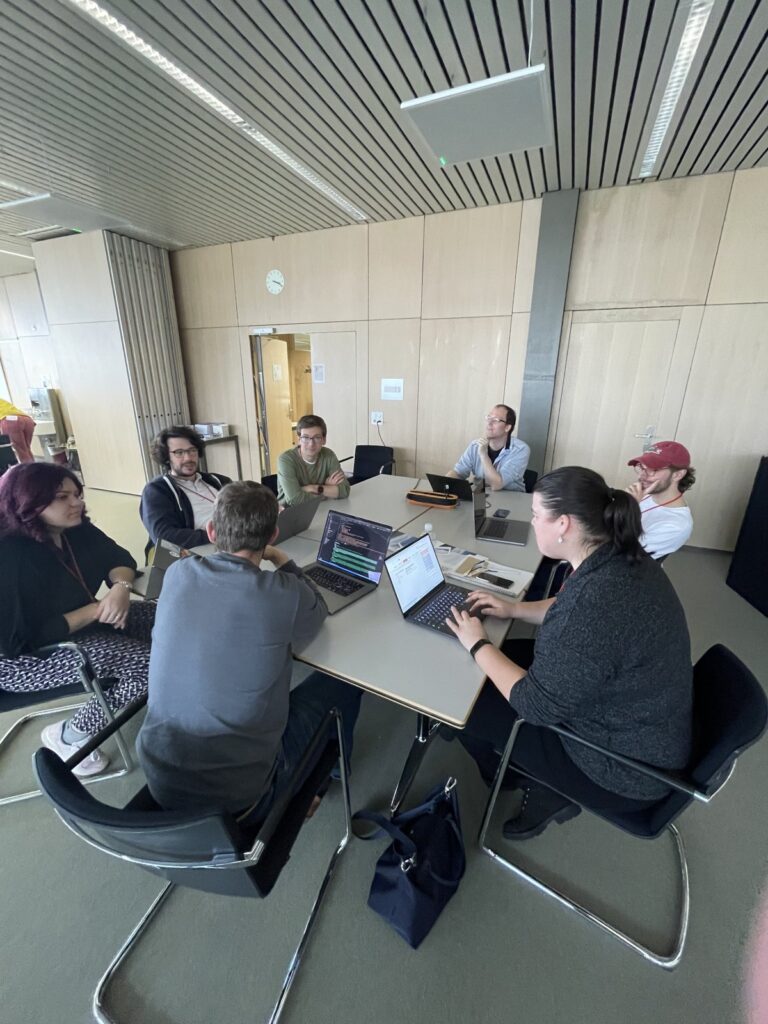
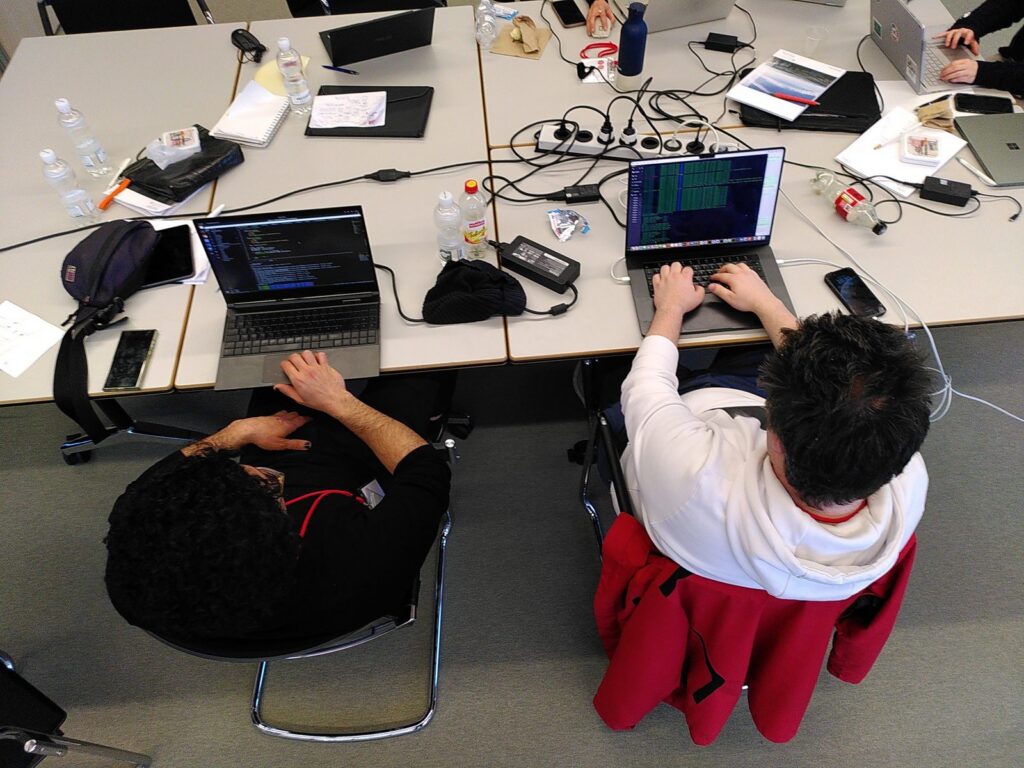

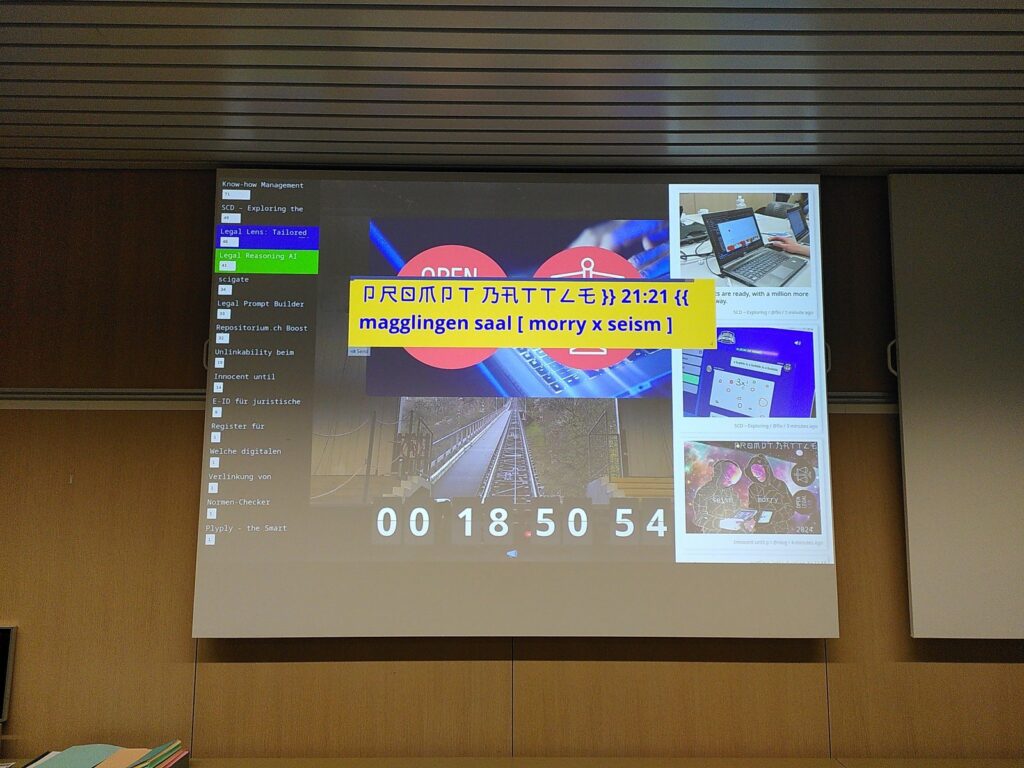
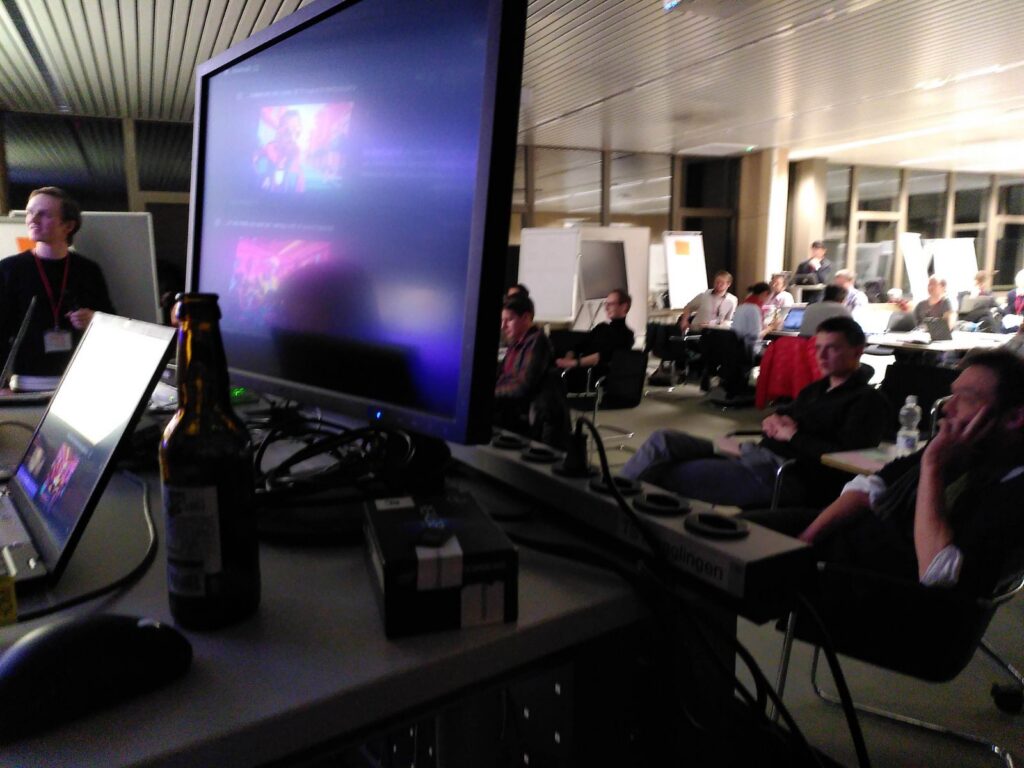
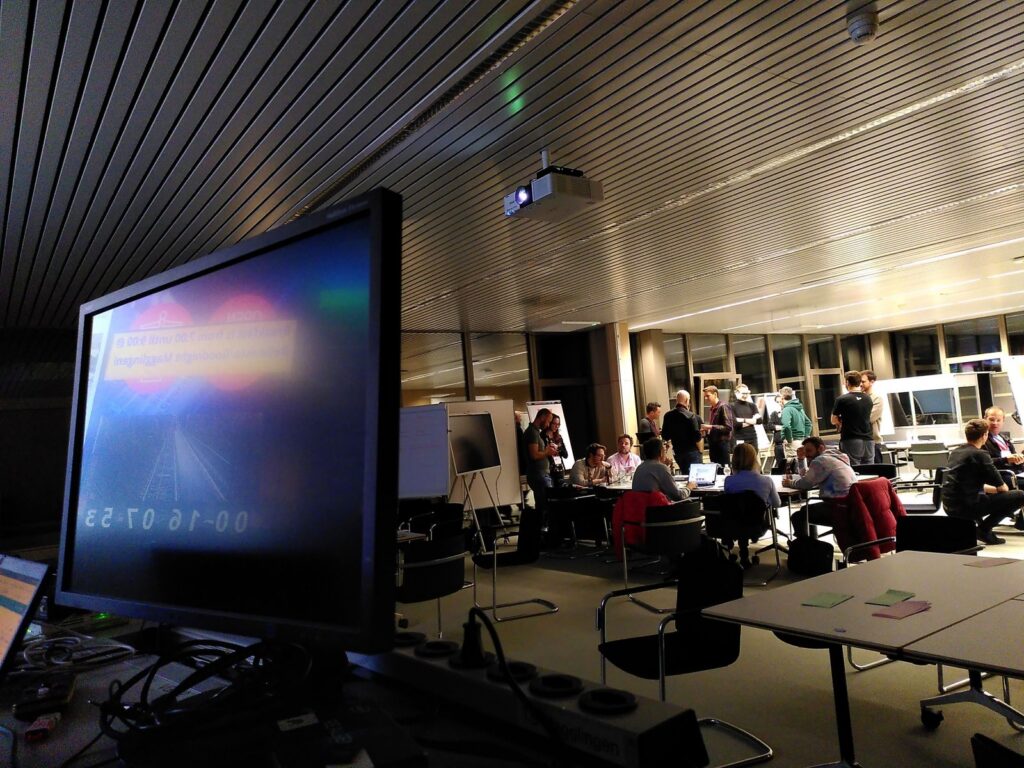


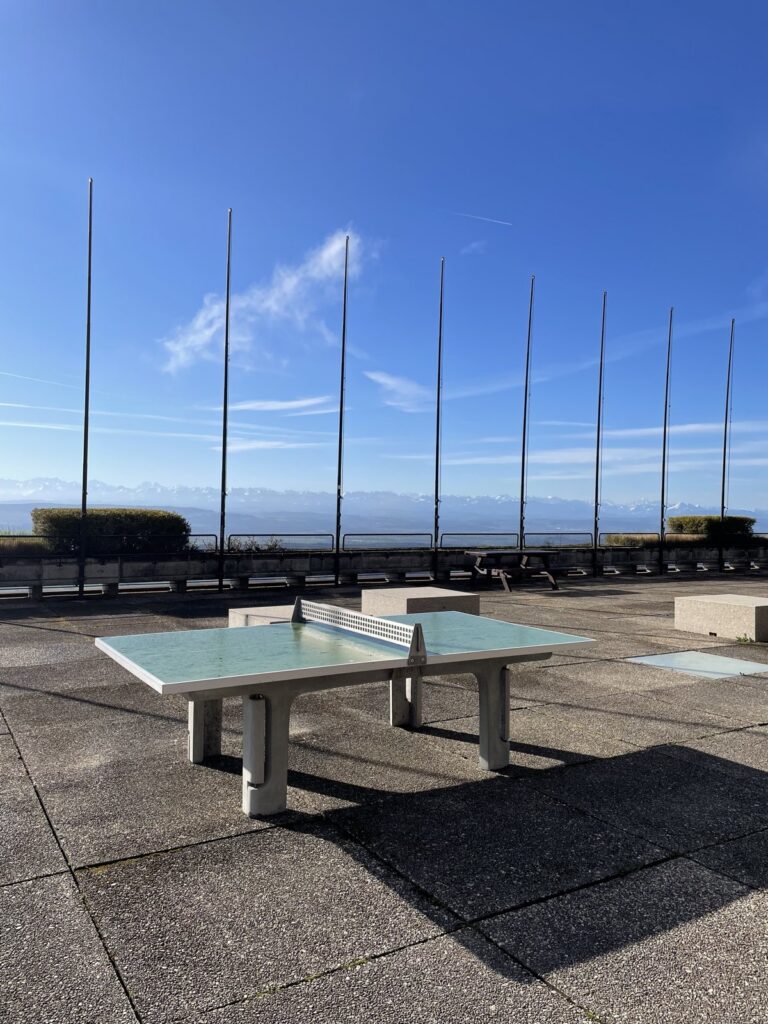
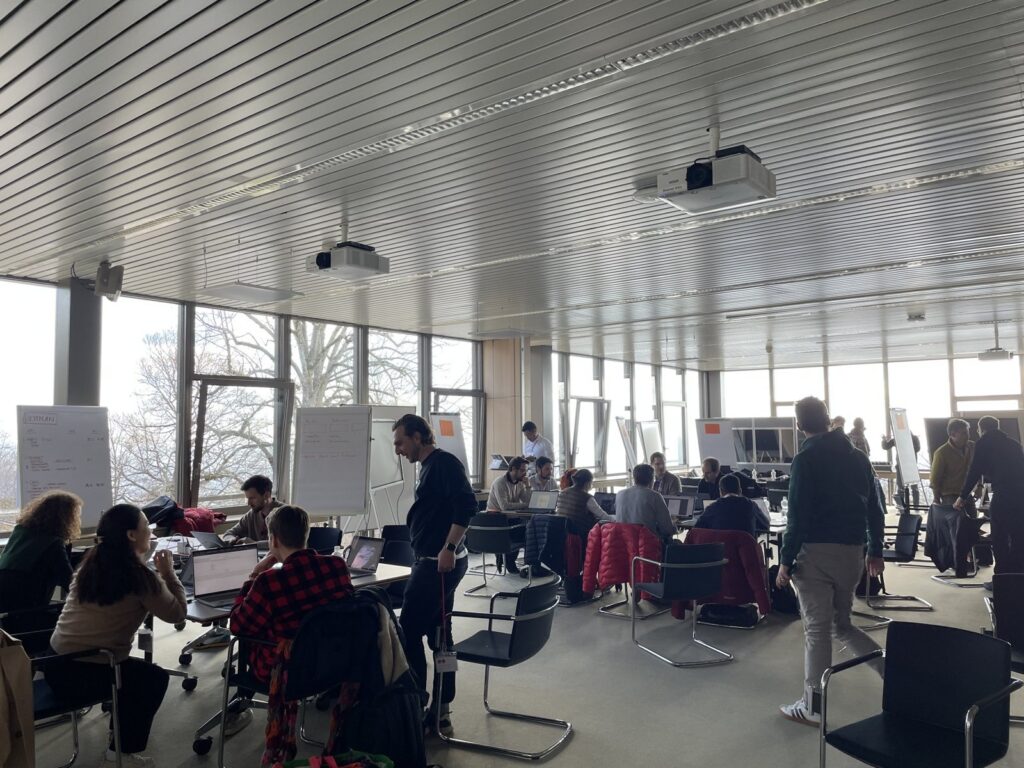
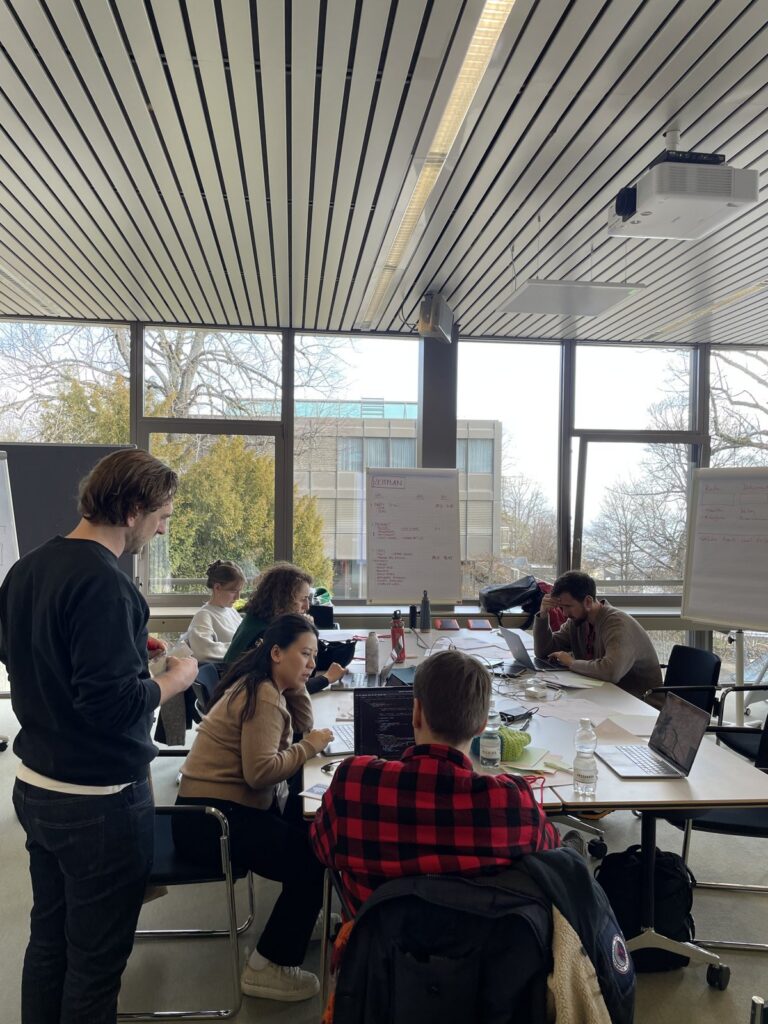
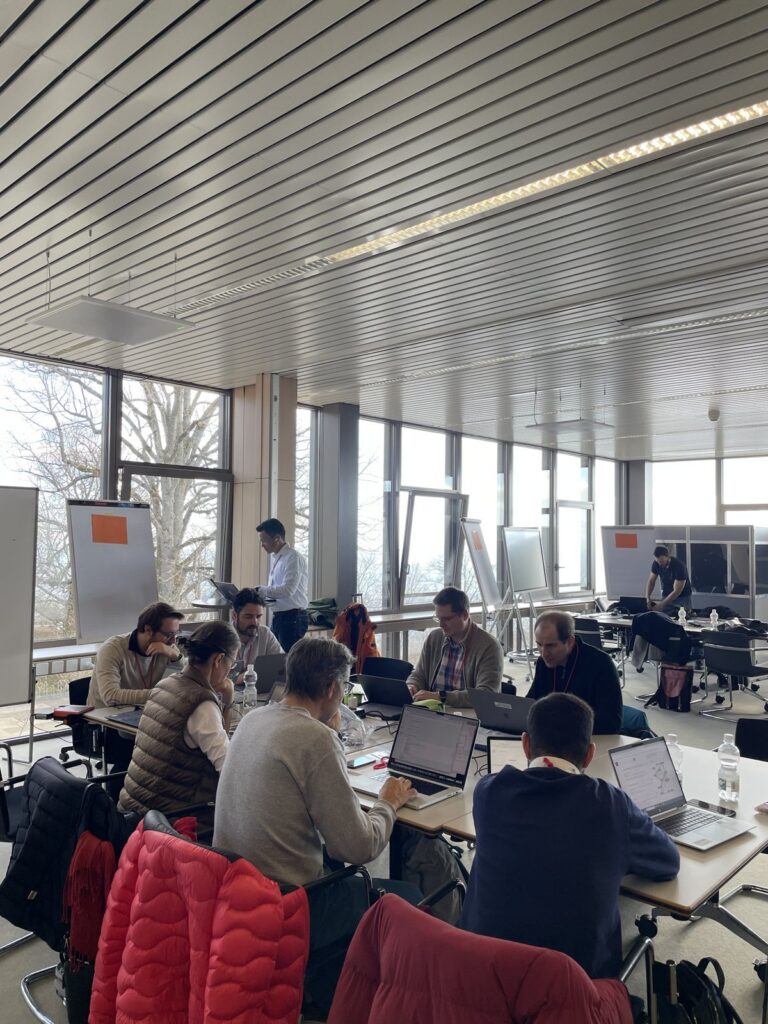
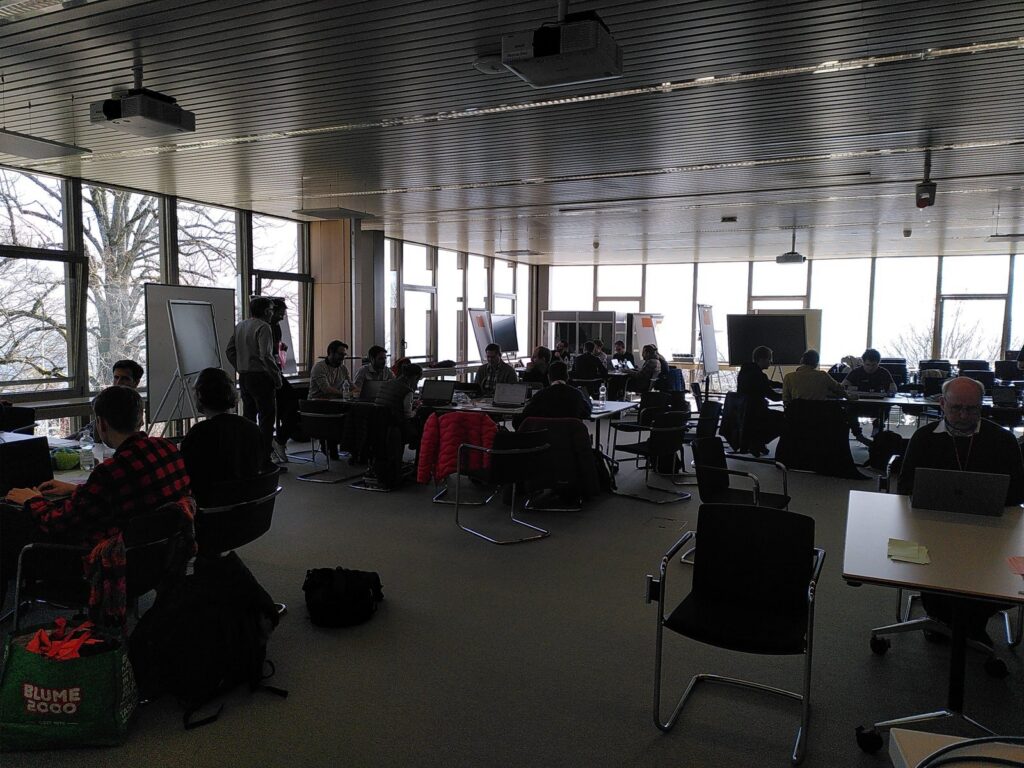
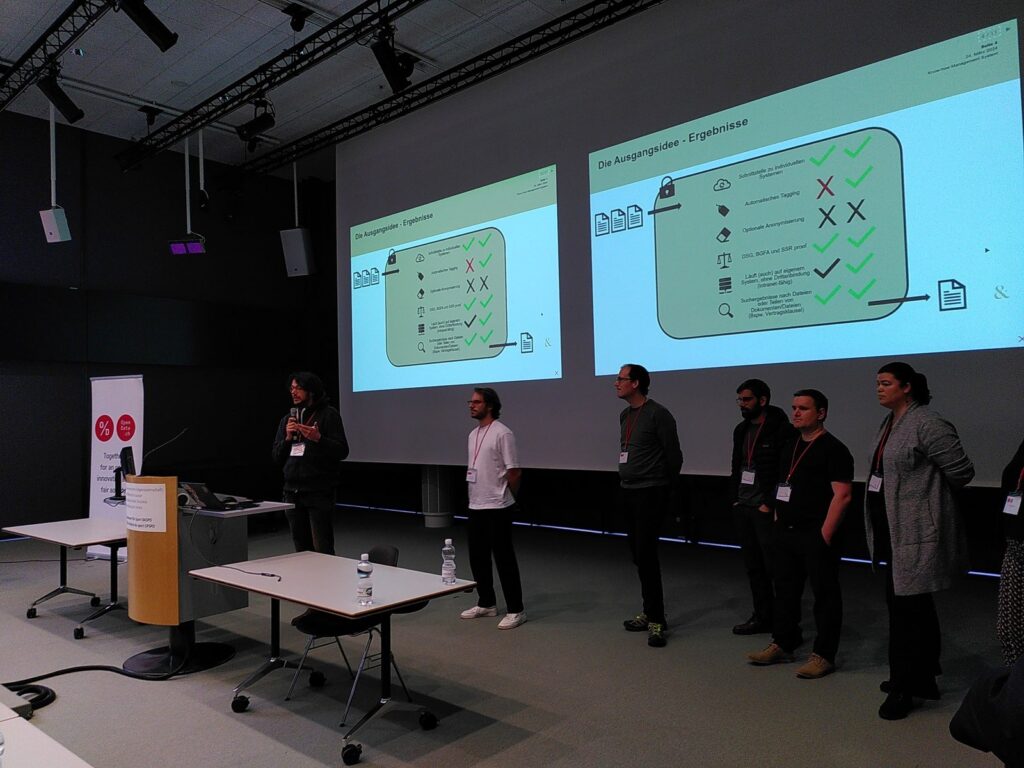
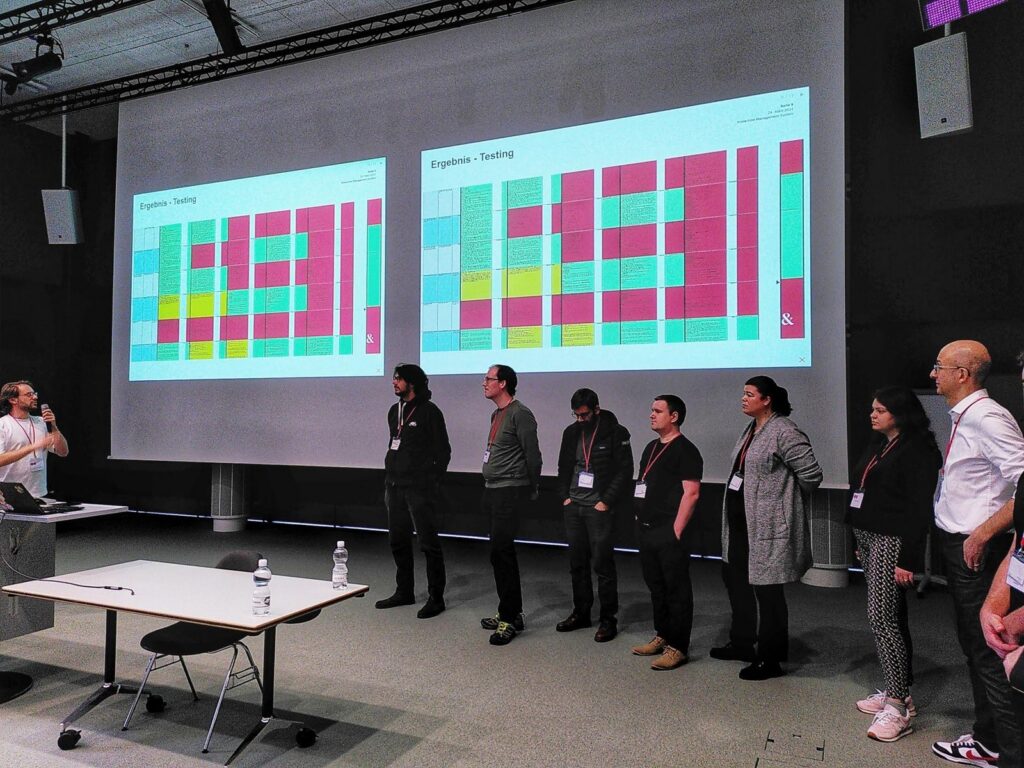
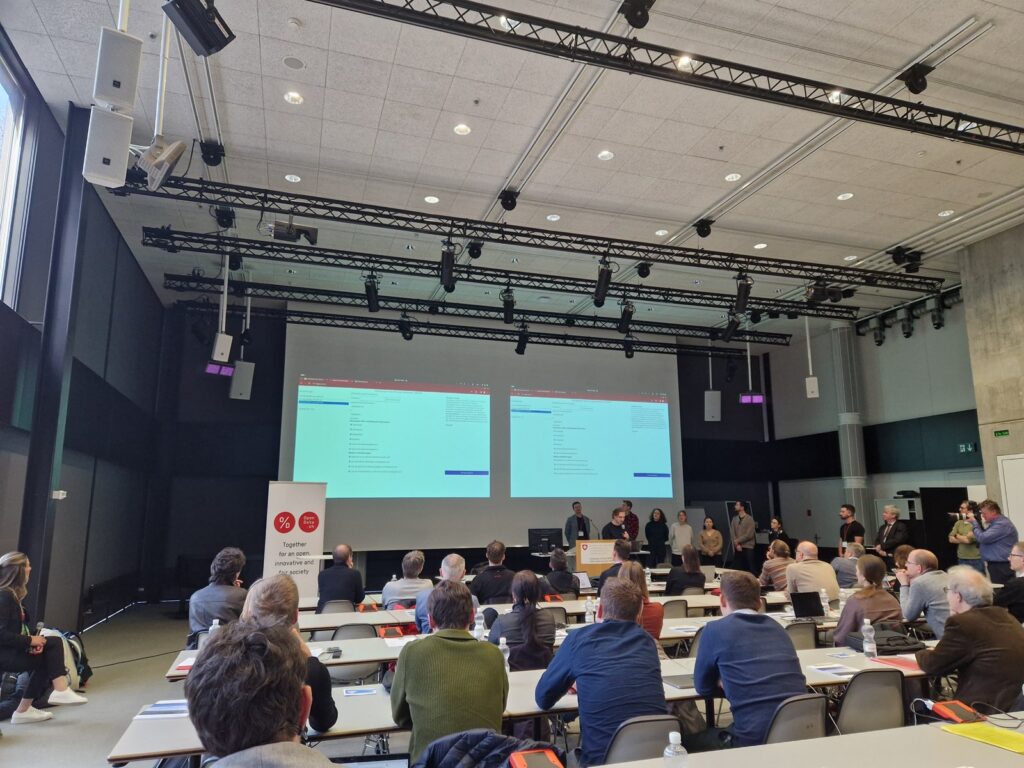
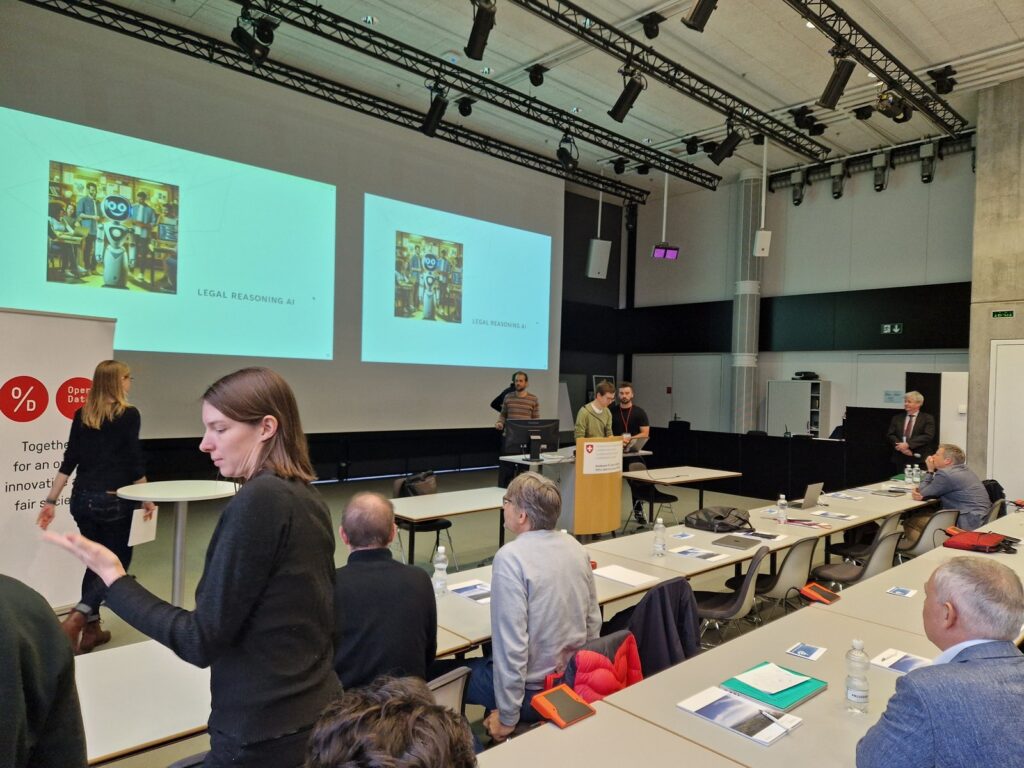
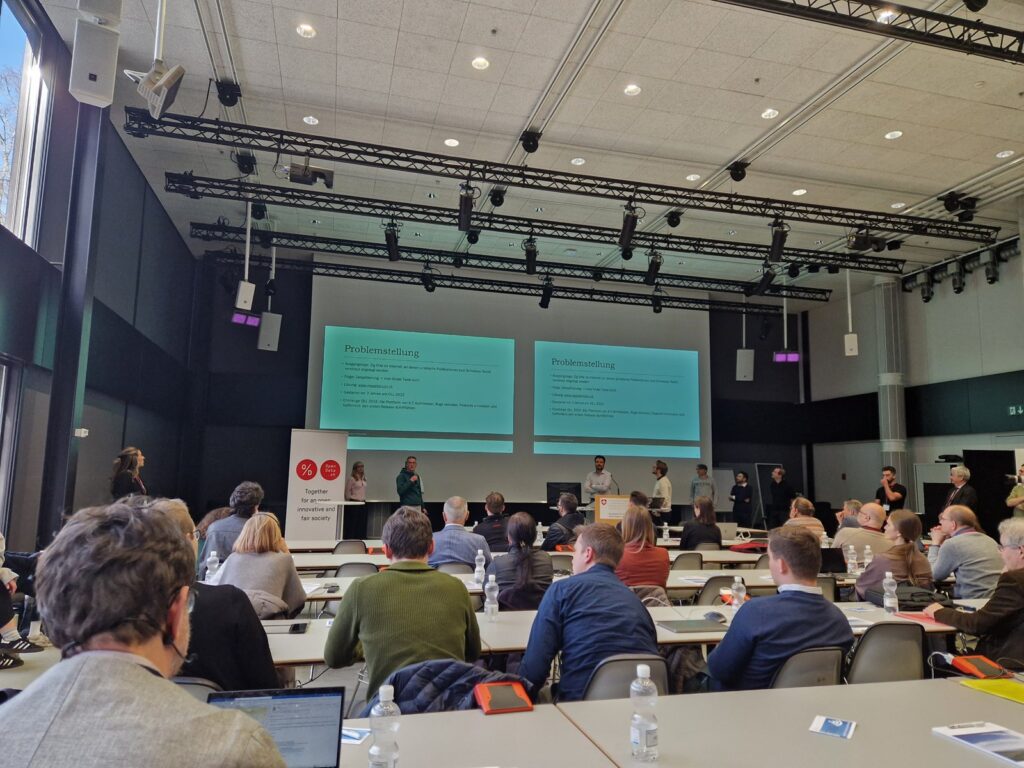
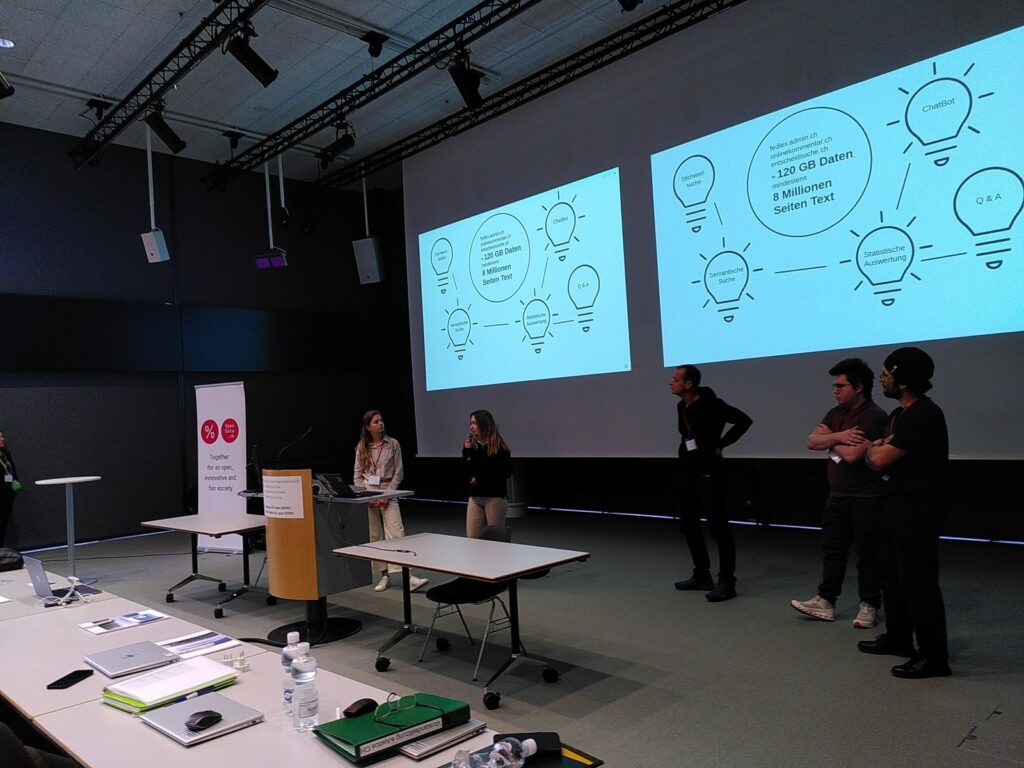
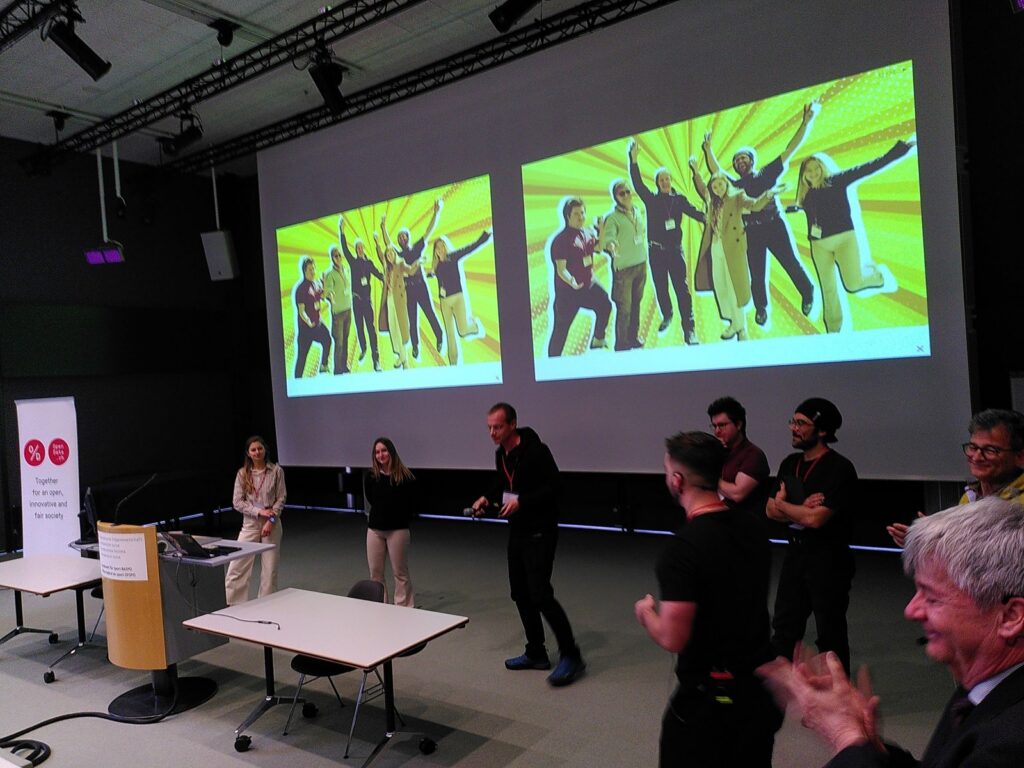
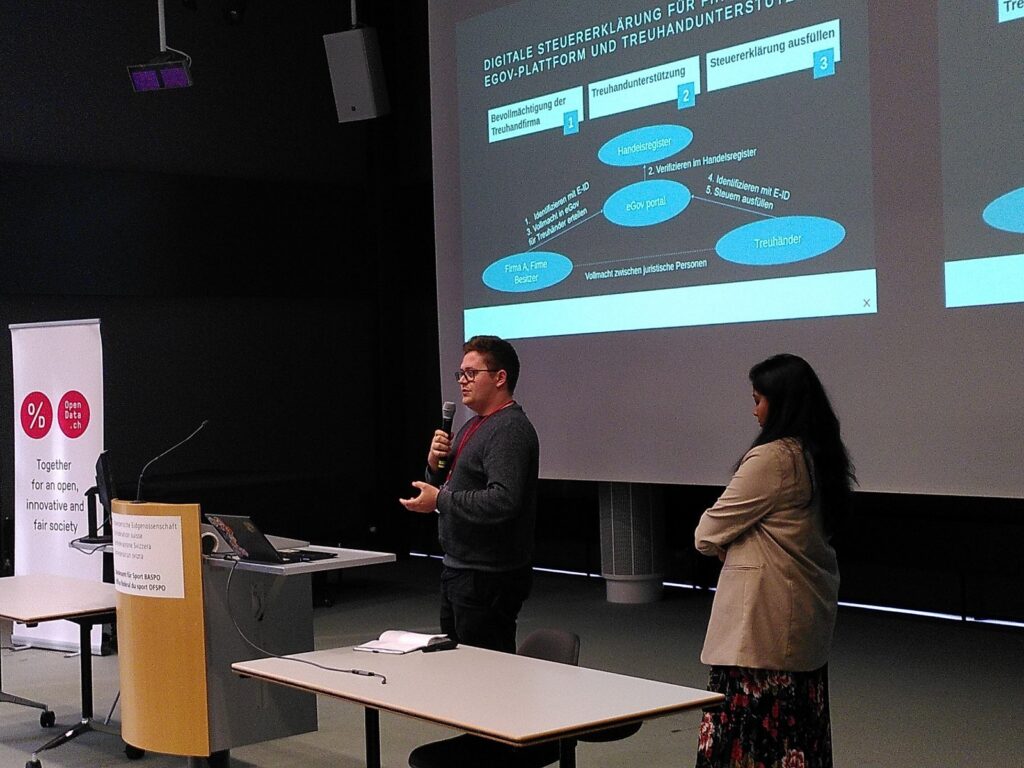
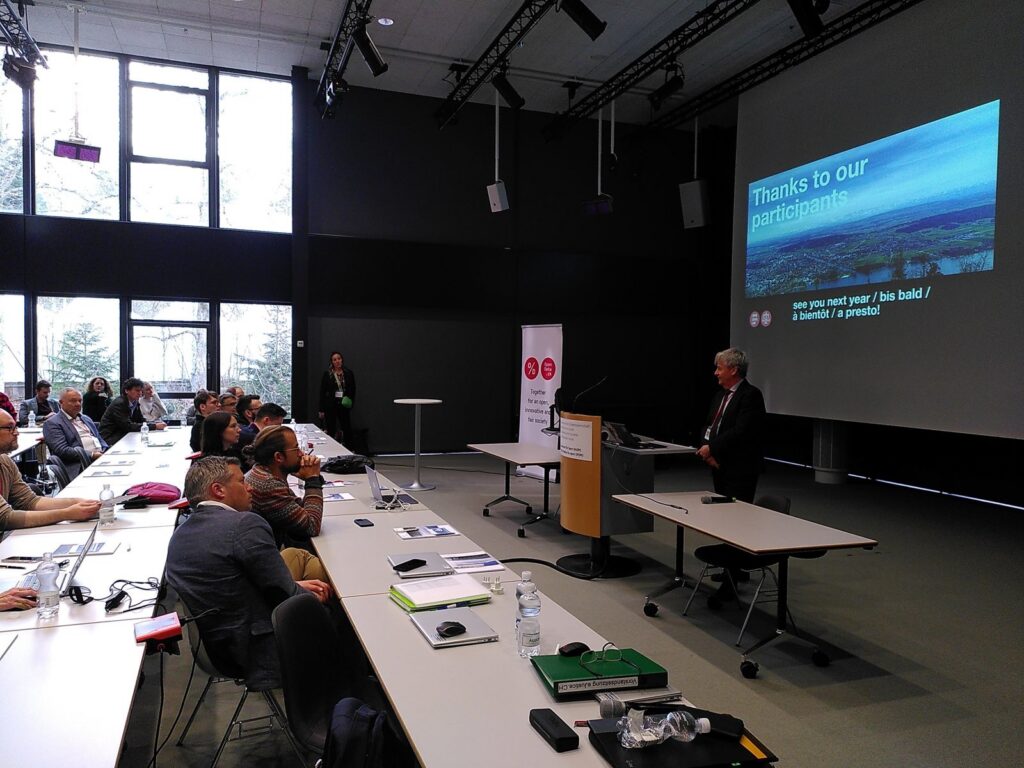
Foto: Oleg Lavrovsky, Gaston, Florin Hasler
Dokumentation und Aufzeichnungen
- Open Legal Lab 2024 – Präsentation der Challenges (SWITCHtube)
- Open Legal Lab 2024 – Präsentation der Ergebnisse (SWITCHtube)
- Open Legal Lab 2024 – Folien zur Eröffnung
- Open Legal Lab 2024 – Folien zum Abschluss
- Opendata.ch, Jahresbericht 2024 (S. 4: Open Legal Lab 2024)
Challenges
- Innocent until prompted guilty – Opendata.ch (Oleg Lavrovsky)
Drop the mic on your best prompts for litigation and legal work
Challenge-Beschrieb
There were several challenges at Open Legal Lab 2024 that were directly related to LLM, GPT and other A.I. techniques, and we believe all the teams used prompts in some ways during the hackathon. We created this page to discuss the general question of <strong>how do you learn to prompt?</strong> Also known as <a href="https://de.wikipedia.org/wiki/Prompt_Engineering">prompt engineering</a>, this is an emerging technical field that is being noticed by the legal community. We put this page up to collect prompt ideas from our participants, and if inspiration strikes you, there is an ☝️ <a href="https://pad.okfn.de/p/innocentuntilpromptedguilty">Etherpad here</a> into which you are welcome to drop your token burners.
<img src="https://s3.dribdat.cc/oll/b/1/E2OT3HZYSISZZP540TZ1MA43/Screenshot_from_20240325_002129.png" width="500" style="border:2px solid black">
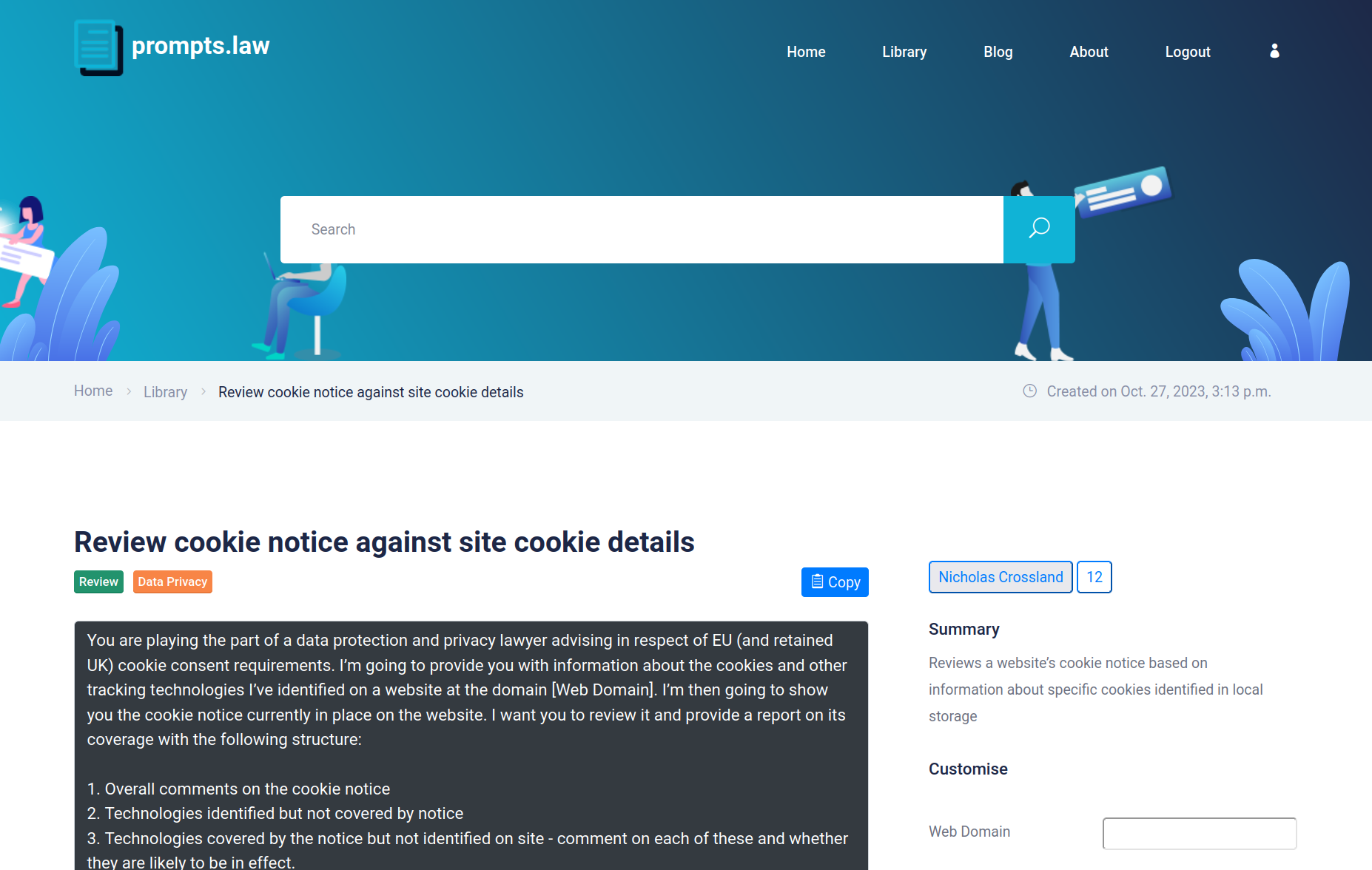
Then we discovered <a href="https://www.prompts.law/">prompts.law</a> - a website of "Prompts Written by the Legal Community" launched last November by a company in London. On their introductory <a href="https://www.prompts.law/blog/post/21/">blog post</a> you can read a few thoughts about this new playing field - and how they want to address it by crowdsourcing and ranking prompts useful for lawyers trying to use conversational agents in their work (we hope, while keeping their and their customers data safe!) We are collecting further links in our new guide for <a href="https://challenges.openlegallab.ch/project/109">prompting at Open Legal Labs</a>:
<a href="https://challenges.openlegallab.ch/project/109">https://challenges.openlegallab.ch/project/109</a>
<h1>Prompts and Copyright</h1>
As we run our hackathon, government juristictions (e.g. <a href="https://www.reuters.com/legal/tennessee-becomes-first-us-state-with-law-protecting-musicians-ai-2024-03-21/">Tennessee</a>) around the world are activating new legal measures in response to continued pressure from the creative and legal community.
We started working on a guide created at Open Legal Lab 2024 (<a href="http://openlegallab.ch">openlegallab.ch</a>) with assistance from NousResearch (Nous-Hermes-2-Mixtral-8x7B-DPO). In it we discuss copyright in the context of A.I. generated images is a complex and evolving area of law.
See also:
<ul>
<li><a href="https://github.com/filipecalegario/awesome-generative-ai?tab=readme-ov-file#ethics-philosophical-questions-and-discussions-about-generative-ai">Awesome Generative AI</a> (Filipe Calegario - GitHub)</li>
<li><a href="https://arxiv.org/abs/2402.17801">Generative AI and Copyright: A Dynamic Perspective</a> - Yang et al 2024</li>
<li><a href="https://academic.oup.com/jiplp/article/18/12/841/7331468?login=false"> Generative AI and copyright: principles, priorities and practicalities</a> - Lim 2023</li>
<li><a href="https://papers.ssrn.com/sol3/papers.cfm?abstract_id=4686751">Generative Artificial Intelligence: When Copyright, Innovation, and Equity Collide</a> - Wu 2024</li>
<li><a href="https://www.weforum.org/agenda/2024/01/cracking-the-code-generative-ai-and-intellectual-property/">WEF - Will copyright law enable or inhibit generative AI?</a> (Jan 13, 2024)</li>
</ul>
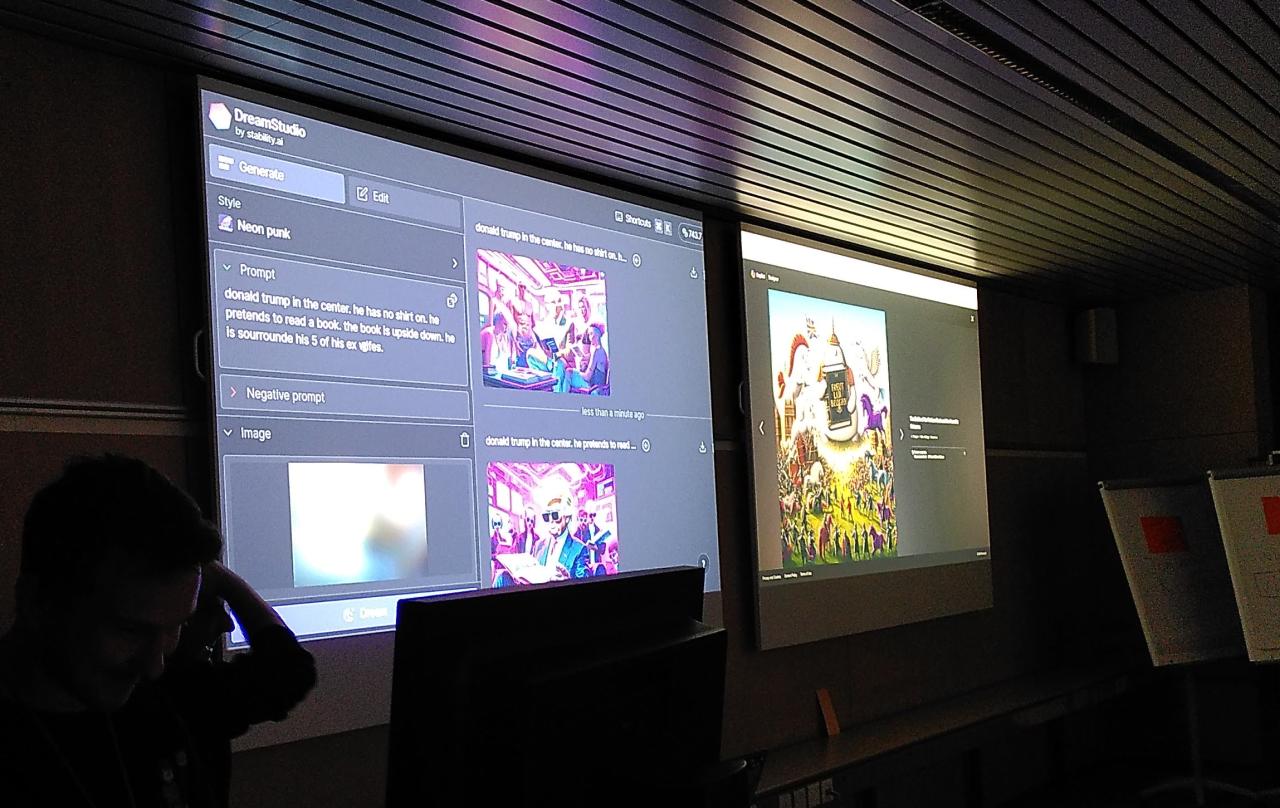
<h1>Prompt Battle</h1>As a late hour special, we took advantage of the dual-projector setup in Magglingen to run an (inofficial and very impromptu) <a href="https://promptbattle.com/">Prompt Battle</a> at Open Legal Lab 2024. This is a format of participative training in prompt writing with an entertaining / sports-like setup.
Two participants ("prompt artists") at a time competed for the attention and appreciation of the others using a prompt-based generative art process based on different models. The audience is asked to shout out three words: 1) a subject, 2) an action, 3) a consequence. The resulting models are voted on by the audience holding up a card (green and pink, in our case) after 3 minutes. The one with less votes after 3 rounds was asked to leave the stage, and be replaced with another participant.
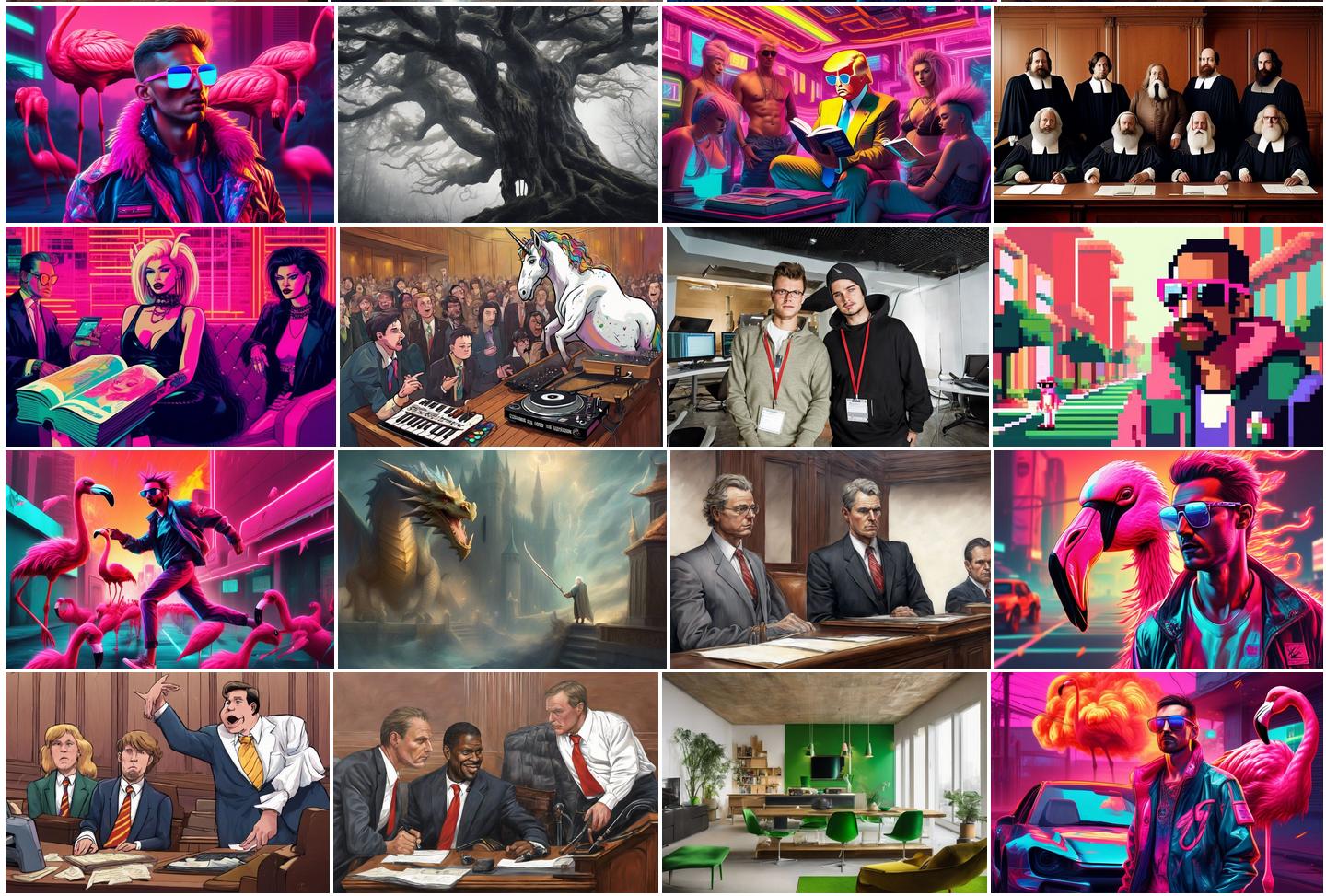
The photos/videos (CC BY-NC-SA 4.0 Oleg) and result generations are <strong><a href="https://proxeus.glarner.cloud/apps/photos/public/8c1BAz91s8nBeh3YGSD7w7Dp6O2Boo5l">available here as gallery</a></strong>.
<a href="https://proxeus.glarner.cloud/apps/photos/public/8c1BAz91s8nBeh3YGSD7w7Dp6O2Boo5l"><img src="https://s3.dribdat.cc/oll/b/1/Z8NPBOJDV9ECSTHKLV2E9JMB/IMG_20240324_215326.jpg" alt="IMG 20240324 215326.jpg" /></a>
<a href="https://proxeus.glarner.cloud/apps/photos/public/8c1BAz91s8nBeh3YGSD7w7Dp6O2Boo5l"><img src="https://s3.dribdat.cc/oll/b/1/0HS3TQDMDE0Z3ZH4GGW6HRGT/Screenshot_from_20240325_000440.jpg" alt="Screenshot from 20240325 000440.jpg" /></a><em>Thanks to everyone for supporting our A.I. experiment/late-night experience! Check out <a href="https://promptbattlebern.ch/">Prompt Battle Bern</a> and <a href="https://hek.ch/programm/veranstaltungen/prompt-battle-2">HeK in Basel</a> ...</em>
- Know-how Management System
- Legal Lens: Tailored Case Notification 🖥️🔍
"Legal Lens" provides a customized online service where lawyers can sign up to get updates about new court decisions that are relevant to th
TimothyChallenge-Beschrieb
<h3><strong>Challenge Description</strong></h3>
Keeping up to date with the latest court rulings is an important task for lawyers who specialise in various fields. "Legal Lens" aims to simplify this process through an innovative online platform. This platform allows lawyers to register their specific topics of interest and receive customised updates on new court rulings that match their topics. By utilising semantic and keyword search technologies, the platform will ensure that lawyers have the insights they need at their fingertips to be better prepared for the changing legal landscape.
Our goal is to create a proof of concept (PoC) that tests the viability of this idea, uncovers potential technical challenges and demonstrates the clear benefits for lawyers.
<hr />
<h4><strong>Goals</strong>🎯🛠️</h4><strong>Moonshot 🌚</strong>We want to build a platform that automatically indexes new court cases, allows lawyers to register their interests and matches these interests with new judgements using semantic and keyword analyses. The result? Personalised email updates for lawyers, making it easier for them to stay up to date and respond to relevant legal changes.Realistic goal:
<strong>Realistic 👽</strong> We focus on developing a simple customer journey, testing the reliablitly of matching interests with court judgements, clarifying initial privacy issues, highlighting the benefits of the platform and designing an email notification system.
<hr />
<h4><strong>User story 👨🏻💻</strong>👩🏽💻</h4>Alessandra, a civil rights lawyer specialising in immigration and asylum cases, used to rely on reading quarterly magazines to keep up to date. After signing up for Legal Lens and selecting her interests, particularly asylum for women activists from Southeast Asia, she now receives instant email alerts about new judgements. This means she is always informed in real time and can improve her strategy and efficiency. Alessandra no longer has to trawl through magazines and can now respond more quickly to her clients.
<hr />
<h5><strong>Organization</strong> 🚀👨⚖️</h5>Our challenge is all about team and exploration! We are calling on everyone - from legal professionals (students, lawyers or judges 😉) to technical whizzes in the fields of data science, UX/UI and devs. to heroes from public administration and court staff.
- Legal Prompt Builder
Lasst uns Juristen dabei helfen, die bestmöglichen Prompts zu erstellen, um durch gute Antworten von LLMs ihre Produktivität zu steigern.
Jan NicklausChallenge-Beschrieb
<h1>LegalPrompts - Prompt Builder für Juristinnen und Juristen</h1>
<h2>Was ist das Problem?</h2>Grosse Sprachmodelle wie ChatGPT erobern die Arbeitswelt. Es gibt inzwischen zahlreiche Modelle mit unterschiedlichen Vor- und Nachteilen. Dazu gehören:
<ul>
<li>Kann das Modell im Internet nach aktuellen Daten suchen oder ist es auf seine Trainingsdaten beschränkt?</li>
<li>Kontextlänge: Wie viele Wörter kann ich in die Anfrage eingeben?</li>
<li>Sprachfähigkeiten: Wie gut performt das Modell in anderen Sprachen als Englisch?</li>
</ul>Es ist schwierig, hier den Überblick zu behalten und die Anfragen dem jeweiligen Modell anzupassen. Aber auch ganz generell helfen Sprachmodelle bei einfachen Anfragen wie «Fasse mir BGE 149 V 57 zusammen» kaum weiter, weil die Antworten oft nicht die relevanten Aspekte aufgreifen oder sogar Erwägungen und Sachverhalte erfinden (sog. Halluzinationen).
<h2>Wie hilft ein Prompt Builder?</h2>
Zu der Frage, wie man eine Anfrage an ein Sprachmodell formuliert, um eine bestmögliche Antwort zu erhalten, gibt es bereits viele Leitfäden, wissenschaftliche Dossiers und Seminare. Für Juristinnen und Juristen wäre es jedoch ein erheblicher Aufwand, sich die Kunst des «Prompt Engineering» von Grund auf anzueignen. Hinzu kommt, dass der Prompt in jedem Einzelfall formuliert werden und zusammengesetzt, ggf. auch Dokumente in den Prompt kopiert werden müsste. Diese Arbeit kann stark vereinfacht werden durch einen Prompt Builder, also ein Tool, das den User an die Hand nimmt, anhand von Fragen wichtige Bestandteile des Prompts ermittelt und einen Prompt zusammensetzt. Ausserdem kann der Prompt Builder den Prompt auf die Anforderungen einzelner Sprachmodelle zuschneiden, beispielsweise darauf hinweisen, dass das frei verfügbare ChatGPT 3.5 keinen Links folgen kann. Mit Quality of Life Features wie der automatischen Einbindung von Entscheiden kann ein auf das Schweizer Recht zugeschnittener Prompt Builder viel Zeit sparen und erlaubt es Juristinnen und Juristen, sich auf ihre eigentliche Arbeit zu konzentrieren.
<h2>Wer kann bei der Challenge mitwirken?</h2>
Alle Teilnehmenden sind herzlich eingeladen. Gerade Juristinnen und Juristen können hier sehr weiterhelfen, weil das Tool die in der Praxis tatsächlich anfallenden Aufgaben lösen soll. Die technische Umsetzung soll in JavaScript und ggf. Python erfolgen.
<h2>Weitere Informationen</h2>
<script src="//cdn.jsdelivr.net/github-cards/latest/widget.js"></script>
Nachfragen gern auf GitHub oder LinkedIn!
- Legal Reasoning AI
The mission of this project is to develop an AI agent capable of performing legal reasoning within the Swiss private law ecosystem. Imagine
Challenge-Beschrieb
<a href="https://s3.dribdat.cc/oll/b/129/0QM5GIW54U5K2XUMAO73Y93Z/Open_Legal_Lab__Legal_Reasoning_AI_Challenge.pdf">Open Legal Lab Legal Reasoning AI Challenge.pdf</a>
- Normen-Checker – Peter Nejkov
Prüft auf Abweichungen zwischen Gesetzestext und Wiedergabe im Urteil
Challenge-Beschrieb
<a href="https://s3.dribdat.cc/oll/b/135/9X6Q5YKI0SZ0X59TTS26UKN0/240321_Hackathon_Challenge__NormenChecker.pdf">240321 Hackathon Challenge NormenChecker.pdf</a>
- Plyply - the Smart Compliance-Tool – Mark Drenhaus
Aufbau eines Compliance-tools, das als Copilot organisationsintern verwendet kann (und auf die Bedürfnisse der Orga. abgestimmt werden kann.
Challenge-Beschrieb
The idea of ai as a co-pilot is gaining ground, and so the questino is: can we design a co-pilot that helps us through the compliance-jungle?
Ideally, the challenge would find a very specific compliance theme to find out more about what the requirements for such a compliance bot would be. - Register für wirtschaftlich Berechtigte BOR – Damaris Jeker Ngoy
Was ist möglich mit OGD und BODS?
Challenge-Beschrieb
Die Schweiz ist einer der wichtigsten Finanzplätze der Welt und nimmt insbesondere bei der grenzüberschreitenden Vermögensverwaltung den ersten Platz ein. Geldwäsche und Terrorismusfinanzierung stellen jedoch eine ernsthafte Bedrohung für die Integrität des Finanzplatzes und die Stabilität des Finanzsystems dar; sie gefährden die Sicherheit und die Wirtschaft des Landes.
Der Bundesrat hat die Verwaltung mit der Erarbeitung einer Gesetzesvorlage zur erhöhten Transparenz und erleichterten Identifikation der wirtschaftlich Berechtigten von juristischen Personen beauftragt. Er will so die Prävention und die Strafverfolgung im Bereich der Finanzkriminalität und damit die Integrität und Reputation des Finanzplatzes und Wirtschaftsstandorts stärken.
Der schnelle und effiziente Zugang zu diesen Informationen ist von entscheidender Bedeutung, sei es bei der Bekämpfung der Geldwäsche, der Finanzkriminalität oder im Zusammenhang mit der Durchsetzung von Sanktionen. Zu diesem Zweck soll ein eidgenössisches Register der wirtschaftlich Berechtigten von juristischen Personen geschaffen werden. Im Register werden Informationen über die wirtschaftlichen Berechtigte von juristischen Personen bzw. Schweizer Unternehmen sowie von bestimmten Kategorien ausländischer Unternehmen, gesammelt.
<a href="https://www.openownership.org/de/">Open Ownership</a> bietet einen Datenstandard zur Erfassung von wirtschaftlich Berechtigten und Unternehmen an und stellt auf diesem basierend auch ein öffentliches Beneficial Owner Register <a href="https://register.openownership.org/">BOR</a> mit weltweiten Daten zur Verfügung. In dieser Challenge möchten wir testen, ob und welche aufschlussreichen Analysen und Strukturen sich mit diesem Datenmodell und den Daten machen lassen und ob wir dieses Modell auch für CH-Verhältnisse nutzen können.
Der <a href="https://standard.openownership.org/en/0.3.0/index.html">Beneficial Ownership Data Standard</a> BODS gibt, mit Identifikatoren und Details zu natürlichen und juristischen Personen, Arten und Ebenen der Beteiligung an Unternehmen, Informationen zur Provenienz, Historisierung und Platzhaltern, wenn Informationen unlesbar gemacht werden sollen sowie einer Liste von technischen Anforderungen für den Registerbau. Der Datastandard ist auf Github unter der <a href="https://www.apache.org/licenses/LICENSE-2.0">Apache Licence Version</a> 2.0 publiziert: <a href="https://github.com/openownership/data-standard/">GitHub - openownership/data-standard: An open standard for representing beneficial ownership and control, developed by Open Ownership in partnership with Open Data Services.</a>
Der Beneficial Ownership Data Standard (BODS) bietet ein strukturiertes Datenformat sowie Leitlinien für die Erhebung, den Austausch und die Nutzung von Daten über wirtschaftliches Eigentum. Dabei beschreibt das Datenschema auch wie und welche Daten ausgetauscht werden sollten. Das <a href="https://www.openownership.org/en/publications/beneficial-ownership-visualisation-system/">Beneficial Ownership Visualisation System BOVS</a> soll Besitzstrukturen so klar wie möglich visualisieren.
BODS wird von <a href="https://www.openownership.org/de/">Open Ownership</a>, einer gemeinnützigen Organisation, die sich für die Transparenz des wirtschaftlichen Eigentums einsetzt, in Zusammenarbeit mit <a href="https://opendataservices.coop/">Open Data Services</a> entwickelt und von einer <a href="https://standard.openownership.org/en/latest/about/governance.html#membership-term-and-role">Arbeitsgruppe für offene Datenstandards</a> zusätzlich unterstützt. - Repositorium.ch Boost 🚀 – Colin Carter
Vor genau zwei Jahren startete das Repositorium.ch Projekt am Open Legal Lab 2022. Nun sind wir so gut wie fertig. Es fehlen noch ein paar l
Challenge-Beschrieb
Vor zwei Jahren startete das Projekt <a href="http://Repositorium.ch">Repositorium.ch</a> am OpenLegalLab 2022 (zur damaligen Challenge: <a href="https://challenges.openlegallab.ch/project/57">https://challenges.openlegallab.ch/project/57</a>).
Nach einer kompletten Überarbeitung der Software ist die Plattform nun so gut wie fertig. Es fehlen noch ein paar letzte Anpassungen und vor allem muss die Plattform noch einmal gründlich durchgetestet werden. Und dafür brauchen wir dich!
Weitere Informationen rund um <a href="http://Repositorium.ch">Repositorium.ch</a> findest Du auf der Webseite <a href="https://repositorium.ch/">https://repositorium.ch/</a>
<h2>Die Grundidee: Gemacht für einen freien juristischen Diskurs</h2>
Der rechtliche Diskurs wird neben der Rechtswissenschaft zu einem grossen Teil durch Praktikerinnen geprägt, die oftmals keinen direkten Zugriff auf die bestehenden Repositorien der Hochschulen haben. Sie veröffentlichen ihre Beiträge daher oft über Verlage, welche die Beiträge hinter paywalls abschotten, bauen eine eigene Infrastruktur auf (Kanzlei-Newsletter, Blogs) oder nutzen die sozialen Medien oder weitere Plattformen. Zugleich zeichnet sich die bestehende Repositorienlandschaft durch eine starke Zersplitterung aus: Jede Universität und Fachhochschule verfügt über ein eigenes institutionelles Repositorium, das Zugriff auf die Forschungsergebnisse der jeweiligen Institution gewährt, ohne aber auf die spezifischen Bedürfnisse der Juristinnen einzugehen.
Viele Texte zum Schweizer Recht sind damit zwar irgendwo im Internet frei zugänglich, man findet sie aber (innert nützlicher Frist) nicht. Denn es fehlt an einer zentralen (d.h. schweizweiten und institutionsübergreifenden), fachspezifischen, frei und kostenlos zugänglichen Datenbank, um das brachliegende Potential der frei verfügbaren juristischen Texte zu nutzen. Das <a href="http://Repositorium.ch">Repositorium.ch</a> schliesst diese Lücke.
- SCD – Exploring the Federal Supreme Court 🏛 – Florian Geering
Let's find new ways for anyone to analyse data on judgments by the Swiss Federal Supreme Court! 📊
Challenge-Beschrieb
<a href="https://bubbles.legaldata.ch/">https://bubbles.legaldata.ch/</a>
<strong>The Data:</strong> The <strong><a href="https://zenodo.org/record/7793043">Swiss Federal Supreme Court Dataset (SCD)</a></strong> is the largest open-access dataset on Swiss judgments, with 31 variables documenting all 120,368 Federal Supreme Court judgments between 2007 and 2023.
🔥 It is available in its <strong>fifth edition</strong> already, and now also includes the raw text of all judgments.With this challenge, we want to <strong>explore new ways to enable anyone to interact with this rich data</strong>, even if they have zero prior programming knowledge.
<strong>At <a href="https://challenges.openlegallab.ch/project/82">last year's</a> Open Legal Lab</strong>, we designed and released the <a href="https://scdv.legaldata.ch/">SCD Viewer</a>, a <a href="https://shiny.posit.co/">Shiny</a> webapp which lets users interact with the data on Swiss Federal Supreme Court judgments and run simple analyses themselves.
<strong>Can we go further this year?</strong> What new and exciting ways to interact with this data will we come up with?
<ul>
<li>✨ Automatic monthly recap of the latest jurisprudence?</li>
<li>⚡️ Dashboard that highlights interesting new trends in the data?</li>
<li>💫 Upgrade the SCD Viewer to be 10x better and 100x faster?</li>
<li>🌟 Something else entirely? It's up to you!</li>
</ul>
<h5>🎯 Goal of the challenge</h5>
<blockquote><em><strong>Enable new ways to interact with the Federal Supreme Court jurisprudence documented in the SCD.</strong></em>
</blockquote>
<h5>🚀 Roadmap</h5>
<ul>
<li>[x] Collect data</li>
<li>[x] Define user journey</li>
<li>[x] Create and deploy product</li>
<li>[x] Prepare presentation</li>
</ul>
<h5>🏁 Final presentation</h5>📎 <a href="https://s3.dribdat.cc/oll/b/171/7004BTGM18I7EEL7E4NJWK1W/slide_scd_bubbles.pdf">slide scd bubbles.pdf</a>
- scigate – Walter Boente
An unified search entry point into today's highly fragmented legal database landscape and a one-stop shop for legal data.
Challenge-Beschrieb
<em><img src="https://bucketeer-036aa605-c047-4623-8610-f1764b90cf98.s3.amazonaws.com/public/2095/LD7RI3TAI3JB87STZWSSL99O/scigate2.png" alt="scigate2.png" />I. The project</em>
The project aims to further develop a project that was started in the Open Legal Lab 2023 and to create legal data showcase, in other words:<ul>
<li>a unified search entry point into today's highly fragmented landscape of legal databases, and</li>
<li>at the same time a low-threshold, accessible one-stop-shop for legal data.</li>
</ul>Traditionally, libraries have been the gatekeepers for access to legal data, especially legal texts, but also legal data in the broadest sense. Libraries not only made this data spatially accessible, but also added metadata that made the data itself searchable and discoverable. This role of libraries has changed significantly in recent years. Today, legal data are often made available in databases by different actors, with different access and accessibility.The current fragmentation of access to legal data affects national and international research and its visibility. The project "Gateway to Legal Data" tries to create a counterbalance. Beyond the existing and desirable diversity of data sources, a unified search entry as well as a one-stop-shop for legal data shall be created. Its architecture can be described as follows:
<img src="https://bucketeer-036aa605-c047-4623-8610-f1764b90cf98.s3.amazonaws.com/openlegallab/63/SLW3JU9AT1MC7K5S8H9YQWE4/architecture.png" alt="Title" />
<strong>II. The Challenge</strong>
A running prototype can be found here: <a href="http://www.scigate.online/">www.scigate.online</a>. The system is in part modularized and should be further modularized. In particular, data sources should be extended, and data aggregation added while supporting more search functionality. The linchpin of scigate.online are so-called proxies, whose task is to address data sources, translate their response and homogenize as far as possible the data to allow a unified search and access via scigate.online.<ol>
<li>Part of the challenge will be to build more proxies to connect additional data sources, such as <a href="https://onlinekommentar.ch/">https://onlinekommentar.ch/</a> and other legal data sources, to the platform. This data will be harmonized as much as possible so that it can be made available via a uniformed API. In the future, this should minimize the need to write a new scraper for each legal data research project.</li>
<li>Another part of the challenge will be to present the data as search results on the platform. The proxies currently collect three lines for each entry plus a link to display the entry. The selection of what should be displayed for each entry, how it could be displayed and what existing functionality of the source systems might be used to render the search as user-friendly as possible, could be optimized. The search could also be extended by including more facets or auto completion.</li>
<li>Finally, the retrieved hitlists and documents could be used to provide additional functionality. They could be fed into AI to mark the most relevant passages, to have an automated summary or to answer a natural language query.</li>
</ol><strong>III. Resources</strong>
Running prototype: <a href="http://www.scigate.online/">www.scigate.online</a>
The different code bases can be found here:<ul>
<li>The common search interface: <a href="https://github.com/lehrstuhl-boente/scigate-ui-new">https://github.com/lehrstuhl-boente/scigate-ui-new</a></li>
<li>The proxies to connect the different search engines: <a href="https://github.com/lehrstuhl-boente/scigate-proxies">https://github.com/lehrstuhl-boente/scigate-proxies</a></li>
<li>The API to bulk download results: <a href="https://github.com/lehrstuhl-boente/scigate-api">https://github.com/lehrstuhl-boente/scigate-api</a></li>
</ul> - Unlinkability beim Vorweisen einer E-ID
Wenn eine E-ID vorgewiesen wird, soll es keine Möglichkeit geben diese E-ID auf Basis von technischen Parametern zu identifizieren
- Verlinkung von Entscheiden. Register für Rückverlinkung – Jörn Erbguth
Verlinkung von Online-Kommentar auf Entscheidsuche und Zurück
Challenge-Beschrieb
Hier wird demonstriert, wie sich die gegenseitige Verlinkung auswirkt:
Im OnlineKommentar zu Art 25 DSG ist in den Fussnote 40 ein Entscheid des Bundesgerichts zitiert. Die Verlinkung des Entscheides zeigt bereits Titelinformationen des Entscheides an. Beim Klick auf den Link wird der Entscheid auf <a href="http://entscheidsuche.ch">entscheidsuche.ch</a> aufgerufen. Dort ist aufgeführt, in welchen Dokumenten Links auf diesen Entscheid gefunden wurden.
<a href="https://entscheidsuche.ch/OLL2024.mp4">https://entscheidsuche.ch/OLL2024.mp4</a>
- Digitale Nachweise – Bundesamt für Justiz (BJ)
Welche digitalen Nachweise könnte es im Schweizer Rechtssystem geben?
Challenge-Beschrieb
Die Idee ist, herauszufinden, welche Prozesse von digitalen Nachweisen profitieren und modernisiert werden könnten.
Weiterentwickelt in:
<a href="https://challenges.openlegallab.ch/project/107">https://challenges.openlegallab.ch/project/107</a>
- E-ID für juristische Personen – Bundesamt für Justiz (BJ)
Digitale Nachweise wurde in ein neues Themengebiet eingeführt.


Programm
Sonntag, 24. März
- 09:30
Swiss Olympic HouseEmpfang (Kaffee & Gipfeli)
- 10:00–11:00
- 11:00–11:30
Swiss Olympic HouseZusammensetzung der Teams für die Arbeit an den Challenges
- 11:30
Swiss Olympic HouseArbeit an den Challenges (open end)
- 18:00–19:30
Dinner
Montag, 25. März
- 07:00–09:00
BellavistaBreakfast
- 09:00
Leave your room (latest by 9:00!)
- 09:00–14:00
Swiss Olympic HouseFortsetzung Arbeit an den Challenges
- 11:30–13:30
BellavistaLunch
- 14:45
Deadline Projects & Tech Track
- 15:30
- 16:30
Apéro, Verabschiedung
Ursprüngliche Ankündigung lesen
Chatbots, Open Data und Natural Language Processing (NLP): Die Digitalisierung bietet zahlreiche Chancen für das Schweizer Rechtssystem. Am Open Legal Lab entwickeln wir gemeinsam innovative Lösungsansätze für die Rechtsbranche. Treffe Rechtswissenschaftler:innen, Designer:innen und Programmierer:innen und baue während zwei Tagen am Rechtssystem der Zukunft.