GLAMhack 2021
- Hackathon
16–17 avril 2021, 08:30 @ En ligne
Le septième Swiss Open Cultural Data Hackathon s’est tenu en ligne pour la deuxième fois les 16 et 17 avril 2021, accueilli par la Bibliothèque de l’ETH à Zurich. Environ 75 participant·es actifs – développeurs, chercheuses, fournisseurs de données, wikipédiens et designers – ont travaillé sur 17 projets avec des données culturelles ; 28 challenges avaient été publiés à l’avance. Un programme d’accompagnement les 13 et 15 avril, avec des ateliers, des présentations de projets, une table ronde sur le passage du prototype au produit et un poetry slam, a préparé le terrain.
Les résultats allaient d’un guide en réalité virtuelle en latin à travers l’Helvétie romaine, d’un chatbot guidant à travers la collection de la SKKG et d’une promenade dans Zurich vers 1910 jusqu’à l’analyse du discours sur le suffrage féminin dans les journaux historiques. Deux projets de l’année précédente – le Looted-Art Detector et Culture In-Time – ont été poursuivis.
Documentation et enregistrements
- Schlusspräsentation: The Pellaton Experience (Vimeo, infoclio.ch)
- Schlusspräsentation: 1971 and all that – Women’s Right to Vote in Switzerland (Vimeo, infoclio.ch)
- Schlusspräsentation: A walk trough Zurich around 1910 (Vimeo, infoclio.ch)
- Schlusspräsentation: Collection Chatbot: Silverfish (Vimeo, infoclio.ch)
- Schlusspräsentation: e-rara: Recognizing mathematical Formulas and Tables (Vimeo, infoclio.ch)
- Schlusspräsentation: helvetiX: An XR guide to Helvetia (Vimeo, infoclio.ch)
- Schlusspräsentation: heARTful – Art & Emotions (Vimeo, infoclio.ch)
- Schlusspräsentation: St. Galler Globus (Vimeo, infoclio.ch)
- Schlusspräsentation: The spatial evolvement of a Museums’ collection (Mapping A Collection) (Vimeo, infoclio.ch)
- Schlusspräsentation: Wikidata Tutorial Factory (Vimeo, infoclio.ch)
- Schlusspräsentation: Making digitised scores audible (Vimeo, infoclio.ch)
- Schlusspräsentation: WikiCommons metadata analysis tool (Vimeo, infoclio.ch)
- Schlusspräsentation: Culture In-Time 2 (Vimeo, infoclio.ch)
- Schlusspräsentation: Deploy Looted-Art Detector (Vimeo, infoclio.ch)
- Schlusspräsentation: Nachtschicht 21 – a 3D, Virtual Reality & Art Exhibition (Vimeo, infoclio.ch)
- Schlusspräsentation: The scene lives! (Vimeo, infoclio.ch)
- Schlusspräsentation: Archived-Data-Diver (Vimeo, infoclio.ch)
- GLAMhack 2021 – kreatives und vergnügliches Hacken (opendata.ch, 27.4.2021)
- Challenges und Projekte auf hack.glam.opendata.ch
- Open Cultural Data Hackathon 2021 (infoclio.ch)
- GLAMhack 2021 im ZB-Lab der Zentralbibliothek Zürich
- Der Häusersammler Friedrich Ruef-Hirt (Saro Pepe Fischer, bonartes.org)
Défis
- 1971 and all that – Women’s Right to Vote in Switzerland
How did the discourses around the women's suffrage evolve over time in Switzerland?
Description du défi
2021 marks the 50th anniversary of women’s suffrage in Switzerland: a perfect opportunity to investigate what led to the events in 1971 and what happened since then.
In our challenge, we focused on the discourse around women, feminism and women’s right to vote in Switzerland by analysing relevant newspaper articles. Our aim was to apply natural language processing methods on those texts that are accessible via the impresso app. This app – product of an SNF funded project – contains a huge number of digitised articles that were published between 1740 and 2000. It mainly features historical newspaper collections, but also the archives of Le Temps and the Neue Zürcher Zeitung. Some of the articles from the Impresso corpus are subject to copyright, therefore we cannot share them publicly.
In this corpus we wanted to identify characteristic topics that are related to women’s suffrage in Switzerland. We created a topic model and an interactive wordcloud in a Jupyter notebook. A first topic model which still has to be improved has been visualised. Further steps would be to visualize how the identified topics in the articles referring to the women's suffrage evolved over time, e.g. by a timeline slider.

By Heinz Baumann, Comet Photo AG (Zürich) – This image is from the collection of the ETH-Bibliothek and has been published on Wikimedia Commons as part of a cooperation with Wikimedia CH. Corrections and additional information are welcome., CC BY-SA 4.0, https://commons.wikimedia.org/w/index.php?curid=99507189
- Archived-Data-Diver
Automatically generate an overview of large archived datasets
Description du défi
Finding and viewing open datasets can be time consuming. Datasets can take a long time to download, and after exploring them you realise it is not in the form you needed.
The idea is to create a tool that could run on open data providers' servers, but also on a local computer, which automatically generates an overview of the files, images and along with some summary statistics.
- ART Track: Your personal Art Space
Improve and enhance a person's interaction with Art through personalised statistics and Machine Learning.
Description du défi
This is work in progress. Currently only a skeleton of the code is written and some basic functionalities. I am very much open for collaboration!
The purpose of this App is to improve and enhance a person's interaction with Art. It aims at enabling two main capabilities:
- Allow the user to learn more about and track the art works that he/she encounters over time and allow to answer questions like:
- Which art works have I seen in which galleries?
- Where can I see more work of an artist?
- How do the works that I've seen/liked relate to each other (e.g. based on art period, art school)?
- Which artists/art movements have I seen most often?
They will also be able to give inputs about how they feel about the art works (e.g. inspiration, loneliness, connection). Furthermore the users will be able to share and connect with friends.
- Allow the users to enhance their art experience through Machine Learning, e.g. by using the following functionalities:
- Generate a poem from an image (ref. https://github.com/researchmm/img2poem)
- Classify an art work to an art movement
Technologies
The App is written in Python using the library Kivy. Based on the input for an artist name, it queries the API of WikiArt to retrieve artist details. This details are then stored in a DB.
Installing
Clone the GitHub and run
« `
pipenv install« `
Authors
- Simona Doneva – Initial work
- A walk trough Zurich around 1910 – Amt für Städtebau der Stadt Zürich
Following the paths of Friedrich Ruef-Hirt discovering his fascinating photographs taken between 1905 and 1910.
Description du défi
A new data set contains images by the photographer Friedrich Ruef-Hirt (1873-1927). Between about 1905 and 1910, he systematically documented all the neighbourhoods of the new greater Zurich area after the town's expansion in 1893. In just a few years, he created a unique collection of pictures of houses and streets. The pictures were originally available as postcards.
The city's Archives of Architectural History (Baugeschichtliches Archiv der Stadt Zürich) contain more than 1000 postcards by Friedrich Ruef-Hirt. They offer a unique opportunity to reconstruct the city around 1910. Since the artist numbered his works on the front side it might be possible to re-live his photographic walks through town on an contemporary map or in the new 3D street model published by the city of Zurich.
- Browse the pictures: http://baz.e-pics.ethz.ch/index.jspx?category=801
- Map of Zurich 1913: http://baz.e-pics.ethz.ch/index.jspx?category=26197 (also available already georeferenced)
- 3D-Model of Zurich: https://www.stadt-zuerich.ch/ted/de/index/geoz/geodaten_u_plaene/3d_stadtmodell.html
Some more historical Background
The City of Zurich contained of no more than 12'000 Buildings around the year 1910 (compared to almost 55'000 today). In one thousand of the houses in 1910 there was some kind of bar or restaurant (a.k.a. 'Bierhalle' or 'Trinkstube') included, which means in almost every 10th building! Lots of these establishments were located in the corner house of a block and lots of them can be seen and identified in Ruef-Hirts photographs. Names and locations of the restaurants can be found in the old adress books of the city (a very useful source for historical Research by any means), see: https://drive.google.com/drive/folders/12cnmRlf_PUZ1Jb9aWpKqHwi-tuVRIWUg?usp=sharing (unfortunately not fully online digital yet).
Contact:
Saro Pepe Fischer, Baugeschichtliches Archiv der Stadt Zürich, Neumarkt 4, 8001 Zürich - Before and after: Documenta Natura – ETH-Bibliothek
New ways of display of the panorama photo sequences of Documenta Natura (1987–2010)
Description du défi
Starting point
Who doesn't know them, the paired comparison pictures in which we still like to search for the ten differences even in adulthood. The image sequences of Documenta Natura also demand an incomparable desire for discovery. Here, however, the differences usually exceed the number ten. A green space has been replaced by a shopping paradise, an allotment garden by a customs station, the secluded little forest by a tunnel portal, the sparse tree growth by a new ban forest.
The photographic method is simple; the result in the form of tableaus is striking and impressive in its expressiveness: before – after, then – now, this is how the long-term documentations of Documenta Natura between 1987 and 2010 present themselves.
Blick (Westansicht) auf das Brünnenfeld vor und nach dem Bau des Zentrums "Westside", Bern, 2002/2008 (0037-01-003)
Until the closure of the Documenta Natura, the photographers worked in analogue with 4×5' large-format cameras on slide material by means of single shots or in the form of multi-part panorama shots consisting of 2 – 5 individual shots. As a supplement, black and white negatives and an additional view with a 35 mm camera were also produced; only afterwards were the tableaus digitally processed and electronically recorded together with a comprehensive description of the content and technical aspects of the images. (Furter information see Blogpost in German: https://blogs.ethz.ch/digital-collections/2021/02/19/11-jahre-nach-der-schliessung-der-stiftung-documenta-natura-liegt-der-bildbestand-digital-vor/)
Challenge
The updating of the photo series is only partially guaranteed on the image database of the Image Archive of the ETH Library, E-Pics Image Archive Online. This means that the photo sequences are not necessarily displayed chronologically in the search result over the period of creation, which can be several years, and must therefore be grouped by the user.
Pontresina GR, Im Wald am Hangfuss bei Weggabelung östlich des Dorfteils Laret, 1999/2007 (0005-19-018)
Fundamentals & Material
- Focus on Panoramic Views
- Detailed metadata
- 7’000 scanned images in high resolution and online on E-Pics Image Archive Online: http://ba.e-pics.ethz.ch/link.jsp?category=26608
…
- Collection Chatbot: Silverfish – Stiftung für Kunst, Kultur und Geschichte (SKKG)
Friendly chat bot to guide you through the collection
Description du défi
The Stiftung für Kunst, Kultur und Geschichte (SKKG) owns a large collection of historical objects: From General Franco's toothpick holder to Sisi's piano to the spinning wheel from Appenzell.
The data on the objects consists of the name, the genre, the date, the material, the dimensions and a photograph of the object. The goal is to present this data visually or to find new contextualizations and connections within the data. There are no limits to creativity.
The data sets are:
- selection of objects that are said to have belonged to known persons.
- collection of crossbows.
- collection of objects that came from a former Appenzeller museum.
- Culture In-Time 2 – Culture Creates
Simple event calendar for public viewing of performing arts productions past and future.
Description du défi
GLAMhack 2021 provided the opportunity to continue working on Culture inTime, a sandbox for adding and visualizing Performing Arts Production metadata in a simple calendar-like user interface. Culture inTime was first developed during GLAMhack 2020. A few features have been added:
- Anyone with the right skills can now add their own SPARQL queries of existing linked open data (LOD) sources
- Anyone can now configure their own Spotlights based on data sources in Culture inTime
Culture inTime continues to put its focus on Performing Arts Productions. Go to https://culture-intime-2.herokuapp.com/ to try it out!
- Deploy Looted-Art Detector
Make it easy for anyone to use the Looted-art Detector we created at last year's Glamhack2020.
 Rae Knowler
Description du défi
The goal is to create an easy-to-use online tool that analyses provenance texts for key indicators: UNCERTAINTY, UNRELIABILITY, ANONYMITY and RED FLAG.
The user uploads the file to analyse, and the tool enhances the file with quantitative information about the provenance texts.
Try it out! https://artdata.pythonanywhere.com
- e-rara: Recognizing mathematical Formulas and Tables – ETH-Bibliothek
Description du défi
The ETH Library enables access to a large number of scientific titles on e-rara.ch, which are provided with OCR. However, these old prints often also contain mathematical formulas and tables. Such content is largely lost during OCR processing, and often only individual numbers or letters are recognized. Special characters, systems of equations and tabular arrangements are typically missing in the full text.
The aim of this project is to develop a procedure for selected content, how this information could be restored.
Data
Images & Full texts from e-rara.ch
OAI: https://www.e-rara.ch/oai/?verb=Identify
Contact
Team Rare Books and Maps ETH Library
Melanie, Oliver, Sidney, Roman
- e-rara: Spatial focuses of ETH-Professors – ETH-Bibliothek
Showing where ETH-professors got their knowledge from
Description du défi
Various publications by former ETH professors can be found on e-rara.ch. The locations in those publications can be used to identify key research areas or locations of great interest to these professors. The representation on a virtual map is intended to provide information about what the spatial focuses of ETH professors in the second half of the 19th century were and whether they have changed over time.
Challenge
Using Named Entity Recognition (NER), locations (possibly also people) are to be taken from the available full texts and represented by linked data and web mapping.
Only publications (without bibliographies) by ETH professors in the period before 1900 are used for the challenge.The virtual map should be able to be structured using filter options such as persons, time (year), location, frequency, etc.
Data
Collection of Books from ETH-professors on e-rara: https://www.e-rara.ch/nav/classification/16094449
OAI: https://www.e-rara.ch/oai/?verb=Identify
Contact
Team Rare Books and Maps ETH Library
Melanie, Oliver, Sidney, Roman
- Fresh perspective onto historic collections – Schweizerische Nationalbibliothek, Graphische Sammlung
Open source image collection of the Swiss National Library
Description du défi
The Swiss National Library would like to gather experiences in visualizing and contextualizing big image collections (like graphics, photographies, architectural plans, maybe even texts) either by using keywords based on thesauri of geographic names and name authorities, or by looking for similarities in color or form.
In Wikimedia Commons…
- Category:CH-NB photographs by Eduard Spelterini
- Category:Collection Gugelmann
- Category:CH-NB-Grafiken Orts- und Landschaftsansichten
- Category:CH-NB-Max van Berchem
- Category:CH-NB Zürich Hauptbahnhof Wannerpläne
… and Opendata.swiss
How?
- I.e. use existing tools like Vikus Viewer
- Look for tools, which allow the visualization of historic routes on interactive maps by integrating georeferenced images
- Try to find so-called “Kodak-Points” of the 16th/17th century – points of special (touristic) interest – by placing georeferenced images on an interactive map.
Vikus Viewer allows to arrange big collections of images on a dynamic canvas and supports the exploration of thematic and material patterns on a timeline.
Contact
eMail to … the Prints and Drawings Department (PDD) of the Swiss National Library - Harald Nägeli – Höhlenbewohner – ETH Zürich
52 photographs of Harald Nägeli’s graffitis in the underground car park at the ETH
Description du défi
Task:
Since the underground car park is going to be renovated, some of Naegeli’s work will disappear. Therefore the ETH is looking for a solution that would digitally preserve the works in the long term and make them accessible for the public.Based on this problem, we have come up with some initial approaches that can serve as a starting point for further development.
– – – – – – – – – –
Approach 01:
Multidimensional Publication | Conservation at the location (image-centered storytelling)
[images 01-…]Nägeli's works will be archived with a strong reference to the ETH underground car park and made accessible over time. In this way, the works could be visualised according to their original position on a three-dimensional, interactive map.
Additionnaly, three-dimensional scans could also be an option to make the experience more immersive.
Simple 3D scans can be created with the iPhone 12, with Kinect or from several perspective photographs.Example: https://www.instagram.com/reel/CMnM22DhTDm/
– – – – – – – – – –
Approach 02:
Multidimensional Publication | Conservation at the location (Information centered storytelling)
[images 02-…]The works of Harald Nägeli are embedded in a digital mediation format.
Similar to the website "Leviathan Cycle", created by OK RM, it is possible to work with the space and the positions of the works in the underground car park. Therefore a map could be used to navigate between the artworks.Example: https://leviathan-cycle.com/
Another possibility could be to generate additional layers of content to enrich the slim data-set. Possible content could be soundscapes of the underground car park, image descriptions, historical backgrounds or personal inputs.
Example: https://www.eguide.ch/
– – – – – – – – – –
Approach 03:
Höhleneinwohner on the Road | Augmented Reality App
[images 03-…]AR application that places Nägeli's "Höhleneinwohner" in three-dimensional space. Users of the app can virtually attach Nägeli's works to walls in public or private spaces and photograph/film them.
The app detects surfaces and angles in the room allowing Nägeli's "Höhleneinwohner" to be placed in the correct perspective in the scene. In this way, the art can continue to exist digitally beyond its actual lifetime on the walls of the ETH garage .…
- heARTful – Art & Emotions – Schweizerisches Institut für Kunstwissenschaft (SIK-ISEA)
Dicovering artworks through emotions
Description du défi
Brief project description:
Everybody experiences emotions. This is the starting point for a journey of discovery through art, on which we would like to take as wide an audience as possible.
A web app shows artworks and asks users which emotion(s) they trigger in them. The six universal basic emotions of fear, joy, anger, sadness, disgust and surprise are suggested. There is also the possibility of describing one's own feelings in a differentiated way in a free text field.
After clicking on one emotion tag, you can see how other users feel about this artwork.
An info button can be used to display the «reverse side» of the picture, which contains precise information about the artwork (artist, title, date, technique, dimensions, copyright, picture credits).
Arrow navigation takes you to the next work of art, which can be responded to emotionally.
Technical description:
The project team worked with image and metadata from the photo archives of the Swiss Institute of Art Research SIK-ISEA. Link to the data sets:
https://opendata.swiss/de/dataset/kunstwerke-aus-dem-bildarchiv-von-sik-isea
https://opendata.swiss/de/dataset/werkverzeichnis-der-kunstlerin-eva-aeppli-1925-2015
A node.js server and a react-frontend are used. The webapp runs in the browser and is therefore accessible under a URL.As an admin, any selection of images can be loaded into the app and made available to a specific audience.
Possible contexts of application:
Art education, museum, school, art therapyProject team:
Anna Flurina Kälin, art educator und information scientist;
Jan Lässig, digital art educator and multimedia producer;
Thomas Stettler, information scientist;
Angelica Tschachtli, art historianLink to project presentation: https://museion.schule/vermittlung/heARTful-presentation.pdf
- helvetiX: An XR guide to Helvetia
The ancient Romans had accurate maps of Europe, but no navigation devices yet. helevetiX now provides one.
Description du défi
4th century Romans travelling to foreign countries had accurate road maps of the Roman Empire. One of those Roman road maps has been preserved and today is known as "Tabula Peutingeriana" (Latin for "The Peutinger Map", from one of its former owners, Konrad Peutinger, a 16th-century German humanist and antiquarian in Augsburg). The map resembles modern bus or subway maps and shows all major settlements and the distances between them, a feature which makes it a predecessor of modern navigation systems.
The Peutinger Map is an illustrated itinerarium (ancient Roman road map) showing the layout of the cursus publicus, the road network of the Roman Empire. The map is a 13th-century parchment copy of a (possible) Roman original and is now conserved at the Austrian National Library in Vienna. It covers Europe (without the Iberian Peninsula and the British Isles), North Africa, and parts of Asia, including the Middle East, Persia, and India.


Tabula Peutingeriana, 1-4th century CE. Facsimile edition by Konrad Miller, 1887/1888
Today, HTML and its geolocation API provide a lightweight, yet powerful tool to precisely locate any device all over the world. Modern maps, open data DEMs (digital elevation models) and Extended Reality frameworks can be combined in order to create virtual worlds (see last year's Swiss Open Cultural Data Hackathon project swissAR) and geographical information systems.
helvetiX aims at providing an immersive Virtual Reality guide for any Roman merchant or legionary when travelling to ancient Helvetia. (In Latin, of course.)
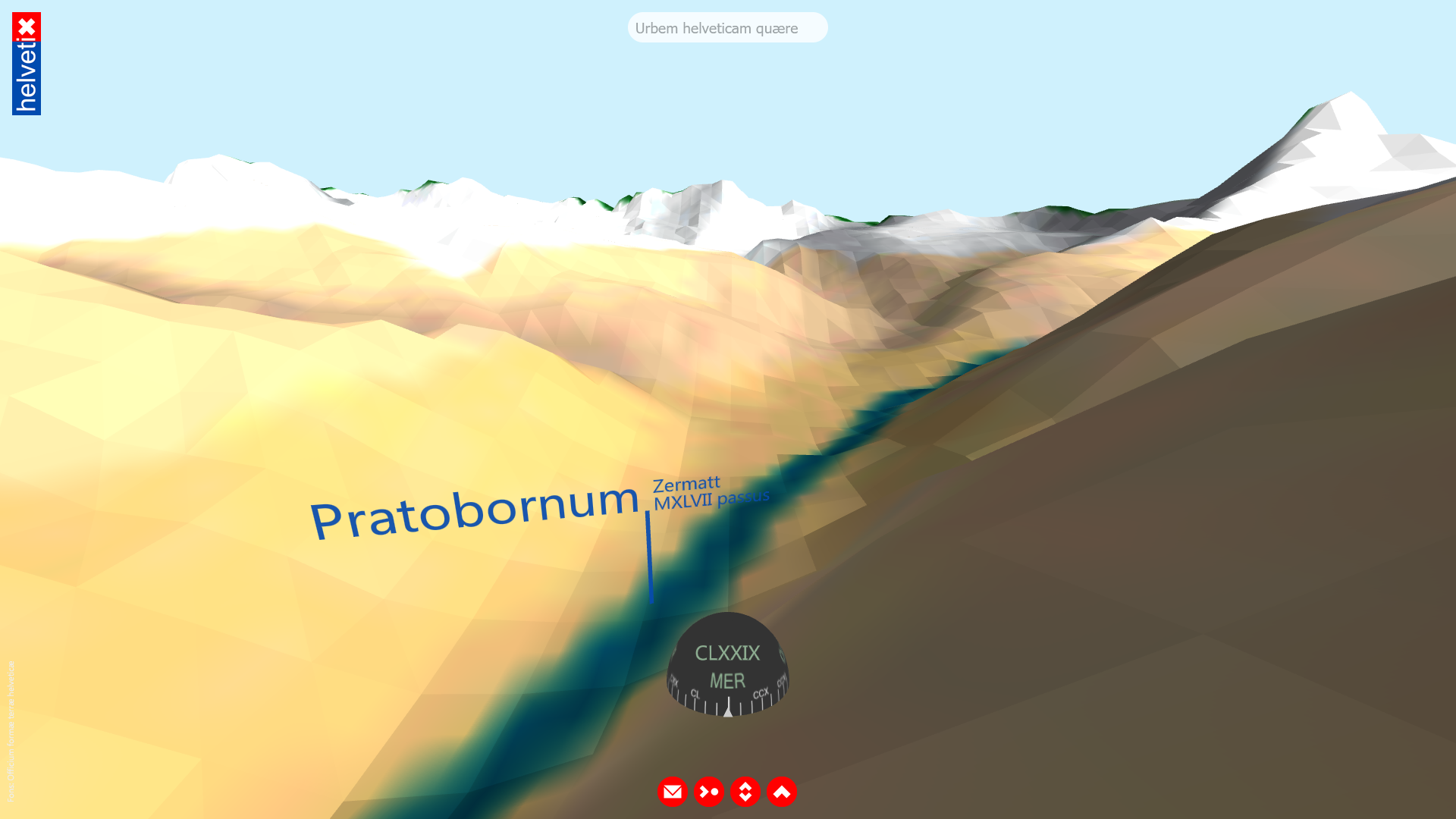
Pratobornum (Zermatt), 1047 double steps away: Screenshot from the helvetiX prototype.
- IndiviDUALbooks
Secure access to any publication with copyright exception protects all stakeholders rights: Spotify of books
Description du défi
PROBLEMs.
- How to choose & connect to the unique user – the closest relevant to his/her unique issue/need
- the 'best practices' (e.g. the COVID-19 contact tracing app: from (millions of apps) in app stores);
- approved by reliable experts, how to easily access the ethical solutions in times of crisis?
- The prevalent economic systems of developed countries are built top-down for corporate & political power growth, 70% of digitalisation solutions fail (Behnam Tabrizi , 2019); not for the empowerment of an individual.
This provider-oriented, dead-end dichotomy of development (for centralising power) proves to be destructive for democracy & human dignity (Sh. Zuboff, #TheAGeOfSurveillanceCapitalism), clearly seen during current crisis: the failure of wellbeing promises to people is breaching the social contracts.
Services users, robbed of human right to healthy living & stripped of political power, suffer and lose TRUST in this system because they can’t influence the capitalist (like via GAFAM / USA)/communist (like from China) powerplay and diminish the digital inequality gap growth by peaceful action.
SOLUTION. Personal empowerment, thanks to mass adoption of the user & context relevant best practices,
- via human-centric access to digital apps, with TRUST being built:
- by seamless mass dissemination of indiviDUAL BENEFICIAL digital behaviour habit: visual access to the secure MyData-interface
- to API's of Mydata-certified Operators / public service operators / public health operators (MyData-IHAN, SITRA Project, Finland)
- enabled by taking responsibility of the approval of the 'best practices' by global expert community of MyData.org
- in cases of lacking public service of approval / choice of the 'best practice'.
E.g.: choice in EU among several available COVID-19 infected Contact Tracing apps.
Tool: MyData IndiviDUALbooks, for under-served people, rescue & learning; 'MyData best practices' dissemination service, B2CoOp2C.
When knowledge sources are not accessible (e.g. closed by pandemic; paywalled; marginalized; privacy harming),…
- Making digitised scores audible – Zentralbibliothek Zürich
Description du défi
The Zentralbibliothek Zurich and several other Libraries in Switzerland own large numbers of music scores. Several of these scores are accessible via the digital platforms e-manuscripta and e-rara. But what if you want to hear the music instead of just seeing the score sheets?
We would like to make digitised music scores deposited on e-manuscripta and e-rara audible, using OMR and notational software. Our overall goal would be to develop a workflow resulting in audio files. Such a workflow would at any rate include manual steps. Rather than developing a fully automated pipeline, this little explorative study is an attempt to find out about the potentials of OMR in a cultural heritage context, possibly making written music more accessible.
- "Making of GLAMhack21" Video – Opendata.ch
Film and document the GLAMhack21 and present your video at the project presentation
- Nachtschicht 21 a 3D, Virtual Reality & Art Exhibition – Nachtschicht21
We want to showcase the artworks of swiss contemporary artists in a VR space.
Description du défi
Nachtschicht21 https://www.nachtschicht21.ch/ is curating artworks of young swiss contemporary artists. During this hackathon we'd like to create beside the gallery exhibition, which will start on the 11.5.2021, a VR space, in which the works can be made accessible to everyone around the globe. This we plan to do with A Frame.
Data to work with during the two days hackathon:
https://drive.google.com/drive/folders/1_6AoAPutT2V7uh6ZE9W9S1OJwklS3KWF?usp=sharingSoMe-channel of Nachtschicht 21
https://www.instagram.com/nachtschicht21/ - Stadthausplatz Zurich – Amt für Städtebau der Stadt Zürich
A collection of photographs and views of the historical town hall square in Zurich from the 19th century
Description du défi
This new dataset contains a selection of historical images of the old main town square ("Stadthausplatz"), a central place in former Kratzquartier in Zurich. The square and most of the buildings disappeared in the 19th century when the Bahnhofstrasse (main street) was built.
The city's Archives of Architectural History (Baugeschichtliches Archiv der Stadt Zürich) contain many pictures of the "Kratzquartier" before and after its demolition. The redevelopment of the Kratzquartier and other areas of the city prompted the city council to issue a decree in 1877 that all major demolitions and changes in the city were to be photographed. This decree formed the foundation stone for the "Baugeschichtliches Archiv der Stadt Zürich".
General idea: Merging of a historical photo-lot, historical maps and further archival information (lists of inhabitants for exampel) on a location that has disappeared forever. Can the square be resurrected virtually by some means?
Data access: https://data.stadt-zuerich.ch/dataset/baz_stadthausplatz |
Browse the pictures: http://baz.e-pics.ethz.ch/index.jspx?category=26204 | Historical city map around 1860:| Further documents: https://drive.google.com/drive/folders/1hZqXq4Wx61dq1H1Gd3bjf01d9ZmGti4l?usp=sharing
Contact: Saro Pepe Fischer, Baugeschichtliches Archiv der Stadt Zürich, Neumarkt 4, 8001 Zürich
- St. Galler Globus – Zentralbibliothek Zürich
Conceptualizing Interactive Narratives for a "Scientainment" Audience
Description du défi
Among the many treasures of the Zentralbibliothek Zürich the St. Galler Globus offers a controversial history, interdisciplinary research approaches and narrative richness. The globe is a magnificent manifestation of the world concept of the late 16th century. The modern (for its time) cartographical knowledge, representation of current (i.e. contemporary) and historical events and diverse mirabilia combined with its overwhelming size and opulent paint job certainly led it to be a “conversational piece” wherever it was exhibited.
Even though it is a fully functional earth and celestial globe regarding its size and elaborative decorative artistry, it is assumed that the globe was more of a prestigious showpiece than a scientific instrument.
The globe's full splendor is best appreciated by exploring the original at the Landesmuseum Zürich or its replica in the Stiftsbibliothek St. Gallen. Because of its size and fragility it is not possible to make the globe fully accessible for exploration to the public.That is where you can step in! Fortunately the ETH Institute of Geodesy and Photogrammetry made a high resolution 3D prototype available for both the original and the replica globe (Low Resolution Preview: https://hbzwwws04.uzh.ch/occusense/sg_globus.php).
Combined with the rich expertise around the St. Galler Globus we want to create digital concepts of how we could make the St. Galler Globus’ narratives and historical context accessible to a broader audience interested in “Scientainment”.
We are looking for people who want to create digital prototypes, write and visualize narratives, conceptualize interactive experiences or find other ways to show the rich narratives of the St. Galler Globus.With those concepts we want to show the potential inherent in exhibiting a digital version of the St. Galler Globus.
Passwords to the sources: Magnetberg
- Structured Data on Wikimedia Commons
Work with Structured Data on Wikimedia Commons to explore content in new ways
Description du défi
Work with Structured Data on Commons to explore content in new ways
We will be here for the two days to teach people how to use the query service and explore possibilities of creating new visualisations of content
https://commons.wikimedia.org/wiki/Commons:Structured_data
One of the datasets we will be exploring is 4000 photographs released from UNESCO's archives https://commons.wikimedia.org/wiki/Category:Photographs_produced_by_UNESCO
Presentation https://docs.google.com/presentation/d/1VeRAZC-iIcVnwSWqCOCbmb2yl2FX6nyO5-DAL6Do05Q/edit#slide=id.gcd327c455a_0_5
Contact John Cummings
- Swiss Coffee DATA ART
Let's create data art visuals by using existing data on coffee consumption in Switzerland
Description du défi
In Switzerland, Coffee shops have long been popular among consumers for work-related reasons, such as alternative workplaces to office spaces, as well as a source for on-the-go coffee when travelling to and from work.
How does demand & offer vary from canton to canton? How did the pandemic affect consumption?
Based on data published by Euromonitor International in December 2020,
Let's create visualisation with exciting tools.
- The Pellaton Experience – Stiftung SAPA – Schweizer Archiv der Darstellenden Künste
Turning oral history into an interactive information network
Description du défi
Ursula Pellaton (*1946) is a walking encyclopedia of Swiss dance history. Her enthusiasm for dance began in 1963 with a performance of "Giselle" in Zurich. That was the beginning of her many years of involvement with dance, which has accompanied her ever since as a journalist and historian, among other things.

She shared a lot of her knowledge in 16 hours of video recordings that were the basis for a biography in traditional book form. However, both video and book are limited by their linear narratives that differ from our experience of history as a living network of people, places, events, and works of art. Based on a longer excerpt from the recordings and its transcript, we would like to turn this oral history document into a comprehensive online experience by creating a navigable interface and augmenting the video with supplementary information and material.
Contact: Birk Weiberg, Swiss Archive of the Performing Arts,
- The scene lives!
Opening a dataset of underground multimedia art
Ficht HämmerliAndre KudraDescription du défi
Create an open dataset of demoscene productions, which could be filtered to individual countries, themes, or platforms, and help make the demoscene more accessible to people who may have never heard about it. This dataset could be of interest from an art-history perspective to complement our UNESCO digital heritage application – or just be used to introduce people to the history of the 'scene.
Outputs
- Project report (Readme above)
- Backend: Data Package & API
- Frontend: Demo app
- The spatial evolvement of a Museums’ collection – Museum der Kulturen Basel
How did geopolitics and scientific interests affect provenances in a collection of 75 000 European artefacts?
 Franz Flückiger
Description du défi
The Museum der Kulturen Basel (MKB) is the largest ethnographic museum in Switzerland and one of the most eminent of its kind in Europe. The MKB collections are renowned throughout the world; in total they hold over 340 000 artefacts from all over the world. A large number of them stems from various places in Europe – from northern Scandinavia to the South of Greece, from Portugal to the Carpathians, from remote Alps to bustling cities. This European collection comprises around 75 000 artefacts, such as religious objects, handicraft, cloths, pictures, toys and everyday items. They came into the museum’s collection as acquisitions or gifts during the last 120 years.
While in the very beginning the focus of the collectors was on objects from remote Swiss hamlets, the interest slowly shifted to artefacts from industrialised environments. Changing geopolitical developments enabled collecting in different regions of Europa at different times. Also, personal interests or personal connections of single collectors led to sudden large additions from one specific area.
The goal of this challenge is to show the rise and fall of dominant geographical provenances during the last 120 years of collecting in Europe. This could enable the answer to interesting questions such as: Which specific spatial interests arose and fell during the last 120 years? How did the idea of Europe’s border change over time? When was the peak of collecting in remote Swiss valleys? Which were the effects of the First and the Second World War on the geographical provenance of new acquisition? How did the fall of the Iron Curtain affect the collection practice?
The data provided by MKB has never been published before. It stems from a database used for managing the collection, which grew over generations. There are inconsistencies on different levels, as errors and omissions occurred both when the objects were first cataloged and when the catalogues were transcribed into the database. Terminologies contained therein may today be inaccurate, outdated, or offensive.
The provided material may be raw – but to the same extent its quantity and uniqueness is precious! - WikiCommons metadata analysis tool – ETH-Bibliothek
A metadata analysis tool comparing metadata of GLAM source systems with Wikimedia Commons.
Description du défi
The Image Archive of the ETH Library is the largest Swiss GLAM image provider. Since the ETH-Bibliothek went Open Data in March 2015, the image archive has uploaded 60,000 out of more than 500'000 images to Wikimedia Commons. The tool Pattypan is currently used for uploading.
On the image database E-Pics Image Archive Online, volunteers have been able to comment on all images since January 2016, thereby improving the metadata. And they do it very diligently. More than 20,000 comments are received annually in the image archive and are incorporated into the metadata (see also our blog "Crowdsourcing").
However, the metadata on Wikimedia Commons is not updated and is therefore sometimes outdated, imprecise or even incorrect. The effort for the image archive to (manually) match the metadata would simply be too great. A tool does not yet exist.
Challenge
A general GLAM analysis tool that compares the metadata of the source system of the GLAMs (e. g. E-Pics Image Archive Online) and Wikimedia Commons and lists the differences.
The analysis tool could highlight the differences (analogous to version control in Wikipedia), the user would have to manually choose for each hit whether the metadata is overwritten or not. Affected metadata fields: Title, date, description, …Automatic "overwriting" of metadata (update tool) is against the Wikimedia philosophy and is therefore undesirable. Furthermore, it is also possible that Wikipedians have made corrections themselves, which are not recorded by the image archive.
Data
- Bildarchiv Online, http://ba.e-pics.ethz.ch
- Wikimedia Commons: https://commons.wikimedia.org/wiki/Category:Media_contributed_by_the_ETH-Bibliothek
- Pattypan, Wikimedia Commons Upload Tool: https://commons.wikimedia.org/wiki/Commons:Pattypan
- Blog Crowdsourcing: https://blogs.ethz.ch/crowdsourcing/
Contact
Nicole Graf, Head Image Archive ETH Library
- Wikidata Tutorial Factory
Or how to efficiently produce Wikidata tutorials for heritage institutions
Description du défi
Our Hackathon project consists in producing a website with Wikidata tutorials specifically aimed at heritage institutions. The tutorials shall cover a broad range of topics, providing simple explanations for beginners in several languages. The tutorials will be gathered on a website, where users can either look for specific instructions or go through the whole programme of tutorials. In this perspective, we have created a storyboard going from a general introduction to the usefulness of Wikidata for GLAMs to tutorials explaining how to edit specific information.
The tutorials are based on powerpoint presentations with audio tracks. We have prepared a template to facilitate the tutorial production during the hackathon. We also have scripts for some of the topics. We will be using applications such as deepl to automatically translate the scripts. With the use of “text to speech” converters, we will record the scripts in English, French, German and Italian. This will allow us to produce many tutorials in the short time span of the GLAMhack.
A second aspect of our project consists in producing a short video as an introduction to our website. This video should explain what kind of information is registered about GLAMs in Wikidata and what benefits the institutions can draw from the database.
We are looking for participants who are interested in sharing their Wikidata knowledge, people who have experience with fun and easy tutorials, people who know wordpress to work on the website, polyglots who can edit the automatically generated translations or people without any Wikidata know-how who want to help us develop the user journey of our tutorial programme by trying it out. For the short introduction video, we are looking for multimedia producers.
- Zurich Time Lapse – Zentralbibliothek Zürich
Time-based 3D model of Zurich for time-lapse representations of the city’s evolution
Description du défi
We would like to turn back the wheel of time and be able to trace the development of the city of Zurich back to the Celtic-Roman settlements in an animated way. A diachronic 3D model would enable a wide range of applications. For example, one could walk with Zwingli through the streets to Froschauer's print shop.
While today’s topographical data is freely available (at swisstopo and Stadt Zürich), it is a challenge to go back in time, especially behind the earliest maps dating from the 18th century.
In his book "Zürich im Zeitraffer" Thomas Germann gathered available archeological, printed and archival information and combined them all into his books with drawings of the city's development at different epochs. The illustrations show how much the topography has changed over time. Rivers have been diverted, swamps dried up and huge city walls were erected and torn down.Idea:
Based on the information from Thomas Germann's illustrations in combination with current geodata models of the city, we want to develop a time-lapse representation in the form of a 3D visualization.
Possible scenariosRepresenting the entire urban development of Zurich is too time-consuming. Therefore, we aim to develop a prototype or "proof of concept" within the GLAMhack. In order to simplify the complexity, the following approaches should be considered:
- step-by-step "remodeling" of the objects, starting from today's cityscape and based on current geodata
- Division into two main topics:
- Modeling of topographic elements (Swisstopo + information from "Zürich im Zeitraffer")
- Modeling of structural aspects of buildings (open data + information from "Zürich im Zeitraffer").
- Concentration on specific subareas:
- Area-based modeling, e.g. today's Bahnhofstrasse, Lindenhof, etc.
- Building-related modeling, e.g. Grossmünster, ETH etc.
With such a prototype we would like to show possible ways for further projects, which could possibly be pursued as Citizen Science projects.
Datasets
https://www.swisstopo.admin.ch/de/geodata/landscape/tlm3d.html#dokumente
https://data.stadt-zuerich.ch/dataset?tags=polygondaten&tags=3d-stadtmodell
…











Programme
Mardi 13 avril
- 17:00–17:30
- 17:30–19:00


Jeudi 15 avril
- 15:00–15:30
- 15:30–16:00
- 16:00–16:30
Pre-Event: Reconnaissance d’objets et extraction d’entités sur Wikimedia CommonsYannick BurkhalterStudent, Berner Fachhochschule
- 16:30–17:00
- 17:00–17:15
Pause
- 17:15–18:00
- 18:00–18:15
Pre-Event: Poetry slam
- 19:00–20:30
Atelier hackathon LODEPA (données des arts du spectacle)
Pour les membres du réseau LODEPA (Linked Open Data Ecosystem for the Performing Arts) souhaitant participer activement au hackathon – la veille, afin que les collègues de la côte est américaine puissent y assister.



Vendredi 16 avril
- 08:30–09:00
Check-in
- 09:00–09:20
Ouverture, début officiel du hackathon
- 09:20–09:40
Brise-glace
- 09:45–11:00
- 11:00–12:00
Formation des groupes
- 12:00
Première réunion de groupe, pause de midi
- 13:00–13:20
Séance de fitness
- 13:20
Travail en groupes
- 17:30–18:30
Aperçu des projets du GLAMhack
- 18:40–19:00
Séance de fitness
- 19:00
Travail en groupes (« équipe de nuit »)
Samedi 17 avril
- 08:30–08:50
Séance de fitness
- 09:15–09:30
Check-in
- 09:30–09:45
Bienvenue au deuxième jour
- 09:45
Travail en groupes
- 12:00–12:20
Séance de fitness
- 12:20–13:00
Pause de midi
- 13:00
Travail en groupes
- 16:30–17:30
- 17:30–17:45
Clôture
Lire l’annonce d’origine
7e Swiss Open Cultural Data Hackathon – édition en ligne
L’édition 2021 du Swiss Open Cultural Data Hackathon est accueillie par la Bibliothèque de l’ETH à Zurich et se déroulera en ligne les 16 & 17 avril.
Des événements associés avec des présentations et des ateliers sont prévus les 13 et 15 avril.
Une session d’échauffement aura lieu le 3 mars pour les nouveaux venus, ainsi qu’une session d’intégration le 9 avril pour toutes celles et ceux qui souhaitent se familiariser avec les outils et les jeux de données une semaine avant le hackathon.
Équipe d’organisation
 Darienne HunzikerOpendata.ch: Projektkoordination 2021
 Andrea AllemannOpendata.ch: Projektkoordination 2020
 Beat EstermannOpendata.ch: Co-Leitung Programmkomitee
 Michael GasserETH-Bibliothek: Co-Leitung Programmkomitee
- Gabriella PadovanETH-Bibliothek: Koordination Gastinstitution
 Nicole GrafETH-Bibliothek
- Simone LeitnerETH-Bibliothek: Leitung Kommunikation
 Oleg LavrovskyOpendata.ch
 Dominik SieviOpendata.ch: Co-Leitung Datensätze
 Lionel WalterOpendata.ch / Universitätsbibliothek Basel: Co-Leitung Datensätze
 Jonas LendenmannOpendata.ch: Datensätze
 Thomas WeibelFachhochschule Graubünden
 Enrico Nataleinfoclio.ch: Dokumentation
 Jan Baumanninfoclio.ch: Dokumentation


